What Is Kitting in Fulfillment?
How kitting works, how it differs from bundling, when it pays off and a setup checklist for building kits.

Key takeaways
- Kitting combines separate items into one SKU built ahead of orders.
- Bundling picks items together at order time.
- Kits pay off for repeat sets and many small parts.
- Write a bill of materials and assembly steps first.
On this page
Kitting means grouping separate items into one ready-to-ship set under a single SKU. Instead of picking five parts for every order, the warehouse assembles the kit once, stores it and picks it with one scan. This guide explains what kitting is worth, the types of kitting work, how to set it up, what it costs and how to measure it.
What kitting is and why it matters
- Define the kitParts, quantities and packaging.
- Receive partsStored as separate SKUs.
- AssembleKits built in a batch.
- Store the kitOwn SKU and location.
- Pick and shipOne scan, one pick per order.
Value comes from fewer touches per order, fewer picking mistakes and a consistent product presentation.
Types of kitting
| Type | How it works | Typical use |
|---|---|---|
| Pre-built (kit to stock) | Kits assembled ahead and stored | Steady sets, gift sets, starter kits |
| Kit at pack (kit to order) | Parts combined when the order arrives | Custom or occasional combinations |
| Promotional kits | Seasonal or campaign sets | Holiday and launch offers |
| Subscription kits | Same contents repeated each cycle | Subscription boxes |
Subscription boxes use the same steps: see subscription box fulfillment.
Kitting vs. bundling
| Kitting | Bundling | |
|---|---|---|
| Finished item | New SKU, built ahead | No new SKU; items sold together |
| Assembly time | Before orders arrive | At pick and pack |
| Best for | Repeat sets with steady demand | Occasional promotions |
The difference, with light assembly, is in kitting vs. bundling vs. assembly.
When kitting pays off
- The same combination sells repeatedly.
- Orders contain many small parts that are easy to mix up.
- You run promotions, gift sets or starter kits.
- Picking time per order is high because several items must be matched.
Implementing kitting
- Write a bill of materials: what is in the kit and in what quantity.
- Write step-by-step assembly instructions with photos.
- Agree what happens if one part is out of stock.
- Decide how kits are counted: kit SKU plus component SKUs, and the rule for builds and breakdowns.
- Test a small batch and check weight and package size for shipping.
- Release the kit for sale only after the test batch passes.
Cost and benefits
| Item | What to include |
|---|---|
| Assembly labor | Per kit, by step count |
| Materials | Boxes, inserts, labels, dunnage |
| Storage | Parts plus finished kits |
| Savings | Fewer picks and touches per order, fewer errors |
Compare assembly cost with the picking time saved per order, using your real order counts.
Common challenges and fixes
| Challenge | Fix |
|---|---|
| One part runs out and blocks the kit | Reorder point on parts, agreed substitution rule |
| Kits built that do not sell | Build small batches until demand is clear |
| Inconsistent counts | One counting rule and regular cycle counts |
| Returned kits | Decide: restock whole or break apart |
Kitting with a 3PL and across channels
A 3PL stores parts, builds kits on demand or in advance and ships from the same stock, including to marketplaces. Kits for Amazon follow Amazon’s labeling and packaging rules; see FBA prep vs. 3PL. For setup with a provider see Kitting and bundling services.
Measuring kitting performance
- Kit assembly accuracy (kits built to specification).
- Time to assemble per kit.
- Picks saved per order compared with picking parts separately.
- Share of kits unsold after a defined period.
Kitting examples across ecommerce
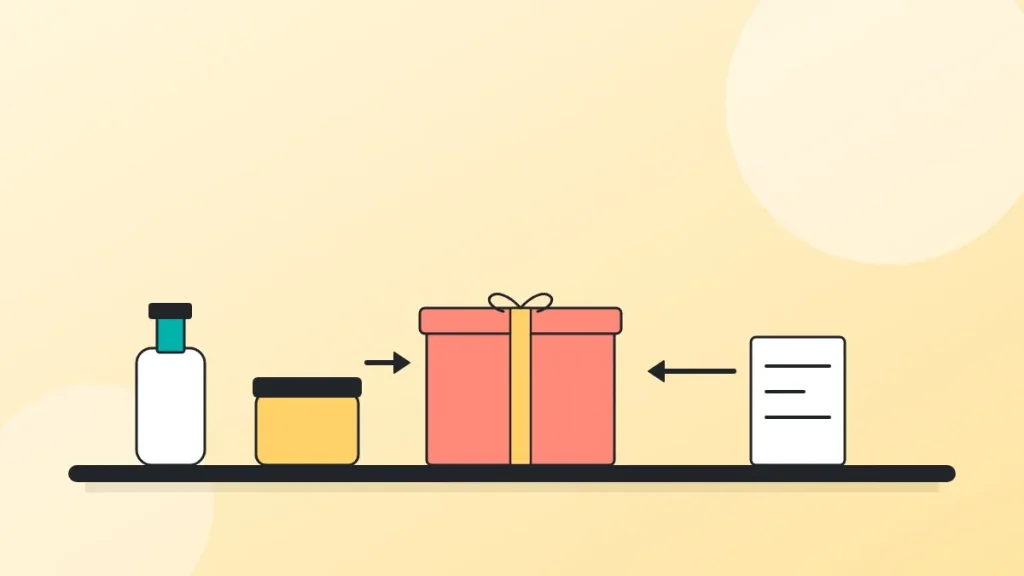
- Beauty sets: several products and a booklet packed in a gift box.
- Subscription boxes: a monthly selection of items packed in the same layout.
- Influencer and PR kits: product samples with printed material, shipped in small batches.
- Starter kits: a main product with accessories sold as one SKU.
- Promotional bundles: seasonal offers that combine existing products.
How to calculate whether kitting pays off
Compare the cost of building a kit ahead of time with the cost of picking and packing its parts on every order. Kitting adds a one-time build step but shortens each order. It pays off when the same kit sells repeatedly, and it does not when every order is different. Gather these figures: the number of components, minutes to pick and pack them one by one, minutes to build one kit in a batch, and expected orders per month. If the batch time per kit is clearly lower than the per-order time, kitting is worth it.
Checklist for a kitting project
- Write the bill of materials for each kit.
- Assign a new SKU and barcode to the finished kit.
- Agree a quality standard and a sample photo.
- Plan component stock so a batch does not stop for a missing part.
- Decide how many finished kits to hold in stock.
- Review results monthly: speed, errors and cost per kit.
Frequently asked questions
What is kitting in fulfillment?
Combining separate items into one finished set with its own SKU, assembled ahead and shipped as one unit.
What is the difference between kitting and bundling?
Bundling sells existing products together and picks them at order time. Kitting builds a new SKU in advance.
Is kitting worth it for small volumes?
Often yes if the same set sells repeatedly. For rare combinations, bundling at pack is simpler.
How are kits counted in inventory?
Both the parts and the finished kits are tracked as SKUs, with an agreed rule for builds and breakdowns.
Can a 3PL assemble kits on demand?
Yes, when the assembly is simple and documented.
How do I cost a kit?
Add parts, materials, assembly labor and storage, then compare with the labor saved at pick and pack.
Anton Kashirin
Anton founded EcomAutomation, the company behind EcomAutoPrep. He works with Amazon FBA sellers and DTC brands on receiving, prep, kitting and shipping, and reviews the guides on this blog against how orders move through the warehouse.