Ecommerce Distribution Center: What It Is
What a distribution center does, how it differs from a fulfillment center and warehouse, and when an online brand needs one.

Key takeaways
- A distribution center moves bulk goods onward to stores, sites or customers.
- A fulfillment center fills single customer orders.
- Brands selling to retailers and consumers need both flows.
- Ask providers about pallets, cartons and parcels from one stock.
On this page
An ecommerce distribution center is a facility that receives goods in bulk, stores them and sends them on: to retail stores, wholesalers, other warehouses or directly to customers. Many online brands use the term loosely for the place where their stock sits and orders leave. This guide explains what a distribution center does, how it differs from a fulfillment center and warehouse, how to plan one, which metrics matter and whether to run your own or use a 3PL.
How an ecommerce distribution center works
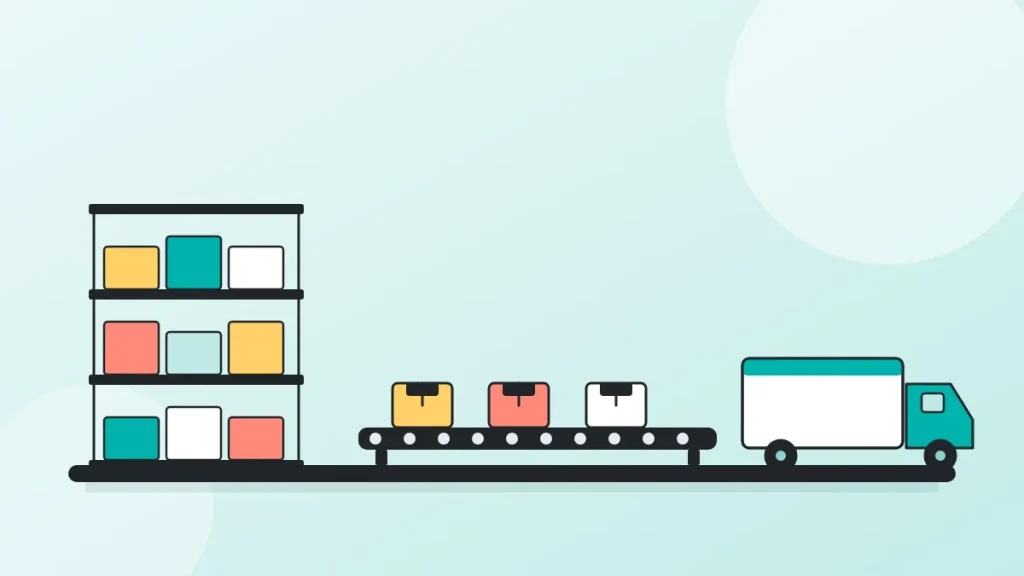
- ReceiveLarge inbound loads from factories, ports or suppliers.
- StorePallets and cartons are put away and counted.
- ReplenishStock is split into smaller lots for other sites or channels.
- Ship outPallets, cartons or parcels go to stores, partners or customers.
The emphasis is flow and volume. Goods move through quickly instead of sitting for months.
Distribution center vs. fulfillment center vs. warehouse
| Distribution center | Fulfillment center | Warehouse | |
|---|---|---|---|
| Main job | Move bulk goods to the next stage | Fill individual customer orders | Store goods |
| Typical output | Pallets and cartons | Single parcels | Few releases |
| Typical customer | Retailers, wholesalers, other sites | End consumers | Owner of the stock |
| Returns | Limited | Core service | Rare |
See fulfillment center vs. warehouse and what a fulfillment center is.
Layout and infrastructure
- Receiving docks sized for the delivery pattern.
- Dense storage for pallets and carton racking, with a separate pick area for single units.
- Packing and shipping zones near outbound docks.
- Clear flow: inbound, storage, outbound with little crossing traffic.
Technology
| System | Role |
|---|---|
| Warehouse management system | Locations, stock, tasks, scanning |
| Order management and integrations | Orders from stores, marketplaces and retail partners |
| Shipping software | Carrier selection, labels, appointments |
| Reporting | Accuracy, speed, inventory |
See warehouse management for the details.
Managing several sales channels
One inventory pool should feed the store, marketplaces and retailers. Each channel brings its own packing and labeling rules, which the distribution center must follow. Details in omnichannel fulfillment and B2B fulfillment.
Performance metrics
| Metric | Why it matters |
|---|---|
| Dock-to-stock time | How fast received goods are sellable |
| Inventory accuracy | Prevents stockouts and oversells |
| On-time shipment rate | Meets delivery windows |
| Order accuracy | Fewer chargebacks and reships |
| Cost per unit shipped | Efficiency over time |
Own distribution center or 3PL?
| Own center | 3PL | |
|---|---|---|
| Capital | Lease, racking, systems, staff | Per-unit and per-order fees |
| Flexibility | Fixed capacity | Scales with volume |
| Control | Full | Through contract and reports |
| Best for | Large, stable, specialized operations | Growing brands, mixed channels |
Questions to ask a provider are in how to choose a fulfillment provider.
How Ecom Auto Prep supports distribution and fulfillment
We store and ship pallets, cartons and parcels from one inventory in Florida. See E-commerce Warehousing Solutions.
A day in an ecommerce distribution center
Inbound trucks arrive at the dock in the morning. Receiving staff check pallets and cartons against the shipping notice, scan every unit and move the stock to storage. During the day, orders from several channels are released to pickers in groups. In the afternoon, parcels go to the carrier pickup and larger orders are prepared as cartons or pallets. Returns are inspected and either restocked or set aside. The work is steady and repeats every day, so the quality of the process matters more than any single piece of equipment.
What to look for in a distribution partner
- Handling for parcels, cartons and pallets in the same building.
- Inventory visible in a dashboard and matching your store.
- Clear receiving times and a written process for discrepancies.
- Integrations with your store and sales channels.
- A location that suits your inbound and outbound lanes.
Common reasons to move to a distribution partner
- Your own space is full, and growth means leasing more.
- Orders come from several channels with different rules.
- You import goods and need inbound handling near a port.
- Peaks overwhelm a small team.
The decision to outsource is rarely about one factor. Compare the full cost of your current setup, including staff time, with a quote for the same volume. Our guide to fulfillment costs shows how to build that comparison.
Frequently asked questions
What is a distribution center in ecommerce?
A facility that receives goods in bulk and ships them on to stores, partners, other warehouses or customers.
Is a distribution center the same as a fulfillment center?
No. A distribution center moves bulk goods. A fulfillment center picks and packs individual customer orders.
Do small online stores need a distribution center?
Usually not. A fulfillment center or 3PL covers storage and parcel shipping.
Can one provider do both?
Yes. Many 3PLs handle pallets and parcels from one inventory. Confirm it before signing.
How is storage priced?
Typically per pallet or per space, plus handling fees for each movement.
When should I move to a bigger setup?
When pallet orders, several channels or volume make parcel-focused setups slow or costly.
Anton Kashirin
Anton founded EcomAutomation, the company behind EcomAutoPrep. He works with Amazon FBA sellers and DTC brands on receiving, prep, kitting and shipping, and reviews the guides on this blog against how orders move through the warehouse.