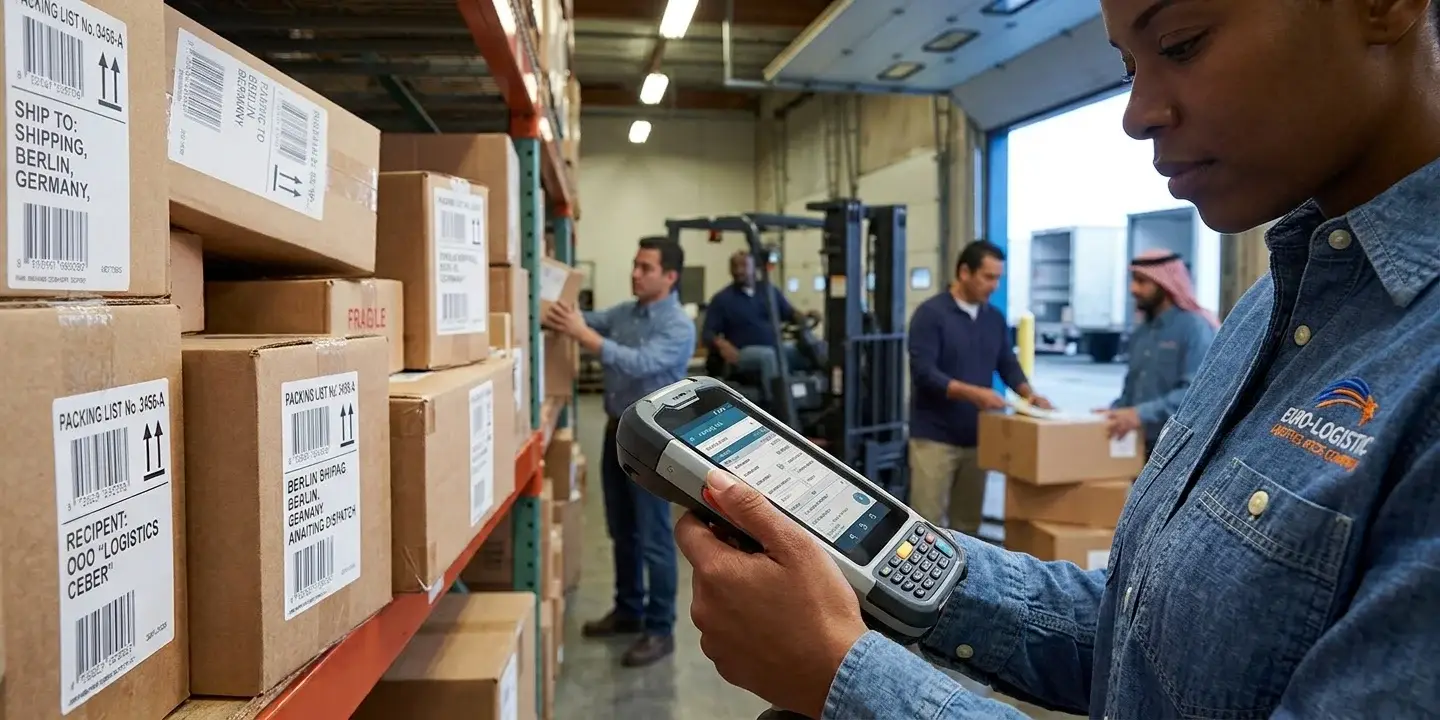

E-commerce brands face mounting pressure to deliver exceptional customer experiences while controlling operational costs. One strategy that accomplishes both objectives is fulfillment kitting, a process that combines multiple individual items into a single package before orders arrive. This approach transforms how businesses manage inventory, process orders, and satisfy customers. Whether you’re launching subscription boxes, creating gift sets, or bundling complementary products, understanding the intricacies of kitting can dramatically improve your bottom line and operational efficiency.
Understanding Fulfillment Kitting and Its Strategic Value
A kit is a new SKU built from several existing SKUs, assembled before an order arrives instead of at the moment it ships. That distinction answers what is kitting in a fulfillment center in practical terms: it is pre-assembly, not a shipping instruction. A three-piece skincare set, a bundled phone charger and cable, or a build-to-order subscription box are all the same mechanism: multiple components collapsed into one pickable, trackable unit inside the warehouse management system.
The strategic value shows up before a single order ships. Every kit you build removes a picking decision from your warehouse floor and moves it into a controlled, repeatable assembly step. That trade matters most when a brand’s catalog is growing faster than its order volume, since more SKUs on the floor almost always means more replenishment work, more slotting decisions, and more room for pick errors, even if daily order counts stay flat.
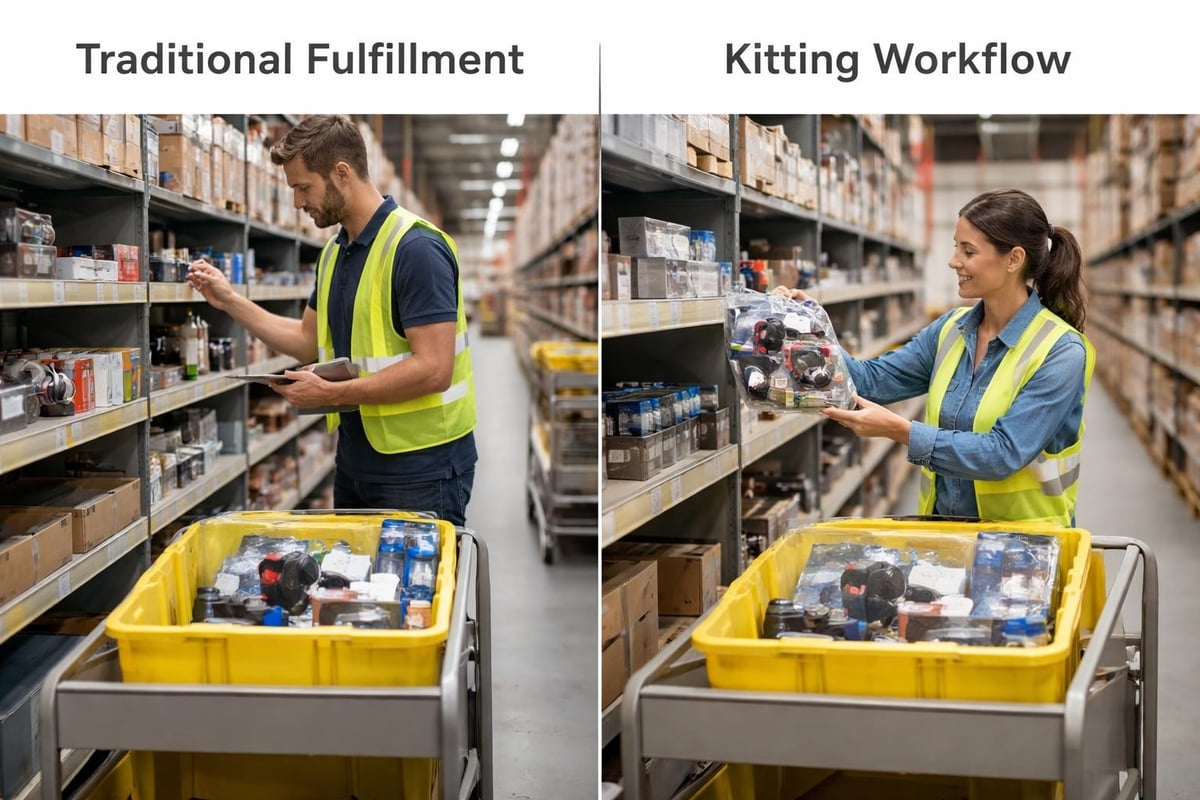
Key Differences Between Kitting and Traditional Fulfillment
The terms kitting, bundling, and assembly get used interchangeably in most 3PL marketing, but they describe different levels of operational commitment.
| Term | What happens | Typical use case |
|---|---|---|
| Traditional pick-and-pack | Each SKU is picked and packed individually at order time | Single-item orders, low-complexity catalogs |
| Bundling | Multiple SKUs are grouped into one shipment, often at order time or via a simple multi-pack listing | Short-run promotions, “buy 3 get free shipping” offers |
| Kitting | Multiple SKUs are physically combined into a new SKU ahead of demand, then picked as one unit | Subscription boxes, built-to-order kits, recurring multi-component products |
| Assembly | Kitting plus a manufacturing-like step (attaching, folding, configuring) before the kit is sellable | Products that are not simply co-packaged but require light construction |
The practical dividing line is timing. Bundling can happen reactively. Kitting and fulfillment work only when the kit exists in inventory before the order does, which means it depends on accurate demand planning, not just warehouse labor.
How Kitting Fits Into Order Fulfillment
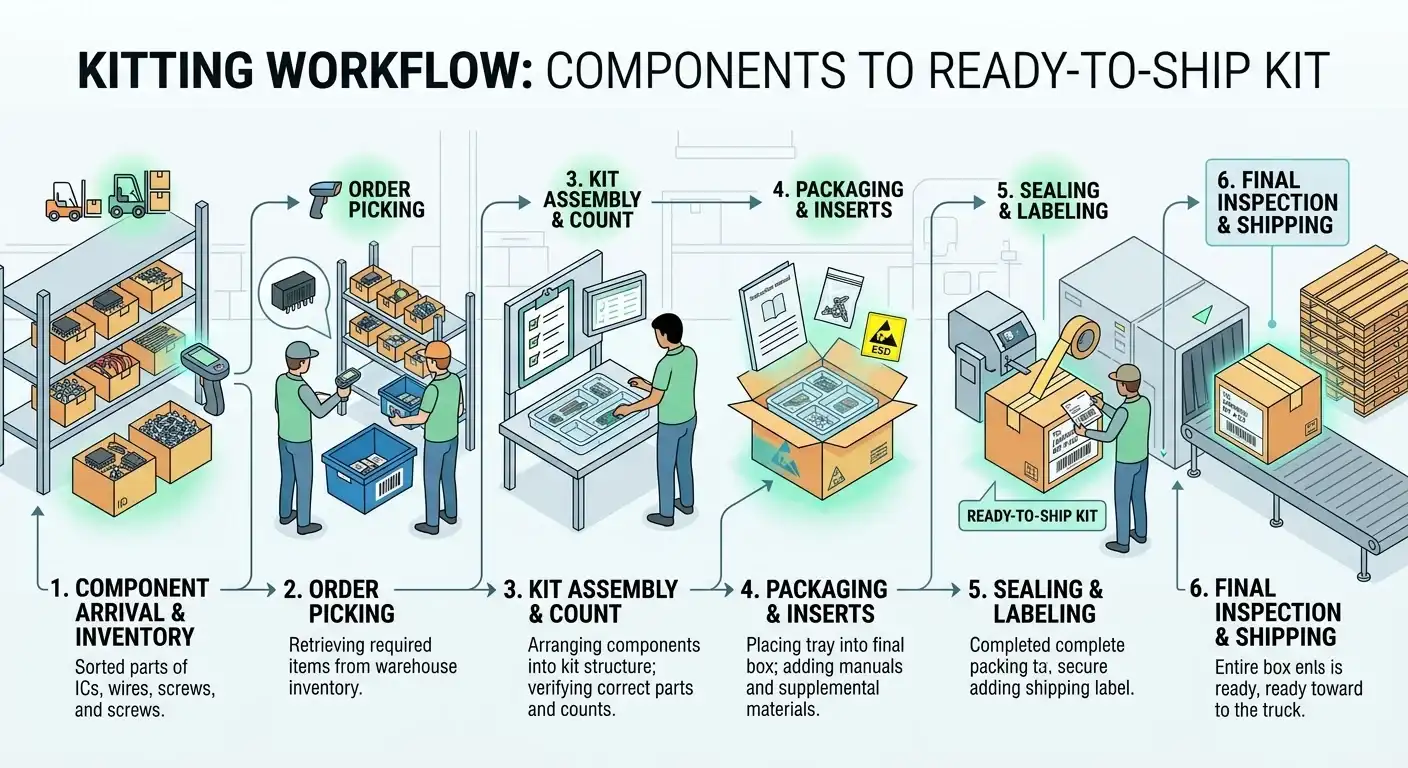
Kitting sits upstream of the standard receive, store, pick, pack, ship sequence. Once components are received and counted, a portion of that inventory is diverted into an assembly step and converted into a new kit SKU with its own barcode and its own WMS location. From that point forward, the kit behaves like any other single-SKU product: it gets picked once, packed once, and shipped once, instead of the warehouse pulling three or four separate items and hand-assembling the order during peak picking hours. This is also where fulfillment and kitting decisions start to diverge for different SKUs on the same catalog: fast-moving, predictable combinations are strong kitting candidates, while low-volume or highly variable combinations are usually better left as pick-time bundles.
Types of Fulfillment Kitting Operations
Different business models require distinct kitting approaches. Understanding which type aligns with your strategy ensures optimal implementation and resource allocation.
Subscription Box Kitting
Subscription kitting is defined by recurring, predictable cadence rather than volume. Because the same components arrive and get assembled on a monthly or quarterly cycle, this is the category where component forecasting errors are most costly: running short on one component two days before a scheduled ship date delays the entire batch, not just one order.
Promotional Bundle Kitting
Promotional kits (holiday sets, launch bundles, influencer packages, gift sets) are built for a defined window and often discontinued afterward. The operational risk here is leftover component inventory once the promotion ends. A kitting plan for a promotional run should include an explicit decision on what happens to unused components before the kit is built, not after.
Custom Configuration Kitting
Custom or on-demand kitting builds a kit only after a specific order or account request triggers it, rather than pre-building inventory. This suits low-volume, high-variability product lines where holding finished kit inventory would tie up capital in configurations that may never sell. The trade-off is slower fulfillment on those specific orders, since the assembly step happens after the order is placed rather than before.
Implementing Effective Kitting Processes
Successful fulfillment kitting requires careful planning and execution across multiple operational dimensions. Simply deciding to kit products isn’t enough; you need robust systems and procedures.
Warehouse Organization and Layout Optimization
Before any kit is assembled, the components and the finished kit SKU need dedicated locations. A kitting operation that shares pick faces between raw components and finished kits creates constant miscounts, since a picker can no longer tell at a glance whether a bin holds standalone inventory or reserved kitting stock. Structured location naming (cart, row, bin) and a clearly separated kitting or assembly area solve this before it becomes a reconciliation problem.
Technology Integration and Inventory Management
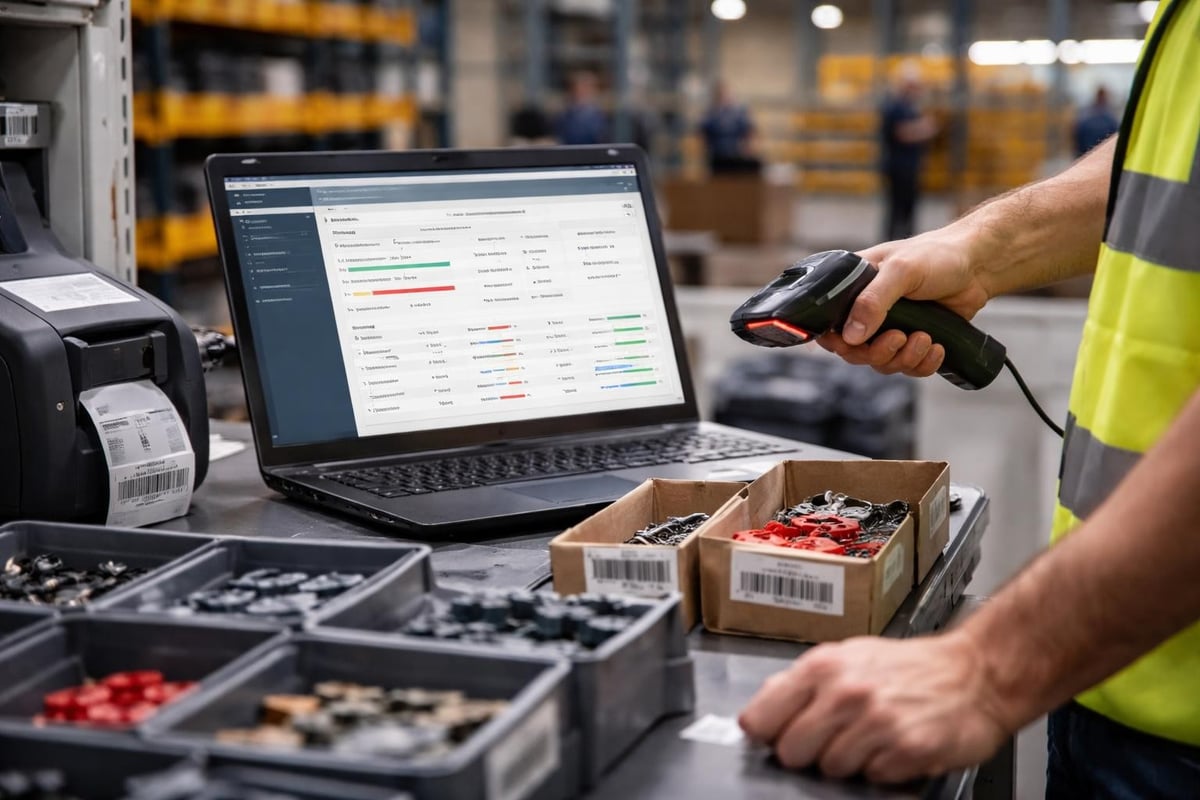
The kit SKU needs its own record in the WMS, with a bill of materials that ties it back to its component SKUs. Every time a kit is assembled, the system needs to decrement each component and increment the kit quantity in the same transaction; if that sync is manual or delayed, component counts and kit counts drift apart within days, and the drift compounds every cycle. This is one of the more common sources of inventory discrepancies in kitting operations, and it is rarely caused by shrinkage. It is usually caused by a transaction that updated one side of the bill of materials and not the other.
Quality Control Protocols
Every completed kit should be inspected for the same failure points before it is stored: missing components, incorrect quantities, damaged items, and correct labeling on the finished unit. Kits that skip this step tend to surface their errors at the worst possible time, when the customer opens the box, rather than in the warehouse where the fix is cheap.
Financial Benefits and Cost Analysis
The economics of fulfillment kitting extend far beyond simple labor savings. Comprehensive analysis reveals multiple revenue and cost advantages.
Direct Cost Reductions
Kitting converts a multi-item pick into a single-item pick. That single change compounds across every order containing that kit, since labor time per order drops and the chance of a mis-pick drops with it, because there is only one location to pull from instead of three or four.
Revenue Enhancement Opportunities
Kits that combine frequently co-purchased items tend to raise average order value, since the customer is buying a curated set rather than assembling one manually. Kitting also lets a brand move slower-moving inventory by pairing it with a strong seller inside a bundle, which recovers margin that would otherwise sit on a shelf as aging stock.Operational Challenges and Solutions
Despite significant benefits, fulfillment kitting introduces unique challenges that require proactive management and creative problem-solving.
Consistent Packaging and Customer Experience
A kit built to a fixed dimension can be packed in a purpose-fit box instead of an oversized generic one. That single decision reduces dimensional weight charges on every unit shipped. The same packaging-optimization math that applies across a brand’s entire parcel volume applies here at the SKU level: shaving unnecessary cubic volume off a package that ships thousands of times a month adds up to real, ongoing savings, not a one-time win.
Operational Challenges and Solutions
Demand Forecasting Complexity
A kit is only as available as its slowest-moving component. If one item in a five-part kit runs out, the entire kit stops shipping even though the other four components are fully stocked. The fix is forecasting at the component level, not just the kit level, and setting reorder points based on the component with the tightest supply chain, not the average.
Storage Space Requirements
Kitting requires holding both component inventory and finished kit inventory simultaneously during a transition period, which temporarily increases the footprint needed for that SKU family. This is a planning input, not a reason to avoid kitting: it needs to be sized into the warehouse layout up front rather than discovered mid-peak season.
Inventory Accuracy Maintenance
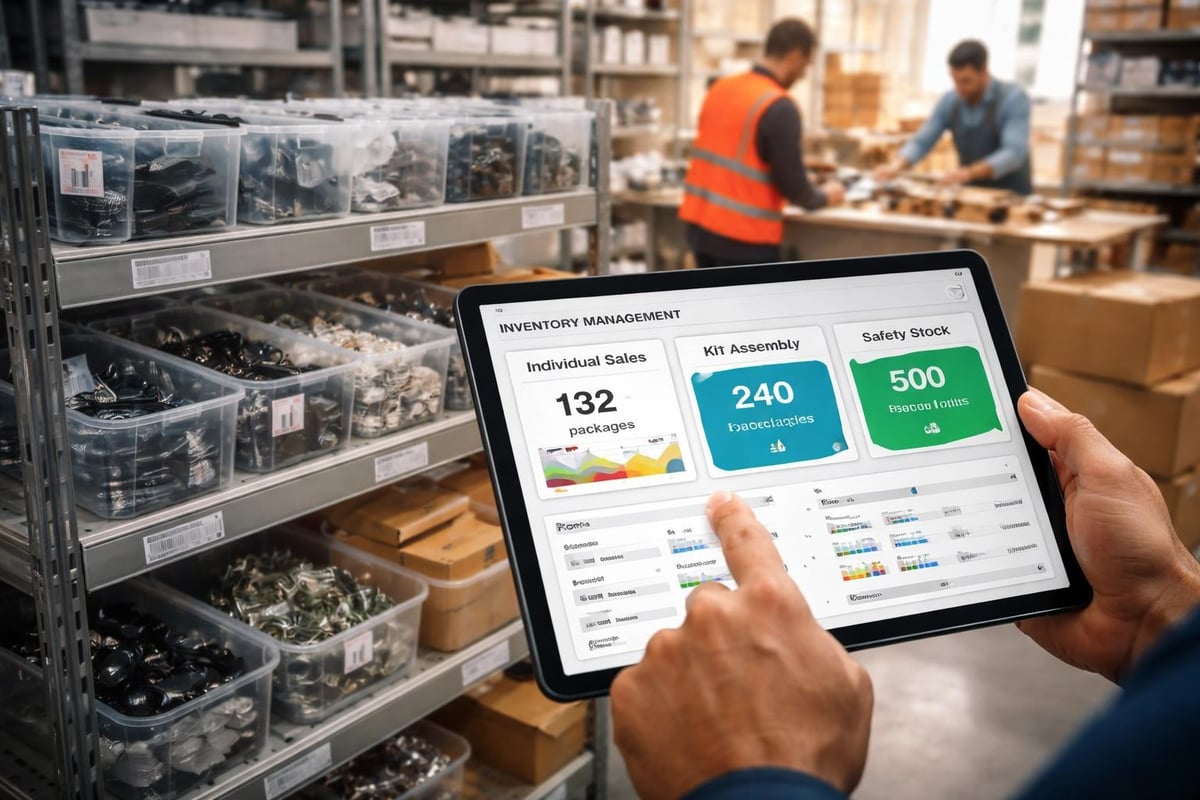
Because a kit represents inventory in two forms at once (components and finished units), cycle counts need to check both. Counting only the finished kit SKU hides component-level errors until the next assembly run fails for lack of stock that the system still shows as available.
Best Practices for Third-Party Logistics Partnerships
Many e-commerce brands partner with specialized fulfillment providers for their kitting needs. Understanding what makes 3PL kitting operations successful helps you select the right partner and structure effective agreements.
Evaluating 3PL Kitting Capabilities
The right question is not whether a 3PL “offers kitting,” since most will say yes. The right questions are more specific: does the provider maintain dedicated kitting space separate from bulk storage, does its WMS support bill-of-materials tracking with automatic component decrements, and can it show real quality-control checkpoints rather than a general claim of accuracy. EAP structures kitting as a value-added service built on Packiyo, with dedicated assembly areas and inspection steps at every stage. You can see how this is set up on our kitting services page.
Communication and Documentation Requirements
A kitting project fails quietly when the 3PL and the brand are working from different assumptions about what a kit contains. Every kit needs a written specification: exact component SKUs and quantities, packaging materials, labeling requirements, and what to do when a component runs short. Verbal instructions get lost the first time a warehouse changes shifts.
Integration with Amazon FBA and Multi-Channel Strategies
E-commerce brands often sell through multiple channels simultaneously, complicating kitting strategies. Amazon FBA presents unique considerations due to its specific prep and labeling requirements.
FBA-Compliant Kitting Approaches
Amazon treats a multi-pack or kit as its own listing with its own FNSKU, which means the kit needs to be labeled, poly-bagged where required, and prepped to Amazon’s current compliance rules before it is forwarded to a fulfillment center. A kit that is correctly assembled but incorrectly labeled for FBA will be rejected or mis-received at the Amazon warehouse, which costs more time than building it correctly the first time.
Direct-to-Consumer Coordination
Brands selling the same kit through their own site and through Amazon need one inventory source of truth for the components, not two separate kitting workflows. Centralizing kitting for both channels in one warehouse avoids the situation where a component is in stock for D2C orders but shown as unavailable for FBA replenishment, or the reverse.
Seasonal Considerations and Scaling Strategies
Fulfillment kitting demands fluctuate dramatically throughout the year. Building flexible systems that scale efficiently prevents bottlenecks during peak seasons while avoiding excess capacity costs during slower months.
Planning for Peak Season Success
Peak-season kit demand needs to be forecast and pre-built well before the season starts, since assembly labor is a fixed constraint during the exact weeks when picking and packing labor is already stretched thin. Waiting until peak week to start building holiday kits means competing for the same warehouse labor as your regular order volume.
Year-Round Optimization
Scaling kitting without excess inventory means building smaller, more frequent kitting runs tied to actual sales velocity rather than one large seasonal build. This keeps capital from sitting in finished kits that do not sell as fast as forecast, and it gives the warehouse room to adjust kit mix as demand shifts mid-season.
Measuring Kitting Performance and ROI
Implementing fulfillment kitting without measuring its impact leaves money on the table. Establishing clear metrics enables continuous improvement and justifies ongoing investment.
Key Performance Indicators
The metrics that matter for a kitting program are kit completion rate (percentage of kits built without a missing component), kit-level pick time versus equivalent multi-item pick time, kit-related return rate, and component inventory accuracy. Tracking only overall fulfillment accuracy hides whether kitting specifically is helping or creating new error points.
Continuous Improvement Methodologies
Kitting programs should be reviewed on a fixed cadence, not just when something breaks. Comparing kit sell-through against component reorder timing on a monthly basis catches slow-moving kit configurations before they tie up storage space for months.
Advanced Kitting Strategies for Competitive Advantage
Once basic kitting operations run smoothly, sophisticated brands explore advanced strategies that create defensible competitive advantages and deeper customer relationships.
Personalization at Scale
Some brands now offer configurable kits where the customer selects components within a set structure. This requires a WMS and kitting process flexible enough to assemble variable combinations without a unique SKU for every possible configuration, which is a meaningfully harder operational problem than a fixed kit and should be scoped with a 3PL before it is promised to customers.
Sustainable Kitting Practices
Right-sized kit packaging reduces material waste in the same way it reduces dimensional weight charges. Brands increasingly ask kitting partners to use recyclable fill and minimal void space, which is easier to standardize at the kitting stage than to enforce at individual pick-and-pack time.
Frequently Asked Questions
How Much Do Kitting and Fulfillment Services Cost?
Kitting is typically priced as a labor charge per kit assembled, separate from standard pick and pack fees, and the rate depends on the number of components, whether assembly (not just co-packaging) is required, and packaging complexity. [Insert Pricing Here] Because kitting cost varies significantly by product, a 3PL should quote it after reviewing your specific component list rather than off a generic rate card.
Can Kits Be Updated After Assembly?
Yes, but updating a kit after it is built usually means disassembling it, since the finished unit no longer exists as separate components in the WMS. If your kit contents change frequently, it is worth discussing smaller batch sizes with your 3PL rather than building large runs that may need to be broken down.
How Are Returns Handled for Kitted Products?
A returned kit needs to be inspected component by component, not treated as a single pass or fail unit. If only one component is damaged or missing, the remaining components can often be restocked and reused in a new kit, which is why a clear disposition process (restock, disposal, or rework) matters as much for kits as for standalone SKUs.
What Information Does a 3PL Need to Start Kitting?
At minimum, a 3PL needs the exact component SKUs and quantities per kit, target packaging, expected monthly kit volume, and how frequently kit contents are likely to change. Providers that skip this discovery step and quote kitting as a flat add-on fee are often the ones that run into accuracy problems once the program is live.
Ready to Cut the Cost of Every Multi-Item Order?
Fragmented SKUs cost more to pick, pack, and ship than a properly built kit ever will. Get a quote for a kitting program sized to your component list, schedule a meeting with our warehouse team to walk through your current bundle SKUs, or request a service pricing breakdown before your next peak season locks in.