

A customer clicks “place order” and from that second, a sequence of system checks, warehouse movements, and carrier handoffs starts running against a clock the customer can’t see. Ecommerce order processing is that sequence. Get it wrong and you get stockouts, mispicks, and delayed tracking numbers. Get it right and processing time stops being a bottleneck and starts being a competitive advantage. This guide walks through every stage of the order processing workflow, from checkout to delivery, the technology that runs it, and the decisions that determine whether a growing brand should keep it in-house or hand it to a 3PL.
What Is Ecommerce Order Processing?
Ecommerce order processing is the administrative and operational workflow that takes a customer’s order from payment verification through inventory allocation to the point where it is physically ready to ship. It answers three questions before a single item is picked: is the payment valid, is the inventory available, and where should this order be routed for fulfillment.
Order processing is frequently confused with order fulfillment, but they cover different halves of the same journey. Order processing is the verification and routing layer: confirming payment, checking inventory, validating the shipping address, and generating the pick instruction. Order fulfillment is the physical layer: picking the item off the shelf, packing it, and handing it to a carrier. A business can have flawless order processing and still fail on fulfillment if the warehouse is understaffed, and the reverse is also true. Treating them as one undifferentiated blob is why many businesses can’t identify where their delays actually start.
A typical ecommerce order processing workflow runs through these stages:
- Order capture and payment verification
- Inventory allocation and stock confirmation
- Pick, pack, and quality control
- Carrier selection and label generation
- Customer notification and tracking
- Returns intake when applicable
Each of these stages has its own failure modes, and each is covered in detail below.
Understanding the Core Stages of Order Processing
The order processing flow is not a single handoff. It is a chain of six to eight discrete checkpoints, and a delay at any one of them adds directly to total delivery time. The stages differ slightly depending on whether the order ships D2C, through Amazon FBA, or through a B2B channel, but the verification, allocation, and pick sequence stays consistent across all three.
Order Verification and Validation
Before an order enters the warehouse queue, it has to clear payment authorization, address validation, and a fraud check. Address validation matters more than most businesses assume: a mismatched or incomplete shipping address caught at verification costs nothing to fix, while the same error caught after a label is printed means a returned package, a reprint, and a delayed delivery. High-value or first-time-customer orders are commonly flagged for manual review at this stage rather than sent straight to picking, since the cost of a fraudulent chargeback is higher than the few minutes a manual check adds to processing time.
Order confirmation should fire immediately after this checkpoint clears, not after the item ships. Customers who receive confirmation within minutes of checkout file fewer “did my order go through” support tickets than customers who wait for a shipping notification to serve as their only confirmation.

Inventory Management and Allocation
Order verification confirms the order is legitimate. Inventory allocation confirms you can actually fill it. This is where oversold SKUs get caught, or, on a poorly integrated system, where they get missed until a picker reaches an empty bin.
Real-Time Stock Tracking
A single-warehouse operation can often get away with inventory syncing once or twice a day. A multichannel seller cannot. If a SKU sells on Shopify, Amazon, and Walmart simultaneously, stock has to decrement across all three channels the moment an order is captured, or the same unit gets sold twice. Real-time inventory tracking, synced through a WMS that pushes updates to every connected channel, is what prevents a warehouse from discovering an oversell only when a picker can’t find the item.
Allocation Strategies
Once stock is confirmed, the system has to decide which physical unit fulfills the order and, in a multi-node operation, which location ships it. Allocation logic commonly routes based on proximity to the delivery address to reduce transit zones, current stock level per location to avoid depleting a single node, and order priority for expedited shipping commitments. Getting allocation wrong doesn’t just slow one order down. It can strand inventory at the wrong node, forcing a future order in that region to ship from farther away at a higher transportation cost.
Pick, Pack, and Quality Control
This is where order processing becomes physical. The instruction generated during allocation turns into a person, or a robotic pick system, retrieving a specific SKU from a specific bin.
Picking Operations
Batch picking, where a single picker collects items for multiple orders in one warehouse pass, generally outperforms single-order picking once daily order volume rises past a few hundred. Cart-based and zone picking further reduce walking time by keeping pickers within a defined section of the warehouse rather than traversing the entire floor for every order. The picking method should be chosen against actual order density and SKU dispersion, not copied from whatever a competitor uses, since a low-SKU, high-volume account and a high-SKU, low-volume account need opposite picking logic.
Packing Procedures
Packaging choice is a cost decision disguised as an operational one. Oversized boxes and mailers increase dimensional weight, and carriers bill dimensional weight when it exceeds actual product weight. Reducing package volume by roughly 400 cubic inches can lower per-shipment cost by $3 or more depending on carrier, zone, and dimensional divisor. At 30,000 orders a month, a $2 per-order packaging saving adds up to $720,000 a year, which is why packaging decisions belong in the same conversation as carrier contracts, not treated as an afterthought. The trade-off runs the other way too: packaging that is too thin increases damage claims and returns, so material choice has to be tested against actual damage rate, not just against label cost.
Quality Assurance Checkpoints
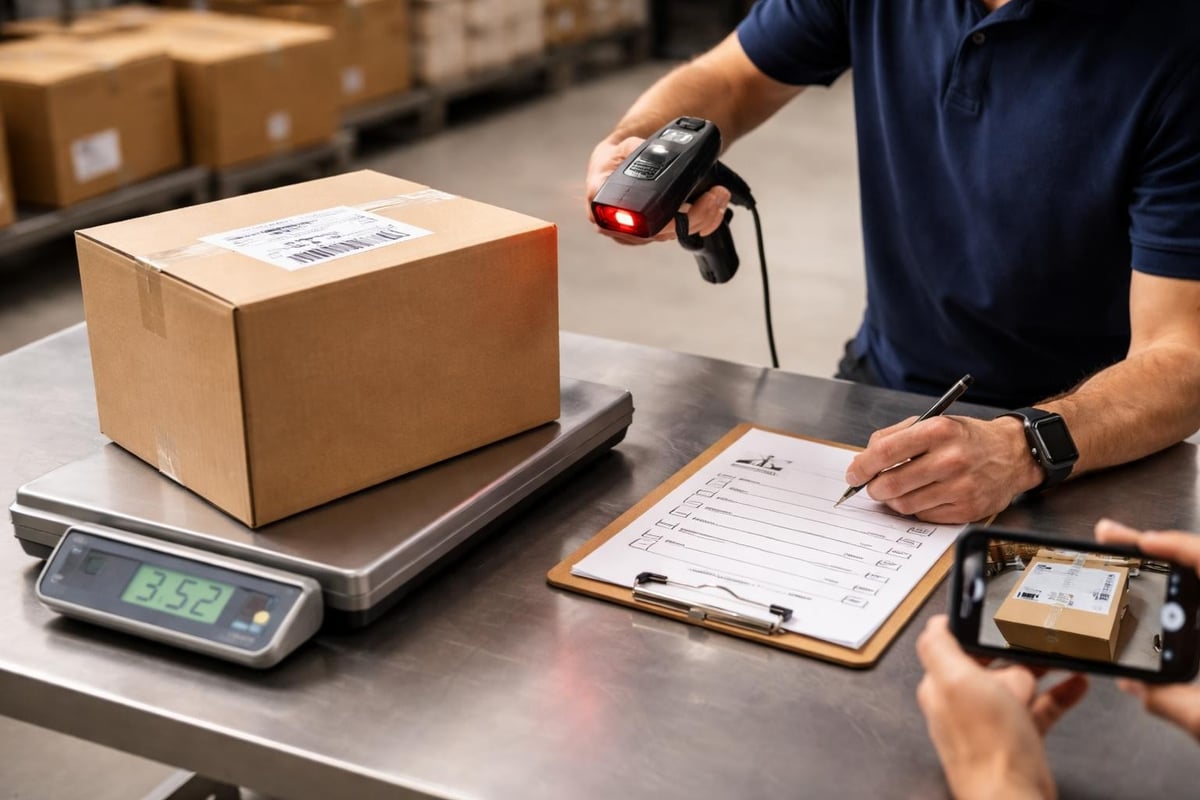
A QC check at pack-out, confirming SKU, quantity, and condition against the order before the label goes on, catches mispicks before they become a customer complaint. This step is frequently skipped under volume pressure, which is exactly when mispick rate climbs. The businesses with the lowest reship rates are the ones that treat this checkpoint as non-negotiable regardless of daily volume, not the ones that skip it during peak.
Shipping and Carrier Integration
Once a package is packed, order processing hands off to carrier logistics: selecting the carrier, generating the label, and getting the package into the outbound network.
Carrier Selection and Rate Shopping
Rate shopping, comparing live rates across carriers for a given weight, zone, and service level, is standard practice, but cost should not be the only variable. A carrier with a lower average label cost but a higher undeliverable or damage rate can cost more in reships and support tickets than it saves on postage. One operational example: switching a major account from a lower-cost carrier averaging around $7.10 per shipment to a more reliable carrier averaging $10.09 was a deliberate trade, accepting a higher unit cost to protect delivery consistency and reduce the downstream cost of failed deliveries. Carrier selection criteria should include delivery consistency, claims experience, and peak-season performance alongside the quoted rate.
Label Generation and Manifesting
Automated label generation pulls the confirmed carrier, service level, and package weight to produce a compliant shipping label without manual entry, which is where human error most often creeps into an otherwise clean workflow. Manifesting, batching the day’s labels into a single carrier handoff record, is what allows an outbound truck to pick up hundreds of packages with one scan instead of hundreds of individual scans. A failed label or a manifest mismatch at this stage is one of the most common causes of a package sitting at a warehouse dock overnight with no visible movement.
Customer Communication and Order Tracking
The warehouse work is largely invisible to the customer. What the customer experiences is the sequence of notifications between “order placed” and “package delivered.”
Automated Notification Sequences
Order confirmation, shipping confirmation, and delivery confirmation form the baseline sequence, but the notification that reduces support volume the most is the one businesses skip most often: a proactive delay notice. A customer told in advance that their order is running a day behind files far fewer support tickets than a customer who discovers the delay by refreshing a tracking page that hasn’t updated.
Tracking and Transparency
Tracking accuracy depends on how quickly carrier scan data flows back into the order management system. A tracking page that lags behind actual carrier scans by a day or more generates support inquiries even when the package is moving normally, because the customer has no way to tell the difference between “on time but not yet scanned” and “actually stuck.” Post-delivery confirmation, closing the loop with a delivery notice rather than leaving tracking status as the last customer-facing update, is a small addition that measurably reduces “where is my order” tickets filed after a package has technically arrived.
Returns Processing and Reverse Logistics
Returns are not a failure of order processing, they are a continuation of it, and the businesses that treat returns as an afterthought tend to have the messiest reverse logistics.
Streamlined Return Authorization
A return authorization step, whether self-service or manually approved, should capture the return reason before the package ships back. Return reason data is one of the highest-value, most commonly wasted data sets in ecommerce operations, since it identifies whether returns are being driven by sizing, damage, or simple buyer’s remorse, each of which requires a different fix.
Return Processing Workflow
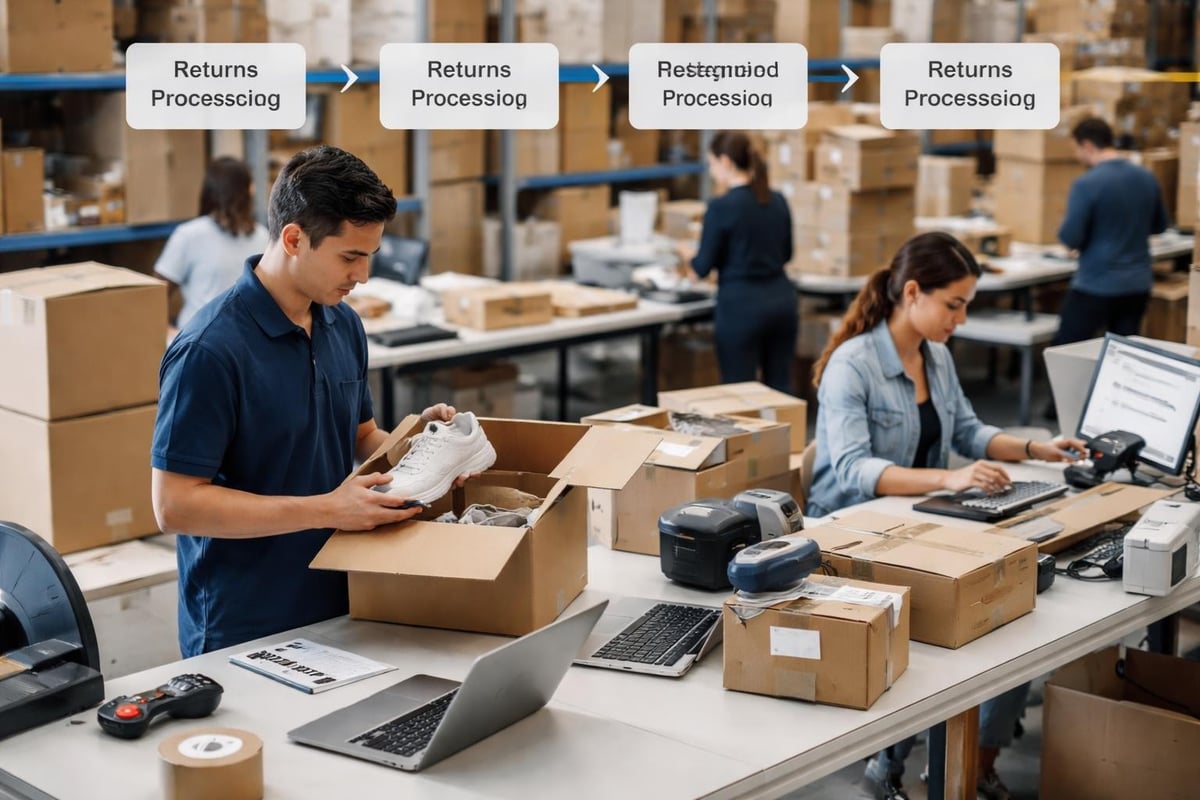
Once a returned item arrives, it has to be inspected, matched to the original SKU, and given a disposition: restock as sellable, restock as damaged or discounted, or dispose. Skipping the inspection step and restocking automatically is how damaged inventory ends up shipped to a second customer, turning one return into two.
Technology Integration and Automation
None of the stages above function well as manual processes past a few dozen daily orders. The technology stack is what turns a checklist into a workflow.
Essential System Integrations
An order management system (OMS) sits at the center, connecting to the ecommerce platform for order capture, a warehouse management system (WMS) for inventory and picking instructions, and shipping software for rate shopping and label generation. Multichannel sellers need this integration layer even more than single-channel sellers, since a missing connection between one sales channel and the WMS is exactly where oversells and delayed order capture happen.
Data-Driven Optimization
The value of these integrations compounds once the data feeds back into decisions: processing time by stage, mispick rate by picker or zone, and cost per order by carrier all become visible metrics instead of guesses. This is the same data referenced in the metrics section further down this guide, and it should be reviewed on a recurring basis, not pulled only when something has already gone wrong.
Scaling Your Order Processing Infrastructure
A workflow that runs cleanly at 500 orders a day does not automatically survive a jump to 5,000.
Capacity Planning
The clearest bottleneck signals are a rising ratio of orders to labor hours without a matching rise in throughput, a same-day shipment rate that starts slipping below its normal baseline, and pick-face replenishment falling behind order velocity. Any one of these trending in the wrong direction for more than a few consecutive days is a signal to add labor, add pick-face positions, or re-slot inventory before the backlog becomes visible to customers.
Distributed Fulfillment Networks
Splitting inventory across multiple warehouse nodes reduces transit zones and delivery time, but it also splits SKU availability, and a poorly planned split can strand slow-moving inventory at the wrong node while the fast-moving node stocks out. The trade-off is between transportation savings and inventory complexity: more nodes generally mean faster delivery and lower shipping cost per order, but they also mean more places for the same SKU to be miscounted or unevenly allocated. This is a reason a growing brand should model the multi-node move against its own SKU velocity data before committing, rather than assuming more nodes are automatically better.
Managing Peak Seasons and Promotions
Peak volume does not just add more of the same orders. It changes the risk profile of every stage above.
Pre-Season Preparation
A pre-season stress test, running a simulated volume spike through the OMS, WMS, and carrier integration before the real peak hits, catches integration failures while there is still time to fix them. This matters more than most businesses assume, since a system that works fine at normal volume can fail silently under load in ways that only surface once a promotion is already live.
Real-Time Monitoring and Adjustment
During peak, exception thresholds should trigger a manual review automatically rather than waiting for someone to notice a growing queue: a same-day shipment rate drop of a defined percentage, a spike in address-validation failures, or a carrier pickup delay are all signals that should page someone immediately, not surface in a weekly report after the promotion has ended.
International Order Processing Considerations
Cross-border orders add a documentation and cost layer that domestic order processing does not require.
Customs Documentation and Compliance
International shipments require accurate commercial invoices, harmonized system codes, and country-specific import documentation. An error at this stage does not just delay the shipment, it can trigger a customs hold that adds days or weeks and generates a support ticket the domestic fulfillment team is rarely equipped to answer, which is why customs documentation needs to be treated as part of order processing rather than an external courier problem.
Landed Cost Calculation
Landed cost, the total of product cost, duties, taxes, and international shipping, should be calculated and disclosed at checkout rather than left for the customer to discover at the border. A customer who receives an unexpected customs bill after delivery is far more likely to file a chargeback or request a return than one who saw the full cost upfront, so checkout transparency on landed cost is a return-rate lever, not just a compliance formality.
Order Processing Models
Most ecommerce brands run order processing under one of three models, and the right one depends on order volume, SKU complexity, and how much operational control the brand needs to keep in-house.
| Model | Control | Cost Structure | Scalability |
| In-House | Full control over packaging, branding, and pick logic | High fixed cost: warehouse space, WMS, direct labor | Limited without significant capital investment as volume grows |
| 3PL | Shared control; packaging and workflows set jointly with the provider | Variable cost tied to orders, storage, and services used | Scales with the provider’s existing infrastructure and labor pool |
| Dropshipping | Minimal control over packaging, inventory, or delivery timing | Lowest fixed cost; no warehousing or inventory investment | Scales easily in order count, but not in fulfillment quality or speed |
In-house processing makes sense for brands with unique packaging or kitting requirements and predictable volume that justifies fixed warehouse cost. A 3PL becomes the stronger option once a brand outgrows self-fulfillment but does not want to carry warehouse lease and labor risk directly, particularly once SKU count climbs past a level where pick-face management alone becomes a full-time job. Dropshipping remains useful for testing new product lines with minimal capital exposure, but it is a poor fit once a brand needs consistent packaging, fast delivery, or Amazon-grade prep compliance.
Ecommerce Order Processing Metrics
Order processing quality is measurable, and the businesses that track these numbers catch degradation before customers do.
| Metric | What It Measures | Why It Matters |
| Processing time | Time from order placement to ship-ready status | Direct driver of total delivery time and customer expectations |
| Order accuracy | Percentage of orders shipped with correct items and quantities | Low accuracy drives returns, reships, and support cost |
| Cost per order | Total labor, packaging, and handling cost per shipped order | Reveals true margin per order beyond the quoted pick fee |
| On-time delivery rate | Percentage of orders delivered within the promised window | Primary driver of repeat purchase and customer trust |
| Mispick / reship rate | Frequency of picking or packing errors requiring correction | Early warning signal for training gaps or process breakdown |
How Ecom Auto Prep Supports Ecommerce Order Processing
EAP 3PL runs order processing and fulfillment out of a Class A warehouse in Coral Springs, Florida, for Shopify, Amazon FBA, Walmart, eBay, and TikTok Shop sellers who need more than a pick-and-pack vendor. Inventory accuracy, structured warehouse locations, and direct access to the people running the floor are built into the operating model rather than sold as an add-on tier. Packaging optimization, carrier selection based on delivery reliability rather than the lowest label price alone, and custom kitting or Amazon prep are handled by a team that treats a customer’s inventory as an extension of its own operation.
Talk to the Team Running Your Order Processing, Not a Support Queue
Get a quote based on your actual order volume and SKU profile, schedule a meeting with the operations team to walk through your current bottlenecks, or request a service pricing breakdown before committing to a switch. No generic rate card, no ticket queue, just a direct conversation with the warehouse.
Frequently Asked Questions
What Are the Steps in Ecommerce Order Processing?
The core steps are payment verification, inventory allocation, picking, packing, quality control, carrier label generation, and customer notification. Returns handling follows as a continuation of the same workflow once a delivered order comes back.
What Is the Difference Between Order Processing and Fulfillment?
Order processing is the verification and routing layer: confirming payment, checking stock, and generating the pick instruction. Fulfillment is the physical execution of that instruction: picking, packing, and shipping. A business can have strong processing systems and still fail on fulfillment execution, or the reverse.
How Can Ecommerce Businesses Reduce Processing Time?
Batch picking instead of single-order picking, automated address validation instead of manual review on every order, and real-time inventory sync across all sales channels are the three changes that most consistently reduce processing time without adding headcount. A recurring review of processing time by stage, not just total, is what identifies which specific checkpoint is actually the bottleneck.
What Software Is Used for Ecommerce Order Processing?
An order management system (OMS) handles order capture and routing, a warehouse management system (WMS) manages inventory and pick instructions, and shipping software handles rate shopping and label generation. These three systems need to be integrated rather than operated as separate tools, since a gap between any two of them is where oversells, mispicks, and delayed notifications originate.
When Should a Business Outsource Order Processing?
The common signals are SKU count outgrowing manageable pick-face organization, order volume exceeding what current staff can process without daily overtime, and shipping cost climbing because in-house rate access can’t compete with a 3PL’s carrier volume. A business evaluating this switch should have its own order, unit, and SKU data ready before the first pricing conversation, since accurate pricing depends on the real workload, not a generic per-order estimate.



[…] performance across shifts and enables faster training for new employees. Understanding the broader e-commerce order process helps contextualize how packing fits into the complete fulfillment […]
[…] how to properly structure your e-commerce order process for bundled products ensures smoother operations across all fulfillment […]
[…] e-commerce order process within a distribution center follows a carefully orchestrated sequence designed to minimize […]
[…] the e-commerce order process from the customer perspective helps identify friction points and improvement opportunities […]
[…] disruption while building the technical capabilities necessary for advanced automation strategies. Streamlining the e-commerce order process provides a foundation for identifying additional automation opportunities throughout your […]
[…] see how common fulfillment workflows fit into this bigger picture, you can review order process steps for 2026 as a helpful reference […]
[…] historical sales data and seasonal patterns. Quality fulfillment partners offer guidance on e-commerce order processes that optimize efficiency from day […]
[…] direct-to-consumer orders may include branded materials and personalized notes. Understanding the e-commerce order process helps ensure compliance across all […]