

Most fulfillment guides tell you to switch to a 3PL “once you outgrow your garage.” That advice is too generic to act on – a 40-order/day jewelry brand and a 40-order/day furniture brand hit that wall at completely different volumes, for completely different reasons. The right question isn’t how many orders am I shipping – it’s what am I shipping, and what does one fulfillment mistake actually cost me.
This guide skips the generic switch-over advice and gives you the numbers: real per-pallet and per-pick price ranges, how the decision changes by product type (apparel vs. bulky/heavy vs. subscription vs. fragile), the specific failure points at receiving and returns that cost startups the most, and a 12-step checklist to set fulfillment up correctly the first time.
What Is Order Fulfillment for Startups?
Order fulfillment is the operational pipeline from checkout to doorstep – plus the reverse trip if the item comes back. It’s not the same as “shipping,” which is only the carrier transit leg (UPS, FedEx, USPS). Fulfillment covers receiving, storage, order processing, picking, packing, and returns.
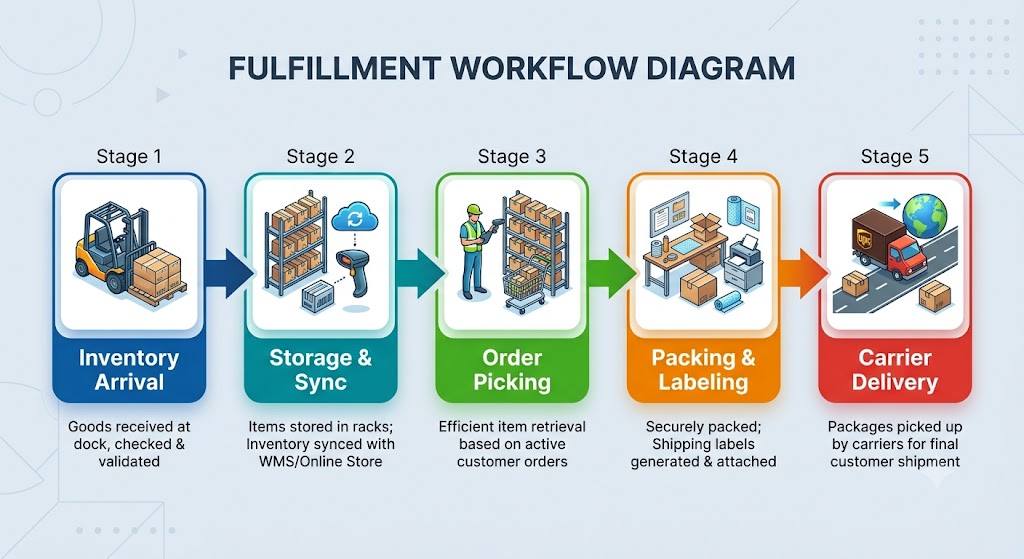
The startup-specific pressure points: unpredictable spikes from a single viral post or launch, capital tied up in inventory instead of growth, the same two or three people packing boxes and running ads, and customers who expect Amazon-speed shipping regardless of your order count.
How Startup Order Fulfillment Works
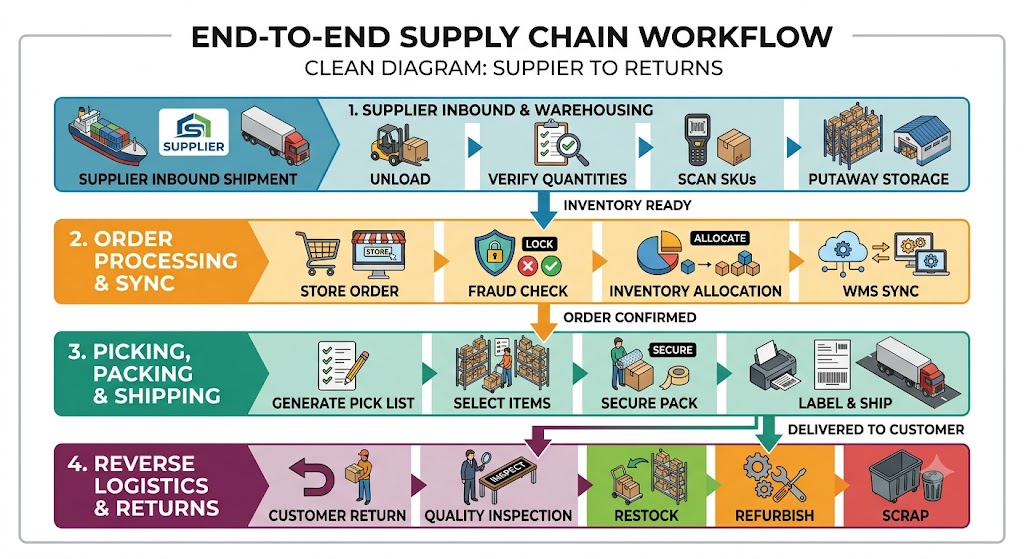
Receiving and Storing Inventory
Staff unload supplier deliveries, inspect for damage, and count physical units against the manifest. This is the single most common place startups lose money silently: an unverified short-ship (supplier sends 480 units, invoice says 500) that isn’t caught at receiving doesn’t surface until you oversell that SKU three weeks later – at which point you’re refunding orders and apologizing to customers, not just adjusting a spreadsheet. Every item gets a barcode and a bin location; skipping this step is the #1 cause of “phantom inventory” in early-stage stores.
Processing Customer Orders
- System integration – order transfers instantly to your WMS.
- Fraud and payment checks – run automatically before fulfillment starts.
- Inventory allocation – stock is reserved and synced across channels in real time.
- Queueing – verified orders route to the packing floor.
Picking, Packing, and Shipping
- Picking: staff work a pick list, using batch routes once order volume justifies it (usually past ~30-40 orders/day).
- Packing: materials are chosen to protect the product while minimizing dimensional weight – this single choice affects your shipping cost more than carrier selection does.
- Shipping: the system weighs the package, selects the carrier rate, and prints the label; tracking goes out automatically.
Managing Returns
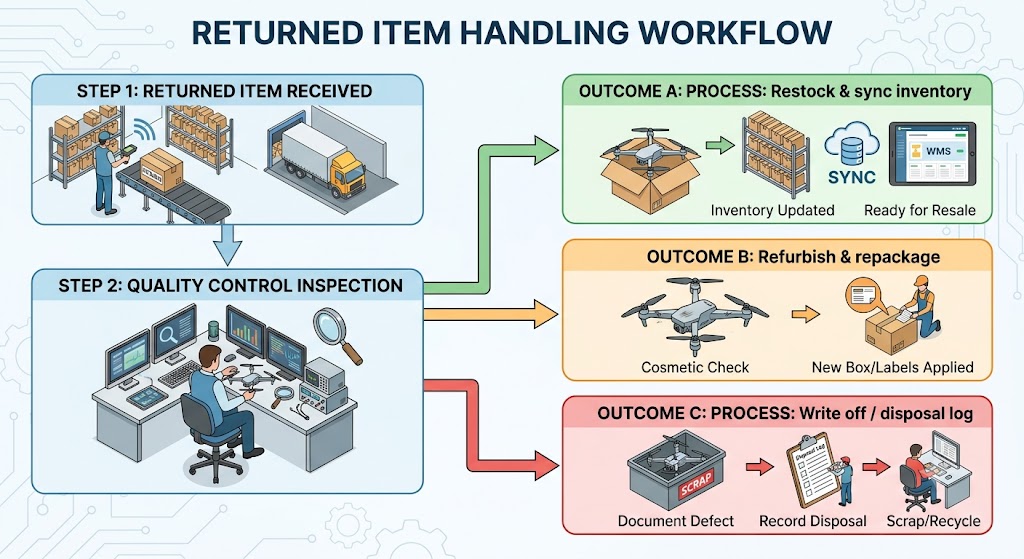
A return sitting unprocessed for a week isn’t just a slow refund – it’s a phantom stockout, because the system still shows that inventory as unavailable.
In-House vs. 3PL: What Actually Determines the Right Call
The volume threshold matters less than what you’re shipping. Here’s how the decision actually splits by product type:
| Product type | Where in-house tends to break down | Where 3PL tends to be worth it |
|---|---|---|
| Apparel/small goods | Around 40-60 orders/day, once batch-picking by hand gets error-prone | Once you’re running multiple SKUs × sizes × colors – 3PL WMS prevents mis-picks |
| Bulky/heavy items (furniture, fitness equipment) | Almost immediately – storage space and per-unit shipping cost punish in-house at low volume | Early, even at 10-20 orders/day, because freight-rate access matters more than pick labor |
| Fragile/custom-packaged (glass, gift sets) | Rarely – hand-packing quality is hard to replicate at a 3PL without a custom SOP | Only with a 3PL that supports custom packing instructions per SKU, which raises cost |
| Subscription boxes | Around month 2-3, once kitting volume outpaces two people’s evenings | Early – kitting automation is one of the clearest 3PL wins |
In-House Still Makes Sense When:
- You’re under ~20-50 orders/day and the product doesn’t punish you on dimensional weight or storage footprint.
- Packaging requires hands-on judgment calls a 3PL can’t replicate cheaply (hand-written notes, delicate assembly).
- You’re still iterating on the product itself – bundles, SKU changes – which is friction-heavy with an external partner.
Trade-off: full control and no minimum fees, at the cost of founder time and higher per-unit shipping (you don’t get carrier volume discounts).
3PL Makes Sense When:
- Order volume is consistent (200+/month) or your product type is bulky/heavy regardless of volume.
- You’re selling across 3+ channels (Shopify + Amazon FBA + TikTok Shop) and need centralized inventory truth.
- Storage is spilling into non-warehouse space – garages, offices.
Trade-off: you give up unboxing control unless you pay for custom packing SOPs, and most 3PLs carry a minimum monthly fee regardless of volume – read that number before signing.
The Hybrid Model Most Guides Skip
Full in-house or full 3PL isn’t the only choice – a lot of startups run both at once, and it’s often the smarter transition path rather than a compromise:
- Split by product type: keep fragile, custom, or low-volume SKUs in-house for hands-on QC, and send bulky or fast-moving SKUs to a 3PL where freight rates and automation matter more.
- Split by channel: fulfill DTC orders in-house where you control the unboxing experience, and let a 3PL or Amazon FBA handle marketplace orders where speed and Prime eligibility matter more than branding.
- Split by season: run in-house year-round and route overflow to a 3PL only during peak spikes (Black Friday, holiday), avoiding a 3PL’s monthly minimum during your slow months.
The failure mode to watch for: splitting inventory across two systems without a single source of truth for stock levels. If your in-house count and your 3PL count aren’t syncing to the same inventory system in real time, you’ll oversell on one side while sitting on excess stock on the other.
Startup Fulfillment Costs: Real Ranges
Rough U.S. market ranges as of 2026 – always get a quote against your actual SKU dimensions, since these swing widely by product size and 3PL tier:
| Cost item | Typical range | Notes |
|---|---|---|
| Pallet storage | $15-$30/pallet/month | Higher near major metro warehouses |
| Bin/shelf storage | $5-$10/bin/month | For active, fast-picking SKUs |
| Receiving fee | $25-$50/hour or $0.10-$0.30/unit | Ask if damaged-carton inspection is included |
| Base pick fee | $2-$5/order | Covers order handling + first item |
| Additional item fee | $0.30-$1.00/item | Multi-item orders add up fast – check this before assuming per-order cost |
| Standard mailer/box | $0.50-$2.00 | Custom branded packaging costs more and may need MOQs |
| Monthly minimum (most 3PLs) | $250-$1,000+ | The number that catches new brands off guard |
Dimensional weight (DIM) is worth calling out on its own: carriers bill by box volume × a DIM divisor, not just actual weight. Shipping a 1 lb item in an oversized box can cost the same as shipping a 5 lb item correctly boxed – right-sizing packaging is often a bigger lever on shipping cost than carrier negotiation.
The Technology Layer: What You Actually Need
Founders often either over-invest in enterprise software too early or under-invest and get stuck reconciling spreadsheets by hand. Three distinct systems matter, and they’re not interchangeable:
- Order Management System (OMS): pulls orders from every sales channel into one place. Below ~50 orders/day, your ecommerce platform’s native order screen is usually enough – a dedicated OMS earns its cost once you’re selling on 2+ channels.
- Warehouse Management System (WMS): tracks bin locations, pick paths, and stock levels inside the warehouse itself. If you’re in-house, even a lightweight WMS drastically cuts mis-picks versus a spreadsheet; if you’re on a 3PL, this is built into their platform already.
- Shipping software: compares carrier rates, prints labels, and pushes tracking numbers to customers automatically. This is usually the highest-ROI tool to adopt first, since manual label creation is the most time-consuming manual task in the whole pipeline.
The real trap isn’t picking the wrong tool – it’s picking three tools that don’t sync with each other, which recreates the same manual reconciliation work you were trying to eliminate.
Order Fulfillment Setup Checklist
- Calculate baseline volume – current monthly orders + 6-12 month growth estimate.
- Catalog and measure every SKU – dimensions, weight, fragility, packaging needs.
- Decide your model – in-house, 3PL, or hybrid, using product type (not just volume) as the deciding factor.
- Integrate software – connect your store (Shopify, WooCommerce, Amazon) to your inventory system.
- Set packaging standards – sizes and materials balancing protection against DIM cost.
- Compare carriers – USPS, UPS, FedEx, and regional options for your specific package profile.
- Write return guidelines – who pays return shipping, eligibility windows.
- Map total per-order cost – before scaling ad spend, know your fulfillment cost per unit economics.
- Set inbound receiving standards – labeling and palletizing requirements, and who verifies quantities against the manifest.
- Set reorder points – stock thresholds that trigger automatic alerts.
- Run end-to-end tests – confirm sync, picking, labels, and tracking work before going live.
- Track KPIs weekly – on-time shipping rate, pick accuracy, turnaround time, return rate.
Peak Season: Where Startup Fulfillment Breaks First
Black Friday and holiday spikes expose weaknesses that don’t show up at normal volume. A few things worth locking down before peak season, not during it:
- Confirm your 3PL’s peak-season cutoffs early. Most 3PLs publish inbound-inventory deadlines weeks before Black Friday – miss the deadline and your stock physically isn’t at the warehouse when demand hits.
- Carriers add peak surcharges on top of standard rates, sometimes announced with only a few weeks’ notice. Build a buffer into margin projections rather than assuming your normal shipping cost holds.
- Pre-pack fast-moving bundles before the rush, not during it – kitting during a live order spike is where pick times blow out and shipping delays start.
- Staffing a short-term surge in-house is harder than it looks. Temporary labor takes time to train on your specific SKUs and packing standards; a 3PL’s ability to absorb volume spikes is one of its clearest advantages during exactly this window.
Mistakes That Cost the Most
Skipping Receiving Verification
Cost of the mistake: a single unverified short-ship can mean 2-3 weeks of overselling a SKU before anyone notices – refunds, cancelled orders, and a damaged review are cheaper to prevent than to fix.
Fix: count against the manifest every time, no exceptions, even under time pressure.
Choosing the Cheapest 3PL
Cost of the mistake: a 2-3% pick error rate sounds small until it’s dozens of angry customers a month at scale.
Fix: ask for the provider’s order accuracy SLA in writing, not just their base pick rate.
Oversized Packaging
Cost of the mistake: DIM pricing can double your shipping cost on lightweight items in oversized boxes.
Fix: right-size boxes per SKU; don’t default to one box size for the whole catalog.
Delaying Automation
Cost of the mistake: manual address entry and tracking updates cost founder hours that scale linearly with orders – automation cost is fixed.
Fix: connect your store to shipping/WMS tools before volume forces the issue.
FAQ
How do I know if my product type needs a 3PL earlier than the standard volume threshold?
If your product is bulky, heavy, or has abnormal dimensions relative to weight, freight-rate access from a 3PL often pays off even under 20 orders/day – the volume threshold applies mainly to standard-sized goods.
What’s the one number to ask a 3PL for before signing?
Their monthly minimum fee and order accuracy SLA – base pick rate alone hides the real cost of a bad fit.
Can I run in-house and 3PL fulfillment at the same time?
Yes – a hybrid split by product type, channel, or season is common and often smarter than an all-or-nothing switch, as long as both sides sync to one real-time inventory system.
How much lead time do I need before switching to a 3PL ahead of peak season?
Most 3PLs need inventory on-site and integrations tested at least 6-8 weeks before a major peak like Black Friday – onboarding during the rush itself is one of the most common startup mistakes.