

The success of your e-commerce business depends heavily on how efficiently you deliver products to customers. Modern ecommerce shipping solutions have evolved beyond simple carrier partnerships to encompass sophisticated software platforms, multi-carrier strategies, and integrated fulfillment services. With shipping costs representing 15-20% of the average order value and delivery speed becoming a key competitive differentiator, selecting the right shipping infrastructure is no longer optional. This comprehensive guide explores the critical components of modern shipping solutions, helping you build a strategy that balances cost efficiency with customer satisfaction.
Understanding Modern Ecommerce Shipping Solutions
Ecommerce shipping solutions encompass the complete ecosystem of tools, services, and strategies that move products from your warehouse to customers’ doorsteps. These solutions integrate carrier networks, shipping software, fulfillment operations, and rate optimization to create seamless delivery experiences.
The landscape has transformed significantly over the past few years. Traditional shipping approaches relied on single-carrier contracts and manual processing, while today’s solutions leverage technology to automate carrier selection, print labels in bulk, and track packages in real-time across multiple providers.
Core Components of Shipping Solutions
Every comprehensive shipping solution includes several essential elements that work together:
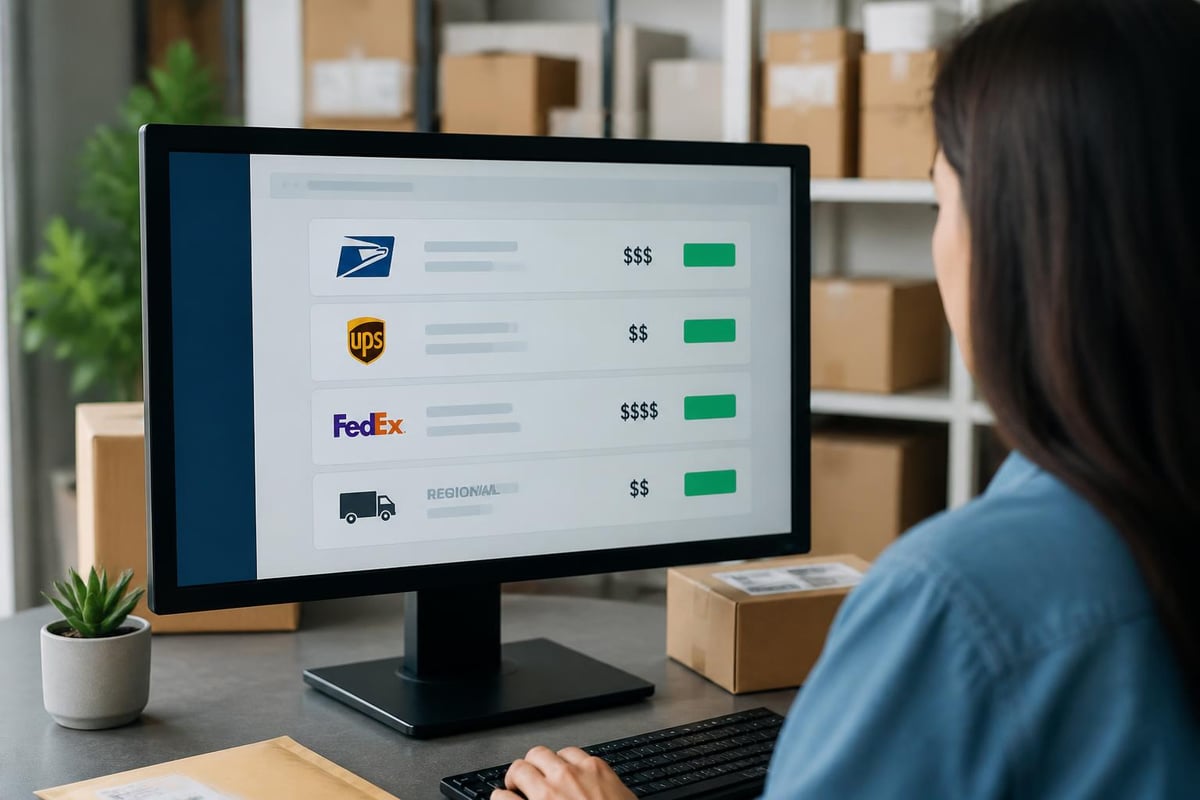
- Multi-carrier integration for rate comparison and automatic carrier selection
- Label generation software with batch processing capabilities
- Real-time tracking that provides visibility to both merchants and customers
- Rate shopping algorithms that identify the lowest-cost option for each shipment
- Returns management systems to handle reverse logistics efficiently
- Address validation tools to reduce delivery failures and additional charges
These components create the foundation for effective fulfillment warehouse services that can scale with your business growth.
Selecting the Right Shipping Software Platform
Choosing appropriate shipping software represents one of the most impactful decisions for your e-commerce operation. The right platform connects your sales channels, inventory management, and carrier networks into a unified workflow.
When evaluating shipping software options, consider your shipping volume, international requirements, and existing technology stack. Platforms designed for businesses shipping under 100 orders daily differ significantly from enterprise solutions handling thousands of daily shipments.
Key Features to Evaluate
| Feature Category | Essential Capabilities | Business Impact |
|---|---|---|
| Integration | Connect with Shopify, WooCommerce, Amazon, eBay | Eliminates manual data entry |
| Automation | Rule-based carrier selection, batch processing | Reduces processing time by 60-80% |
| Analytics | Shipping cost reports, delivery performance metrics | Identifies optimization opportunities |
| Scalability | API access, unlimited user accounts, high volume support | Supports business growth without platform changes |
Modern shipping platforms also offer advanced features like dimensional weight calculators, customs documentation automation for international shipments, and branded tracking pages that reinforce your brand identity throughout the delivery experience.
The cost structure varies considerably across platforms. Some charge flat monthly fees, while others use per-label pricing or tiered subscription models. Affordable shipping solutions balance feature sets with pricing models that align with your shipping volume and growth trajectory.
Carrier Selection and Partnership Strategies
Your carrier network forms the physical infrastructure that delivers your ecommerce shipping solutions. Most successful e-commerce businesses use multiple carriers rather than relying on a single provider, creating flexibility and redundancy in their delivery network.
Building a Multi-Carrier Strategy
Major national carriers like USPS, UPS, and FedEx each offer distinct advantages. USPS typically provides the most economical rates for lightweight packages and delivers to every U.S. address, including PO boxes. UPS excels at business-to-business shipments and offers extensive ground networks. FedEx specializes in time-sensitive deliveries and international shipments.
Regional carriers have gained significant market share by offering competitive rates and personalized service in specific geographic areas. These carriers often provide 20-30% savings compared to national carriers for zone 2-4 deliveries.
Consider these factors when building your carrier mix:
- Geographic coverage relative to your customer base
- Rate structures for your typical package sizes and weights
- Transit times to meet customer expectations
- Service reliability measured by on-time delivery percentages
- Claims handling processes and resolution timelines
- Technology integration capabilities with your shipping software
Negotiating carrier rates becomes possible once you reach consistent shipping volumes. Even businesses shipping 50-100 packages daily can often secure 10-15% discounts from published rates.
Optimizing Shipping Costs Without Sacrificing Speed
Cost optimization represents a constant challenge in e-commerce fulfillment. Shipping expenses directly impact profit margins, yet customers increasingly expect fast, free delivery as a standard offering.
The most effective strategies to reduce fulfillment shipping costs focus on efficiency rather than simply choosing the cheapest carrier for every shipment. Smart optimization balances multiple variables to achieve the best overall outcome.

Packaging Optimization Techniques
Right-sizing your packaging eliminates wasted space and reduces dimensional weight charges. Research shows that optimizing box design through data analysis can improve utilization rates by 30% or more, significantly reducing shipping costs across high-volume operations.
Implementing a diverse packaging inventory allows you to match package size precisely to product dimensions. While maintaining multiple box sizes creates inventory complexity, the shipping cost savings typically justify the added operational burden.
| Package Optimization Strategy | Typical Cost Reduction | Implementation Complexity |
|---|---|---|
| Custom box sizing | 15-25% | High |
| Poly mailer usage for soft goods | 20-35% | Low |
| Dimensional weight auditing | 10-15% | Medium |
| Void fill optimization | 5-10% | Low |
Zone-Based Fulfillment Strategies
Distributing inventory across multiple fulfillment centers reduces average shipping zones, which directly translates to lower carrier rates and faster delivery times. A package shipped from a facility 500 miles away costs significantly less than the same package traveling 2,000 miles.
For businesses ready to scale, strategic fulfillment locations create competitive advantages that are difficult for single-warehouse competitors to match. This approach requires sophisticated inventory allocation algorithms to prevent stockouts while maximizing zone-based savings.
International Shipping Considerations
Expanding into international markets introduces complexity that domestic ecommerce shipping solutions don’t address. Customs documentation, duty calculations, and international carrier selection require specialized expertise and software capabilities.
Essential International Shipping Elements
International shipments require accurate Harmonized System (HS) codes for every product. These standardized codes determine applicable duties and taxes, and incorrect classification can result in shipment delays, additional fees, or customs holds.
Duty and tax calculation capabilities should integrate directly into your checkout process, providing customers with accurate landed cost estimates before purchase. This transparency reduces cart abandonment and prevents costly return shipments due to unexpected fees.
Consider these international shipping approaches:
- Direct carrier services using UPS, FedEx, or DHL international divisions
- Postal networks through USPS international agreements with foreign postal services
- Regional specialists that focus on specific countries or regions
- Consolidation services that combine multiple shipments to reduce per-unit costs
Third-party logistics providers like Pitney Bowes, recognized for their shipping software solutions, offer comprehensive international capabilities that smaller businesses can leverage without building internal expertise.
Integration with Fulfillment Operations
Ecommerce shipping solutions achieve maximum efficiency when tightly integrated with broader fulfillment operations. The connection between inventory management, order processing, picking and packing, and shipping determines your overall operational efficiency.

Workflow Automation Opportunities
Real-time inventory synchronization between your e-commerce platform and fulfillment system prevents overselling and ensures accurate availability information. When a customer places an order, your system should immediately reserve inventory, generate pick tickets, and create shipping labels based on predetermined rules.
Advanced fulfillment operations implement wave picking strategies that group orders by carrier, delivery zone, or product category to maximize picking efficiency. These strategies require shipping software that can delay label creation until the optimal batching window closes.
For businesses managing multiple product categories, specialized services like fashion ecommerce fulfillment or electronic fulfillment provide category-specific expertise in packaging, shipping, and handling requirements.
Specialized Fulfillment Models and Shipping Needs
Different e-commerce business models create unique shipping requirements that standard solutions may not address effectively. Understanding these specialized needs helps you select appropriate ecommerce shipping solutions for your specific operation.
Amazon FBA Integration
Businesses selling through Amazon face dual shipping challenges: delivering inventory to Amazon fulfillment centers and potentially managing direct-to-consumer shipments for other sales channels. Amazon fulfillment services require specific labeling, packaging, and shipment preparation to meet Amazon’s stringent requirements.
Violations of Amazon’s prep requirements result in rejection fees, disposal charges, or inventory delays that can interrupt sales. Professional prep services ensure compliance while allowing you to maintain multi-channel inventory strategies.
Subscription Box Operations
Subscription box fulfillment creates predictable shipping patterns but requires capabilities for kitting, customization, and synchronized monthly shipments. The shipping solution must accommodate variable box weights, manage shipping date windows, and handle subscription-specific scenarios like skip months or gift subscriptions.
Subscription businesses benefit from negotiated carrier rates based on predictable monthly volumes and may qualify for volume-based discounts that sporadic shippers cannot access.
Direct-to-Consumer Strategies
Brands pursuing direct-to-consumer fulfillment strategies require shipping solutions that support premium unboxing experiences while maintaining competitive delivery speeds. These operations often include branded packaging, customized inserts, and gift message capabilities that traditional wholesale fulfillment doesn’t provide.
The shipping solution must balance the added handling time for custom packaging against customer delivery expectations, often requiring premium shipping options to maintain acceptable delivery windows.
Technology Integration and API Capabilities
Modern ecommerce shipping solutions extend beyond standalone platforms to become integrated components of your complete technology ecosystem. API-driven architectures enable custom workflows and connections that pre-built integrations cannot support.
Critical Integration Points
Your shipping solution should connect seamlessly with:
- E-commerce platforms (Shopify, WooCommerce, BigCommerce, custom storefronts)
- Marketplace integrations (Amazon, eBay, Walmart, Etsy)
- Inventory management systems for real-time stock visibility
- Customer relationship management platforms for service inquiries
- Accounting software to streamline financial reconciliation
- Business intelligence tools for shipping analytics and reporting
Businesses with unique requirements often need custom development to connect legacy systems or implement specialized workflows. Robust integration capabilities provide the flexibility to adapt as your business evolves without replacing your entire shipping infrastructure.
Returns Management and Reverse Logistics
An often-overlooked component of comprehensive ecommerce shipping solutions is returns management. With e-commerce return rates averaging 20-30% across most product categories, efficient reverse logistics directly impacts profitability and customer satisfaction.
Building Effective Returns Processes
Self-service return portals allow customers to initiate returns, select return reasons, and print return labels without contacting customer service. This automation reduces support costs while providing customers with the control and convenience they expect.
Your shipping solution should support multiple return methods:
- Pre-paid return labels included with original shipment
- Email return labels generated through customer portal
- QR code returns that eliminate printing requirements
- Drop-off locations that provide tracking without packaging
Advanced return analytics identify patterns that indicate quality issues, sizing problems, or listing inaccuracies. These insights enable proactive improvements that reduce future return rates while improving the customer experience.
Emerging Trends in Ecommerce Shipping
The shipping landscape continues evolving rapidly, driven by technological advancement and changing customer expectations. Understanding emerging trends helps you future-proof your ecommerce shipping solutions and maintain competitive advantages.
Sustainability and Carbon-Neutral Shipping
Environmental consciousness increasingly influences purchasing decisions. Carbon-neutral shipping programs, sustainable packaging materials, and consolidated delivery options appeal to environmentally aware customers while potentially reducing costs through operational efficiencies.
Many carriers now offer carbon offset programs that calculate the environmental impact of each shipment and invest in offsetting projects. While these programs typically add minimal costs per package, they provide marketing value and align with broader corporate sustainability initiatives.
Same-Day and Next-Day Delivery Expansion
Customer expectations continue compressing acceptable delivery windows. What was considered fast shipping five years ago is now standard, and competitive pressure pushes businesses toward same-day or next-day delivery capabilities in major markets.
Meeting these expectations requires strategic fulfillment center placement, carrier partnerships with local delivery capabilities, and technology that can identify and prioritize time-sensitive orders. While premium delivery options carry higher costs, they also command premium pricing and drive customer loyalty.
Predictive Shipping and Anticipatory Logistics
Advanced retailers are experimenting with predictive shipping models that position inventory near customers before orders are placed, based on historical data and purchasing patterns. While this approach creates inventory risk, it enables delivery speeds that traditional models cannot match.
Machine learning algorithms analyze purchasing patterns, seasonal trends, and individual customer behavior to predict future demand with increasing accuracy. These capabilities will become more accessible to mid-market businesses as the technology matures and becomes integrated into standard fulfillment platforms.
Measuring Shipping Performance and KPIs
Effective management of ecommerce shipping solutions requires consistent measurement and analysis of key performance indicators. The metrics you track should align with your business objectives and provide actionable insights for continuous improvement.
Essential Shipping Metrics
| Metric | Target Range | Business Impact |
|---|---|---|
| Average shipping cost per order | Varies by category | Direct profit margin impact |
| On-time delivery rate | >95% | Customer satisfaction driver |
| Shipping cost as % of revenue | 8-12% | Overall business profitability |
| Average delivery time | <3 days domestic | Competitive positioning |
| Return rate | <20% | Product quality indicator |
| Delivery exception rate | <2% | Carrier performance measure |
Cost per package provides the most fundamental metric for shipping efficiency. Track this metric by carrier, service level, and shipping zone to identify optimization opportunities and validate rate negotiations.
Transit time distribution reveals the percentage of orders meeting various delivery windows. Understanding what percentage of customers receive orders within two days, three days, or longer helps you set appropriate expectations and identify service gaps.
Sophisticated operations also track dock-to-stock time (elapsed time from order placement to shipment), label accuracy rates, and dimensional weight recovery (identifying packages where actual billed weight exceeded estimated weight).
Scaling Your Shipping Infrastructure
As your e-commerce business grows, your shipping infrastructure must scale proportionally without creating operational bottlenecks or cost inefficiencies. Planning for scale prevents the painful migrations and system changes that disrupt operations during critical growth phases.
Growth-Ready Shipping Architecture
Platform selection should prioritize solutions that accommodate 10x your current volume without requiring complete replacement. Cloud-based platforms generally scale more easily than on-premise solutions, handling volume spikes during peak seasons without infrastructure upgrades.
Many businesses find that partnering with experienced fulfillment providers provides more scalable growth paths than building internal infrastructure. These partnerships convert fixed costs into variable costs while providing expertise that would take years to develop internally.
Consider the total cost of ownership beyond monthly platform fees. Implementation time, training requirements, integration development, and ongoing maintenance create hidden costs that can exceed software licensing fees over multi-year periods.
Selecting and implementing the right ecommerce shipping solutions requires balancing multiple priorities across cost, speed, reliability, and customer experience. The strategies outlined here provide a framework for building shipping infrastructure that scales with your business while maintaining efficiency and profitability. Ecom Automation Prep helps fast-growing e-commerce brands navigate these complexities through comprehensive fulfillment services that integrate seamlessly with your existing operations, allowing you to focus on growth while we handle the logistics that get your products to customers efficiently and reliably.