


The modern e commerce distribution center represents the backbone of successful online retail operations in 2026. As consumer expectations continue to escalate, demanding faster delivery times and flawless order accuracy, brands must optimize their distribution infrastructure to remain competitive. These specialized facilities combine strategic location planning, advanced technology, and streamlined processes to transform how products move from manufacturers to customers' doorsteps. Understanding the critical components and best practices of distribution center operations enables e-commerce brands to scale efficiently while maintaining the service standards that drive customer loyalty.
The Strategic Role of E Commerce Distribution Centers
An e commerce distribution center serves as the central hub where inventory management, order processing, and shipping converge to create seamless fulfillment operations. Unlike traditional warehouses that simply store goods, these facilities function as dynamic operations centers designed for high-velocity order processing and rapid inventory turnover.
The strategic placement of distribution centers directly impacts delivery speed and shipping costs. Brands that position facilities near major population centers can offer same-day or next-day delivery while reducing transportation expenses. This geographic advantage becomes particularly valuable as customers increasingly prioritize delivery speed when making purchase decisions.
Location Optimization and Market Access
Selecting the right location for an e commerce distribution center requires analyzing multiple factors beyond real estate costs. Population density, proximity to transportation networks, labor availability, and local regulations all influence long-term operational success.
Key location considerations include:
- Access to major highways and interstate systems
- Proximity to airports for expedited shipping options
- Distance to primary customer markets
- Availability of skilled warehouse workforce
- Local zoning laws and building codes affecting operations
Research shows that distribution center design and zoning regulations significantly impact operational efficiency, particularly for last-mile logistics. Communities now implement specific strategies to integrate e-commerce warehouses effectively, balancing economic benefits with infrastructure considerations.

Essential Infrastructure and Layout Design
The physical design of an e commerce distribution center dramatically influences throughput capacity and operational efficiency. Modern facilities incorporate specialized zones for receiving, storage, picking, packing, and shipping, each optimized for specific workflow requirements.
High-velocity operations demand fulfillment center designs built for speed and accuracy, particularly when handling small orders across thousands of SKUs. The layout must minimize travel time between storage locations and packing stations while maintaining organization systems that prevent errors.
Receiving and Quality Control Zones
The receiving area represents the entry point where inventory transitions from suppliers into the distribution system. Efficient receiving operations include designated dock doors, inspection stations, and staging areas where products undergo quality verification before entering storage.
Quality control processes typically involve:
- Physical inspection for shipping damage
- Quantity verification against purchase orders
- SKU validation and barcode scanning
- Compliance checks for Amazon FBA or specific marketplace requirements
- Photography documentation for condition records
For brands utilizing Amazon FBA prep services, the receiving stage includes specialized preparation steps ensuring products meet marketplace requirements before storage.
Storage Configuration and Inventory Management
Storage zones within an e commerce distribution center utilize various systems based on product characteristics and turnover rates. Fast-moving items occupy easily accessible locations near packing stations, while slower-moving inventory resides in higher shelves or more distant areas.
| Storage Method | Best For | Advantages | Considerations |
|---|---|---|---|
| Pallet Racking | Large items, case quantities | High density, forklift accessible | Limited SKU accessibility |
| Bin Shelving | Small items, individual units | High SKU count, easy picking | Lower density |
| Automated Systems | High-volume operations | Maximum efficiency, reduced labor | Significant capital investment |
| Floor Stacking | Bulk storage, uniform products | Minimal infrastructure | Access limitations |
Modern warehouse management systems track every item's location, enabling real-time inventory visibility across multiple sales channels. This technology integration proves essential for brands managing omnichannel operations where inventory must serve both direct-to-consumer orders and marketplace fulfillment simultaneously.
Technology Systems Driving Operational Excellence
Technology infrastructure transforms an e commerce distribution center from a simple storage facility into an intelligent fulfillment engine. Integrated systems communicate seamlessly, automating decisions and reducing manual intervention throughout the order lifecycle.
Warehouse Management Systems (WMS)
A robust WMS serves as the operational brain, orchestrating all activities from receiving through shipping. These platforms optimize pick paths, manage inventory allocation, and generate packing instructions that ensure order accuracy.
Advanced WMS solutions incorporate predictive analytics that forecast demand patterns, enabling proactive inventory positioning. By analyzing historical data and seasonal trends, the system identifies which products should occupy prime picking locations during specific periods, maximizing throughput during peak seasons.
Recent studies demonstrate how data-driven assortment planning and inventory allocation enhance fulfillment efficiency, with major retailers achieving significant improvements through optimized distribution strategies.
Automation and Robotics Integration
Automation technologies range from simple conveyor systems to sophisticated robotic picking solutions. The appropriate automation level depends on order volume, SKU count, and capital investment capacity.
Common automation technologies include:
- Conveyor systems connecting functional zones
- Automated sorting systems for order routing
- Robotic picking arms for repetitive tasks
- Automated guided vehicles (AGVs) for material transport
- Put-wall systems for batch picking operations
While full automation requires substantial investment, even partial automation of repetitive processes significantly improves productivity and accuracy. Brands should evaluate automation opportunities based on volume thresholds where labor costs justify capital expenditure.

Order Fulfillment Processes and Workflow Optimization
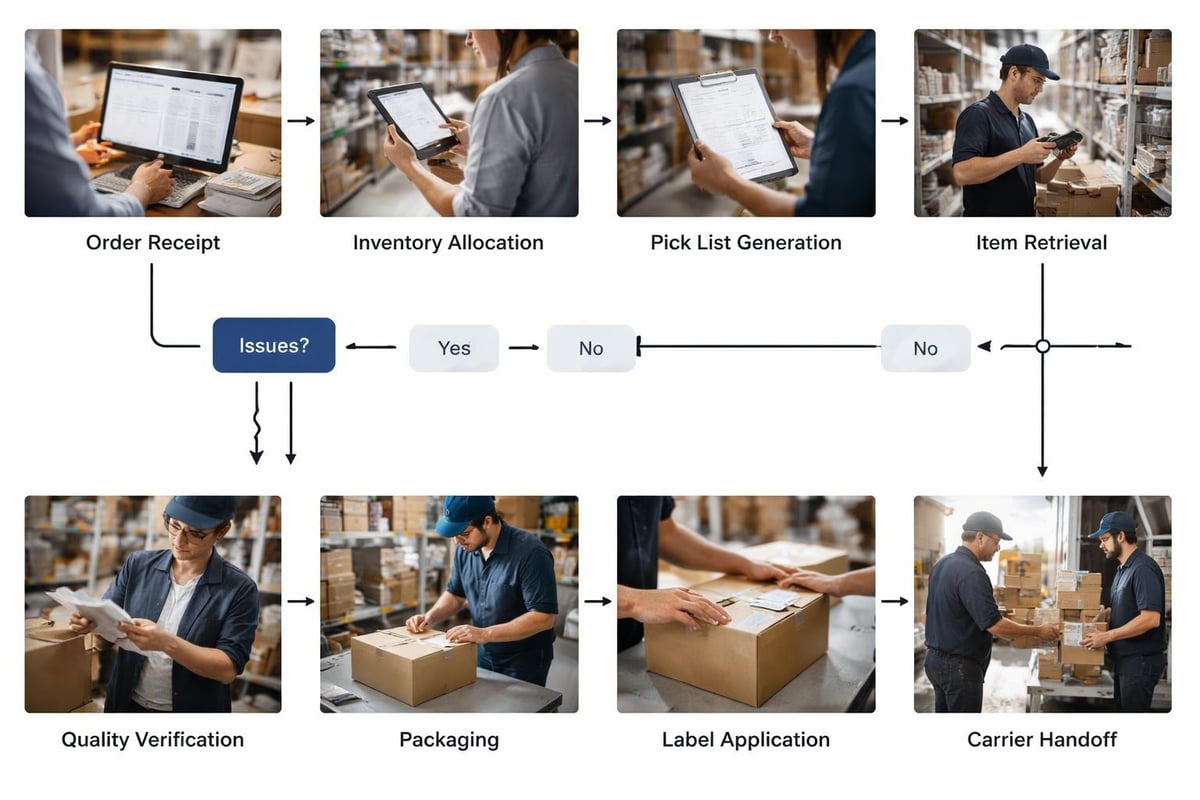
The e-commerce order process within a distribution center follows a carefully orchestrated sequence designed to minimize handling time while maximizing accuracy. Each step adds value by moving the order closer to shipment while verifying correctness.
Pick, Pack, and Ship Operations
Order picking represents the most labor-intensive operation in most e commerce distribution centers. Various picking methodologies suit different order profiles and facility layouts.
Picking strategies include:
- Single-order picking: One picker fulfills one complete order
- Batch picking: Multiple orders picked simultaneously
- Zone picking: Pickers assigned to specific warehouse areas
- Wave picking: Scheduled picking cycles for order groups
- Cluster picking: Similar to batch but organized by delivery route
Packing operations require standardized procedures ensuring products receive appropriate protection while minimizing dimensional weight charges. Trained packers select optimal box sizes, apply correct cushioning materials, and verify contents against packing slips before sealing.
Quality Assurance and Accuracy Verification
Quality checkpoints throughout the fulfillment process prevent errors from reaching customers. Many facilities implement scanning verification at multiple stages, requiring barcode scans that confirm correct products enter each order.
| Quality Check Point | Verification Method | Error Prevention |
|---|---|---|
| Pick Verification | Barcode scan matching | Wrong item selection |
| Pack Verification | Weight validation | Missing items |
| Ship Verification | Address confirmation | Shipping errors |
| Final Inspection | Visual review | Damage or quality issues |
Comprehensive quality systems reduce return rates, protect brand reputation, and maintain the operational efficiency that e-commerce fulfillment pricing models depend upon.
Specialized Services and Value-Added Operations
Modern e commerce distribution centers extend beyond basic storage and shipping to offer value-added services that enhance product presentation and customer experience.
Kitting and Bundling Services
Kitting involves assembling multiple individual items into single SKUs, creating product bundles that increase average order value while simplifying inventory management. This service proves particularly valuable for subscription boxes, gift sets, or promotional packages.
Subscription box fulfillment services require specialized kitting capabilities where each box contains curated selections that may vary by subscription tier or customer preferences. Distribution centers with kitting expertise can customize assemblies based on dynamic requirements.
Custom Packaging and Branding
Custom packaging services transform standard shipments into branded experiences that reinforce company identity and delight customers. These services include branded boxes, tissue paper, promotional inserts, and personalized packing slips that create memorable unboxing experiences.
Branding opportunities in fulfillment include:
- Custom printed shipping boxes with logo placement
- Branded tissue paper and protective materials
- Marketing inserts announcing new products or promotions
- Thank you cards with personalized messages
- Sample products encouraging additional purchases
These touches differentiate brands in competitive markets where product quality alone no longer guarantees customer loyalty.
Workforce Management and Employee Well-Being
Human capital remains critical even as automation advances within e commerce distribution centers. Skilled workers perform complex tasks requiring judgment, handle exceptions that machines cannot process, and maintain the flexibility essential during demand fluctuations.
Creating Productive Work Environments
Employee productivity and retention directly correlate with working conditions, compensation, and growth opportunities. Forward-thinking operations invest in wellness features that promote employee well-being, recognizing that healthier workers demonstrate higher productivity and lower turnover.
Physical environment improvements include adequate lighting, climate control, ergonomic workstations, and break areas that allow genuine rest. Safety programs protecting workers from injury demonstrate organizational commitment to employee welfare while reducing costly workers' compensation claims.
Training and Performance Management
Comprehensive training programs ensure workers understand procedures, equipment operation, and quality standards. Ongoing training addresses new technologies, updated processes, and advanced techniques that improve individual performance.
Performance management systems should balance productivity metrics with quality measures, preventing speed emphasis that compromises accuracy. Incentive programs rewarding both efficiency and error-free performance align employee motivation with organizational objectives.
Sustainability and Environmental Responsibility
Environmental concerns increasingly influence e commerce distribution center operations as brands recognize sustainability's importance to customers and long-term operational efficiency. Eco-friendly practices reduce costs while enhancing brand reputation among environmentally conscious consumers.
Energy Efficiency Initiatives
Energy consumption represents a significant operational expense in large distribution facilities. Sustainable practices in distribution centers demonstrate how energy-efficient systems and renewable energy sources reduce environmental impact while lowering utility costs.
Energy reduction strategies include:
- LED lighting with motion sensors in low-traffic areas
- Solar panel installations offsetting grid electricity
- Energy-efficient HVAC systems with smart controls
- Natural lighting through skylights and window placement
- Equipment optimization reducing idle time consumption
Packaging Waste Reduction
Packaging materials constitute substantial waste streams in e-commerce operations. Right-sizing packaging reduces dimensional weight charges while minimizing cardboard and cushioning material consumption. Automated packaging systems select optimal box sizes for each order's contents, eliminating oversized boxes requiring excess fill materials.
Recyclable and biodegradable packaging materials replace traditional plastic cushioning, aligning operations with circular economy principles. Some facilities implement packaging material recycling programs, repurposing incoming supplier packaging for outbound shipments.
Scalability and Growth Planning
An effective e commerce distribution center must accommodate growth without requiring complete operational overhauls. Scalable infrastructure, flexible processes, and technology systems that expand capacity enable brands to handle increasing order volumes while maintaining service quality.
Capacity Planning and Expansion
Understanding fulfillment costs requires analyzing how volume growth impacts per-unit expenses. Distribution centers experience economies of scale where fixed costs spread across more units, reducing average fulfillment costs as volume increases.
Strategic capacity planning anticipates seasonal peaks, promotional events, and long-term growth trajectories. Facilities should maintain buffer capacity preventing service degradation during unexpected demand spikes while avoiding excessive unused space during normal periods.
Scalability strategies include:
- Modular racking systems allowing configuration changes
- Cloud-based WMS supporting additional users and transactions
- Flexible labor models utilizing temporary workers during peaks
- Multi-site distribution networks spreading volume across facilities
- Third-party logistics partnerships for overflow capacity
Technology Scalability
Technology infrastructure must scale alongside physical capacity. Cloud-based systems offer inherent scalability, automatically provisioning additional computing resources during high-transaction periods. Integration capabilities enable adding new sales channels, marketplaces, or shipping carriers without extensive custom development.
Brands considering whether to operate their own e commerce distribution center or partner with fulfillment providers should evaluate total investment requirements, operational expertise, and strategic focus. Many fast-growing brands find that e-commerce help from specialized fulfillment partners allows them to concentrate resources on product development and marketing while experts handle logistics complexities.
Managing Multiple Sales Channels
Omnichannel commerce requires e commerce distribution centers to serve diverse fulfillment requirements simultaneously. Inventory must support direct-to-consumer orders, marketplace fulfillment, wholesale shipments, and potentially retail store replenishment.
Inventory Allocation Strategies
Advanced systems implement contextual optimization frameworks for omnichannel order fulfillment that consider delivery time uncertainties and channel-specific requirements. These algorithms determine optimal inventory allocation maximizing service levels across all channels while minimizing total inventory investment.
Real-time inventory visibility prevents overselling situations where products sell through multiple channels before inventory updates reflect unavailability. Integrated systems reserve inventory when orders occur, preventing allocation conflicts that damage customer experience.
Channel-Specific Requirements
Different sales channels impose unique fulfillment requirements. Amazon FBA shipments require specific labeling, packaging, and shipping protocols differing from direct-to-consumer orders. Wholesale shipments may need case packing, pallet configuration, and advance shipping notices (ASNs) that retail partners require.
| Sales Channel | Unique Requirements | Special Considerations |
|---|---|---|
| Direct-to-Consumer | Branded packaging, inserts | Customer experience focus |
| Amazon FBA | FNSKU labels, prep services | Compliance with requirements |
| Wholesale/Retail | Case packing, EDI integration | Vendor compliance penalties |
| Subscription Boxes | Variable kitting, scheduling | Recurring fulfillment cycles |
Distribution centers handling multiple channels need flexible processes accommodating diverse requirements without creating operational complexity that slows overall throughput.
Performance Metrics and Continuous Improvement
Data-driven management requires tracking key performance indicators (KPIs) that reveal operational health and improvement opportunities. E commerce distribution centers should monitor metrics spanning accuracy, speed, cost, and customer satisfaction.
Critical Performance Indicators
Order accuracy rate measures the percentage of orders shipped without errors, directly impacting customer satisfaction and return costs. World-class operations achieve 99.5% accuracy or higher, while acceptable thresholds typically exceed 98%.
Order cycle time tracks duration from order receipt to shipment, with faster cycles enabling same-day or next-day delivery promises. Analyzing cycle time by order type reveals bottlenecks requiring process improvements.
Inventory accuracy compares physical inventory counts against system records, with discrepancies indicating process failures in receiving, picking, or cycle counting procedures. Regular cycle counting programs maintain accuracy above 98%.
Cost per order encompasses all fulfillment expenses divided by order volume, providing the fundamental metric for understanding fulfillment economics. Tracking cost trends identifies whether productivity improvements offset volume growth or expenses escalate unsustainably.
Implementing Best Practices
Best practices for optimizing distribution warehouses emphasize continuous improvement methodologies that systematically identify and eliminate inefficiencies. Regular process reviews engaging frontline workers often reveal practical improvements that management overlooks.
Benchmarking against industry standards provides context for performance evaluation. While individual operations vary, understanding typical metrics for similar facilities helps establish realistic improvement targets.
Risk Management and Business Continuity
E commerce distribution centers face various risks threatening operational continuity. Natural disasters, equipment failures, labor disruptions, and cybersecurity threats can halt fulfillment operations, directly impacting revenue and customer relationships.
Disaster Recovery Planning
Comprehensive disaster recovery plans address potential disruptions with predetermined response protocols. Geographic diversification through multiple distribution centers prevents single points of failure where one facility's closure completely halts fulfillment.
Risk mitigation strategies include:
- Backup power generation maintaining operations during outages
- Redundant network connectivity preventing internet failures
- Data backup systems protecting inventory and order information
- Alternative supplier relationships for packaging materials
- Cross-trained workforce capable of performing multiple roles
Cybersecurity Considerations
Digital infrastructure supporting e commerce distribution centers presents cybersecurity vulnerabilities. Warehouse management systems, inventory databases, and network-connected automation equipment require protection against ransomware, data breaches, and system compromises.
Platform performance and security best practices address both digital infrastructure protection and customer data security, essential considerations as fulfillment operations become increasingly technology-dependent.
Integration with Broader Supply Chain
An e commerce distribution center functions as one component within larger supply chains connecting manufacturers, importers, distribution networks, and end customers. Effective integration optimizes total supply chain performance rather than sub-optimizing individual components.
Upstream Supplier Coordination
Strong supplier relationships enable better inventory planning, reduced lead times, and improved product availability. Electronic data interchange (EDI) systems automate purchase orders, advance shipping notices, and invoice processing, reducing administrative overhead while improving accuracy.
Collaborative planning with suppliers prevents stockouts during promotional periods or seasonal peaks when demand surges. Sharing sales forecasts allows suppliers to reserve production capacity, ensuring inventory availability when needed.
Downstream Carrier Partnerships
Shipping carrier relationships significantly impact delivery speed, cost, and customer satisfaction. Negotiated rates based on volume commitments reduce per-package costs, while service level agreements ensure performance standards meet customer expectations.
Multi-carrier strategies prevent over-dependence on single providers while enabling service selection based on destination, package characteristics, and delivery timeframe requirements. Automated carrier selection systems choose optimal shipping methods balancing cost against delivery speed for each order.
Optimizing an e commerce distribution center requires balancing location strategy, technology investment, operational processes, and workforce management to create fulfillment operations that scale alongside business growth. The complexity of modern fulfillment demands specialized expertise that many brands find more efficient to access through partnerships rather than building internal capabilities. Ecom Automation Prep provides comprehensive fulfillment services designed specifically for fast-growing e-commerce brands, handling everything from FBA prep to direct-to-consumer fulfillment so you can focus on growing your business while we ensure every order ships accurately and on time.