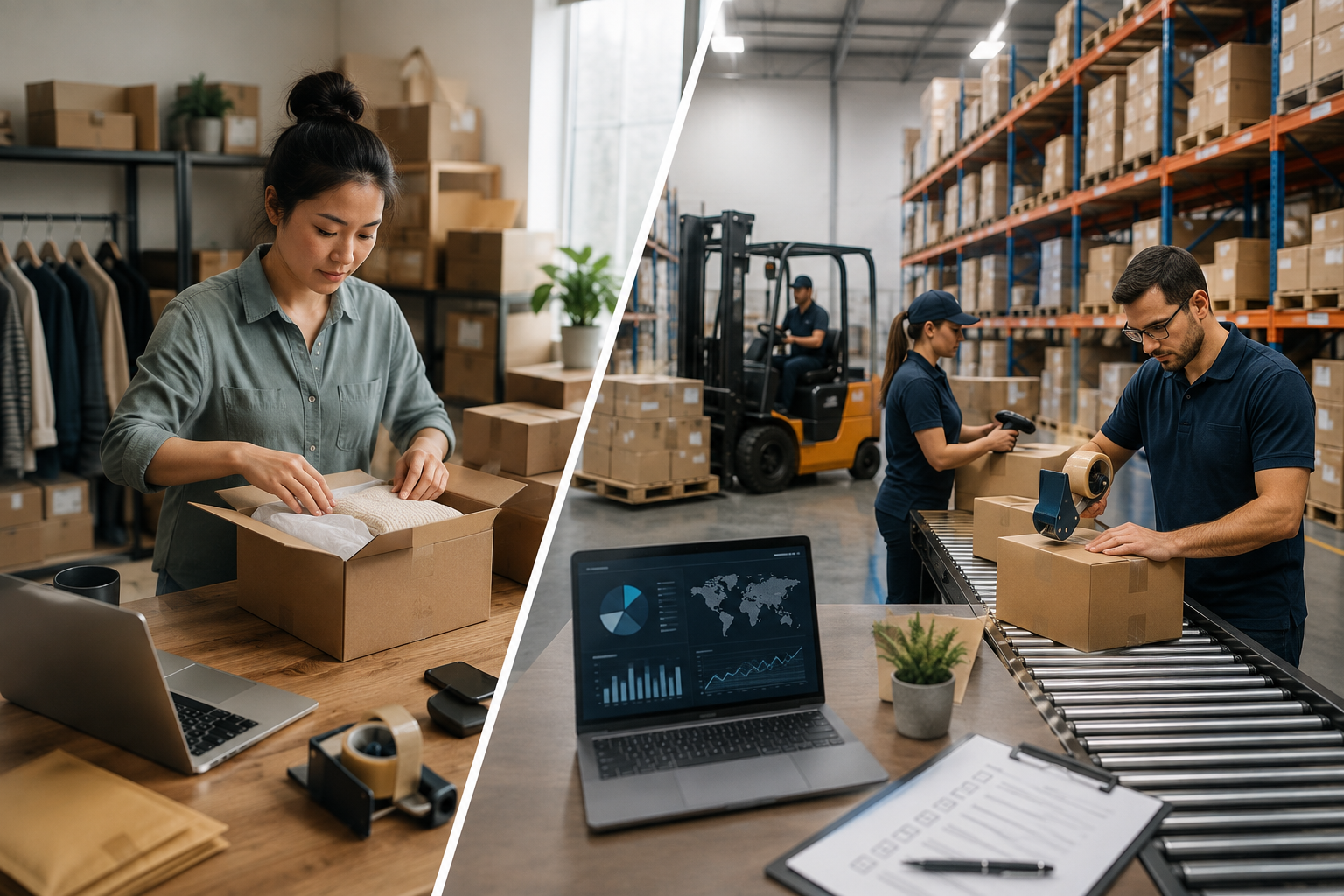

A fulfillment center receives, stores, and ships ecommerce orders on behalf of a brand. It replaces in-house warehousing with a system built specifically for individual customer orders rather than bulk retail shipments. The distinction matters operationally: order cycle time and same-day ship rate become the numbers that decide whether customers get their packages on time, not just storage utilization.
Fulfillment Center: Key Takeaways
Built for Fast, Accurate Order Processing
Individual orders move from click to label in hours, not days, because the facility is designed around single-unit picking and packing rather than pallet-level distribution.
Real-Time Inventory Visibility
A warehouse management system updates stock counts the moment an item is received, picked, or returned, so sellers see accurate availability instead of a weekly snapshot.
Flexible Capacity for Ecommerce Growth
Storage and labor scale with order volume, which means a brand can absorb a seasonal spike or a slow month without renegotiating a lease or hiring a permanent crew.
Shipping, Tracking, and Returns in One Flow
Carrier selection, tracking updates, and reverse logistics run through the same system that manages inventory, so a return automatically becomes sellable stock again instead of a separate manual process.
What Is a Fulfillment Center?
Fulfillment Center Meaning and Purpose
A fulfillment center is a warehouse operated by a brand or a third-party logistics (3PL) provider whose primary job is processing direct-to-customer orders: receiving inventory, storing it, and picking, packing, and shipping individual purchases as they come in. Its purpose is narrower than general warehousing. A fulfillment center exists to move single orders out the door quickly and accurately, not to hold inventory indefinitely.
Key Characteristics of a Modern Fulfillment Center
Short dwell time separates a fulfillment center from long-term storage: inventory is meant to turn over, not sit. High turnover requires systems built for individual order handling rather than pallet moves, along with the speed, accuracy, and integrated technology needed to process hundreds or thousands of small, distinct orders every day without mixing them up.
How Does a Fulfillment Center Work?
1. Inventory Is Received, Verified, and Logged
Inbound shipments are counted, checked against the packing list or purchase order, and inspected for damage before anything is entered into the warehouse management system (WMS). Discrepancies are flagged at this stage, because an error caught at receiving is far cheaper to fix than one discovered after an order has already shipped.
2. Products Are Stored Using Demand-Based Slotting
Fast-moving SKUs go into easy-to-reach pick locations near the packing stations, while slower-moving inventory sits in reserve storage further away. This slotting logic keeps the average pick as short as possible, which directly affects labor cost per order.
3. Online Orders Enter the Order Management System
When a customer checks out, the order flows automatically from the sales channel into an order management system (OMS) that assigns it a pick priority based on shipping promise, carrier cutoff time, and current warehouse workload.
4. Items Are Picked Using the Appropriate Picking Method
Single orders may be picked one at a time, while high-volume periods often use batch or zone picking, where one worker collects items for multiple orders in a single pass. The method chosen depends on order profile, not a fixed house rule.
5. Orders Are Packed and Quality Checked
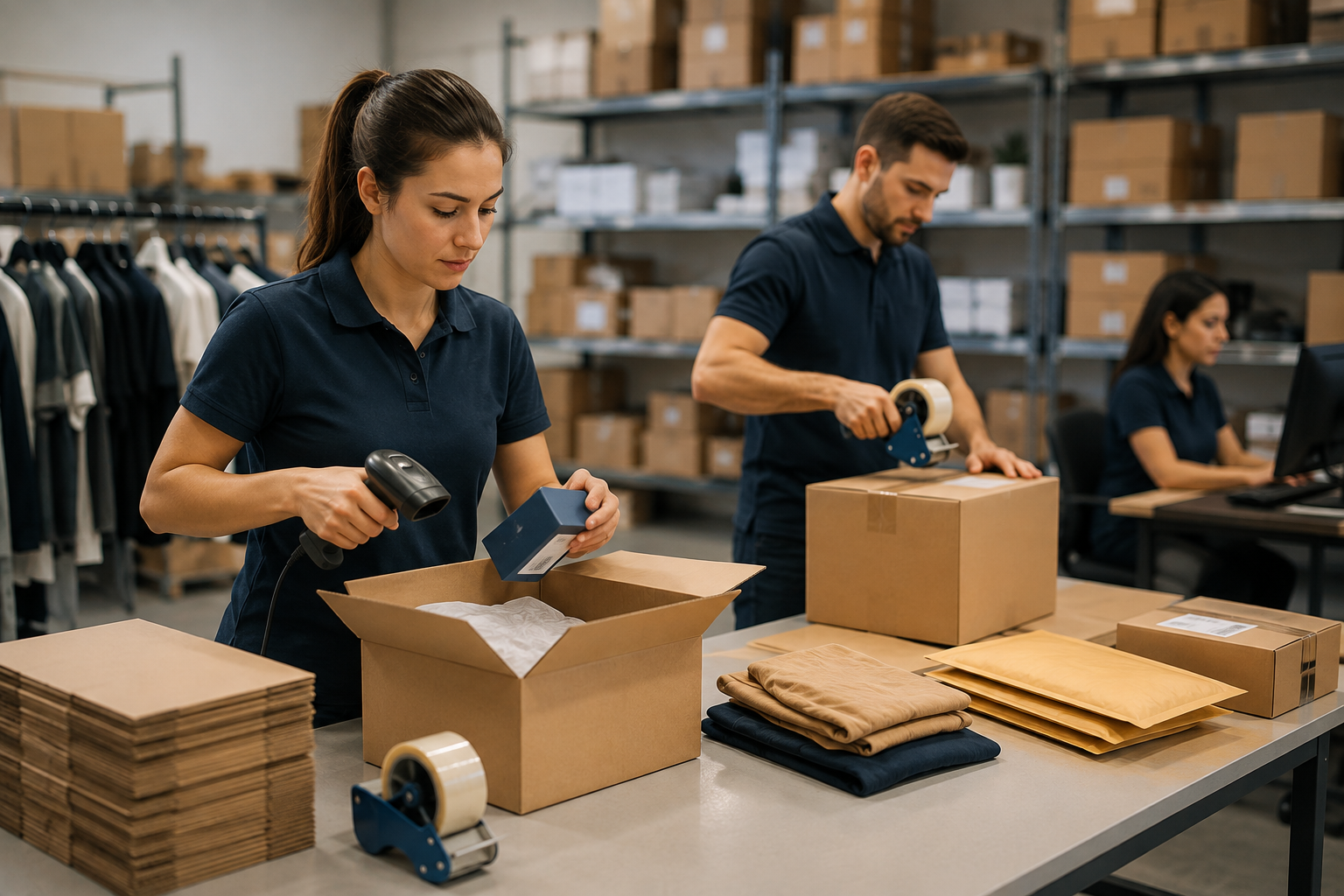
Packing staff verify the picked items against the order, select packaging sized to the contents, and add any required inserts before sealing the shipment. A short QC check at this step catches picking errors before they become a customer-facing problem.
6. The Best Carrier and Service Level Are Selected
Shipping software compares carrier rates, transit times, and service levels for each package and selects the option that meets the delivery promise at the lowest available cost, a process usually called rate shopping.
7. Delivery, Returns, and Inventory Updates Are Tracked
Tracking data flows back to the customer and the seller automatically. If the item comes back, the return is logged, inspected, and either restocked or dispositioned, and the inventory count updates without a manual spreadsheet step.
Core Fulfillment Center Operations and Services
Each of the following functions plays a distinct role in getting an order from the dock door to the customer’s doorstep. Receiving confirms what physically arrived. Storage keeps it organized and locatable. Inventory management keeps the count accurate between receiving and shipping. Order processing turns a checkout event into a pick instruction. Picking retrieves the physical items. Packing protects them for transit. Quality control catches errors before they leave the building. Shipping selects the carrier and generates the label. Tracking gives the customer and seller visibility after the package leaves. Returns brings items back into sellable inventory when a customer sends something back.
Kitting, Labeling, Custom Packaging, and Other Value-Added Services
Beyond the core pick-pack-ship flow, many fulfillment centers also assemble multi-item kits and bundles, apply compliance or marketplace-specific labels, insert branded packaging or promotional cards, and perform light assembly or repackaging. These services matter most for brands selling subscription boxes, gift sets, or marketplace-compliant products such as Amazon FBA shipments.
Why Fulfillment Centers Matter for Ecommerce
Faster Order Processing and Delivery
Dedicated picking and packing infrastructure, combined with carrier cutoff awareness, shortens the time between an order being placed and a label being generated.
Higher Order and Inventory Accuracy
Barcode scanning and system-driven picking reduce the chance that a customer receives the wrong item or quantity, and they keep on-hand counts closer to what is physically in the building.
Lower Infrastructure and Shipping Costs
A brand avoids the capital cost of leasing and equipping its own warehouse, and shared carrier volume across a fulfillment provider’s client base can reach rate tiers a single small shipper would not get on its own.
Flexible Capacity During Growth and Seasonal Peaks
Storage and labor can expand for a launch or a holiday peak and contract again afterward, without the brand carrying the fixed cost of excess space or staff year round.
A Better Post-Purchase Customer Experience
Accurate, on-time delivery and a straightforward returns process directly shape whether a customer buys again, since the unboxing and delivery experience is often the only physical touchpoint a purely online brand has with its customer.
Technology Used Inside a Fulfillment Center
Warehouse Management Systems (WMS)
The WMS is the operational backbone: it tracks every unit’s location, manages putaway and picking logic, and produces the inventory data that everything else in the building depends on.
Order Management Systems and Ecommerce Integrations
The OMS connects to Shopify, Amazon, Walmart, and other sales channels so that an order placed on any platform lands in the same fulfillment queue, instead of requiring separate manual handling per channel.
Inventory Tracking, Barcodes, and Scanning
Barcode or SKU scanning at each touchpoint (receiving, putaway, picking, packing) creates a transaction record that keeps the WMS count aligned with physical reality and makes discrepancies traceable to a specific step.
Robotics, Conveyors, and Automated Storage Systems
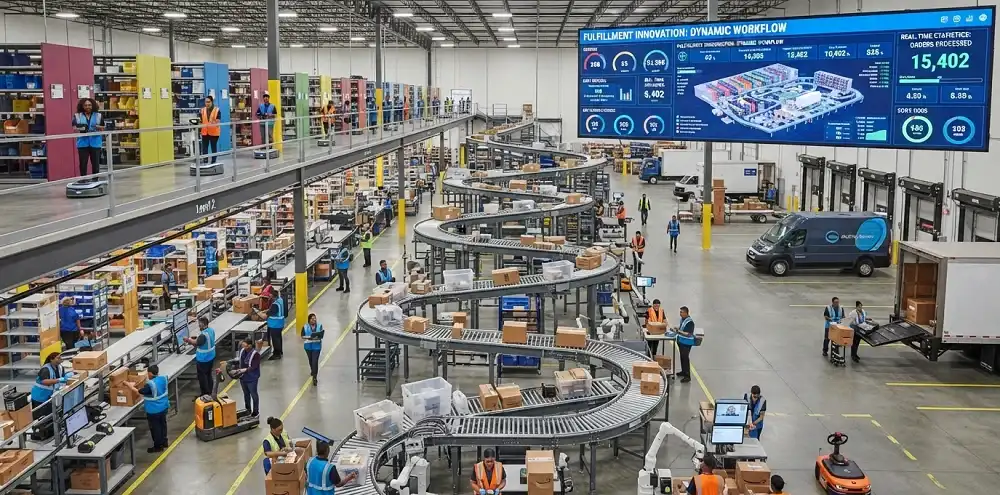
Larger or higher-volume operations may use conveyors, automated storage and retrieval systems, or mobile robots to move inventory and reduce walking time. This kind of automation raises throughput and picking efficiency, though many mid-size fulfillment centers still rely on well-organized manual picking, which can be just as accurate at lower volumes.
Real-Time Analytics and Operational Visibility
Dashboards built on WMS and OMS data give both the fulfillment provider and the brand visibility into order status, inventory levels, and shipping performance without waiting on a manual report.
Fulfillment Center Best Practices
Demand-based slotting keeps travel time and labor cost down by placing high-velocity SKUs closest to packing stations. Accurate, frequent inventory counts prevent the stockouts and overselling that damage customer trust. Batch or zone picking raises throughput during high-volume periods without adding proportional labor. Consistent packaging standards protect product condition and control dimensional-weight shipping cost. Structured quality control at pick and pack catches errors before a customer ever sees them. Active carrier coordination, including realistic cutoff times and service-level selection, keeps delivery promises accurate instead of aspirational.
Common Fulfillment Center Challenges
Capacity, Space Utilization, and Labor Planning
Seasonal spikes and unpredictable growth make it hard to size storage and staffing correctly; too little capacity causes delays, too much sits idle and costs money.
Inventory Accuracy and Order Errors
Even with a WMS, physical miscounts, mislabeled locations, and human picking errors can drift inventory records away from what is actually on the shelf if reconciliation is not routine.
Technology Integration and Limited Visibility
Poorly connected systems between the sales channel, OMS, and WMS can create blind spots where a brand does not know an order is stuck until a customer complains.
Third-Party Control, Service Quality, and Compliance
Outsourcing fulfillment means giving up some direct control over how orders are handled, so service quality, communication, and adherence to safety and shipping regulations become dependent on choosing the right partner.
Types of Fulfillment Centers
In-House vs. Third-Party Fulfillment Centers
An in-house fulfillment center is operated and staffed entirely by the brand, giving full control but requiring the brand to build its own systems, staff, and carrier relationships. A third-party fulfillment center is run by a 3PL on behalf of multiple client brands, trading some direct control for shared infrastructure and faster setup.
Dedicated vs. Multi-Client Fulfillment Centers
A dedicated facility serves a single large brand exclusively, which is common at very high volumes. A multi-client facility serves several brands out of the same building, sharing labor, equipment, and often carrier rates across accounts.
Regional, Distributed, and Micro-Fulfillment Centers
A single central facility keeps operations simple but adds shipping distance for customers far from it. A distributed network of regional facilities places inventory closer to customers to cut transit time and cost. Micro-fulfillment centers take this further with small, urban-located footprints built for very fast local delivery.
Fulfillment Center vs. Warehouse, Distribution Center, and 3PL
| Facility | Primary Function | Typical Order Type | Storage Duration | Who It Serves | Core Technology |
|---|---|---|---|---|---|
| Fulfillment Center | Pick, pack, and ship individual customer orders | Small, single-unit ecommerce orders | Short (fast turnover) | Direct-to-consumer brands | WMS, OMS, barcode scanning |
| Warehouse | Store goods for extended periods | Bulk storage, occasional large moves | Long | Manufacturers, wholesalers, retailers | Inventory management, racking systems |
| Distribution Center | Move bulk shipments to retail or business locations | Large, palletized orders | Medium (transit-focused) | Retail chains, B2B buyers | WMS, transportation management |
| 3PL | Outsourced logistics services broadly, often including fulfillment | Varies by service (storage, freight, fulfillment) | Varies | Any business outsourcing logistics | Combination of WMS, TMS, and carrier systems |
Fulfillment Center vs. Warehouse
A warehouse is built to hold inventory for long periods with infrequent bulk movement. A fulfillment center is built to move small quantities out quickly and accurately. See our detailed comparison in Fulfillment Center vs. Warehouse for a full breakdown by function, cost, and use case.
Fulfillment Center vs. Distribution Center
A distribution center consolidates and reroutes bulk shipments, typically to stores or other businesses, rather than picking individual items for end consumers. A fulfillment center’s unit of work is the single customer order, not the pallet.
Fulfillment Center vs. 3PL
A fulfillment center is a type of facility. A 3PL is a service provider category that may operate fulfillment centers alongside other logistics services such as freight brokerage or transportation management. Most ecommerce brands working with a 3PL are specifically using its fulfillment center capability.
How Much Does a Fulfillment Center Cost?
Common Fulfillment Center Fees
Pricing is typically built from several line items rather than one flat rate: receiving fees for inbound inventory, storage fees (often billed per pallet, bin, or unit), pick and pack fees per order or per additional item, packaging material charges, outbound shipping cost plus any carrier markup, returns processing fees, and account management or minimum monthly fees. Kitting, labeling, and other value-added services are usually priced separately based on labor time.
Factors That Affect Total Fulfillment Cost
Total cost depends on order volume and growth trajectory, SKU count and complexity, product dimensions and weight, how long inventory sits before selling, seasonality and peak volume swings, shipping geography and carrier zones, and any special handling such as fragile items, kitting, or compliance labeling. A provider needs this operating profile before quoting an accurate price, which is why credible fulfillment partners ask detailed discovery questions before naming a number.
When Does an Ecommerce Business Need a Fulfillment Center?
Signs It Is Time to Outsource Fulfillment
Common triggers include order volume outgrowing available space or staff, rising picking or shipping errors, orders consistently shipping later than promised, difficulty absorbing seasonal peaks without hiring temporary labor, and expansion into new geographic markets where a single warehouse location no longer serves customers efficiently.
When In-House Fulfillment May Still Make Sense
Very low order volume, highly specialized handling requirements the brand wants to control directly, or a business model built around in-person or hybrid retail can all make in-house fulfillment the more practical choice, at least until volume or complexity changes that calculation.
How to Choose the Right Fulfillment Center
Locations and Distance to Your Customers
Facility location affects transit time and shipping zone cost, so it should be evaluated against where the actual customer base is concentrated, not just where a facility happens to be available.
Technology and Integration Capabilities
Confirm the provider’s WMS and OMS integrate directly with your sales channels, since manual data reconciliation between systems is a common source of order delays and inventory discrepancies.
Product, Channel, and Special-Handling Experience
A provider with direct experience in your product category and sales channels (Amazon FBA prep, Shopify D2C, B2B, kitting) will already have the workflows built rather than improvising them on your account.
Peak Capacity and Scalability
Ask specifically how the provider staffs and allocates space during peak season, since generic assurances of flexibility mean less than a concrete plan for labor and storage during your highest-volume month.
Service Levels, Reporting, and Performance Accountability
Look for clear service-level commitments on metrics like order accuracy and same-day shipping, along with regular reporting, rather than only anecdotal claims of reliability.
Transparent Total Cost, Contract Terms, and Support
Compare full landed fulfillment cost, not just the headline pick fee, and review contract terms for liability, termination, and support responsiveness before signing.
Fulfillment Center KPIs to Track
| KPI | What It Measures |
|---|---|
| Order Accuracy | The share of orders shipped with the correct items and quantities, with no picking or packing errors |
| Inventory Accuracy | How closely the WMS-recorded stock count matches the physical count on the shelf |
| Order Cycle Time | The time between an order being placed and the shipping label being generated |
| Same-Day Shipping Rate | The percentage of orders received before cutoff that ship the same day |
| On-Time Shipping | The percentage of orders that ship within the committed service window |
| Cost per Order | The total fulfillment cost (labor, packaging, and applicable fees) divided by orders shipped |
| Return Processing Time | The time between a return arriving at the facility and its disposition (restock, disposal, or other) being completed |
How Fulfillment Centers Support Last-Mile Delivery
Carrier Selection, Delivery Promises, and Shipment Tracking
Because a fulfillment center generates the label and hands the package to the carrier, it directly controls which service level is chosen and how realistic the delivery promise shown to the customer actually is. Coordinated tracking updates flowing back through the OMS keep both the seller and the customer informed without a manual status check.
Returns Processing as Part of the Delivery Experience
A return is the second half of the delivery experience, not a separate process. How quickly a returned item is inspected, restocked, or dispositioned affects both inventory accuracy and how fast a customer receives a refund or replacement.
How Ecom Auto Prep Supports Ecommerce Fulfillment
Receiving, Storage, Prep, Order Fulfillment, Shipping, and Returns
Ecom Auto Prep operates an ambient Class A fulfillment facility in Coral Springs, Florida, supporting direct-to-consumer fulfillment, Amazon FBA prep and FBM, and Walmart, eBay, and TikTok Shop order fulfillment from a single inventory pool. Inbound handling covers parcel, LTL, FTL, and container receiving with SKU verification and damage inspection before putaway. Storage uses a mix of pallet, pick-face, and bin locations assigned by product velocity. Value-added services include kitting, bundling, FNSKU and compliance labeling, poly-bagging, bubble wrapping, custom inserts, and inspection. Returns are received, inspected, and restocked or dispositioned back into inventory. Outbound orders ship through multiple parcel carriers selected on cost, reliability, and delivery performance rather than label price alone. Get in touch for a review of your current volume and product profile and a fulfillment plan built around your actual operation.
Talk to the Team That Actually Runs Your Fulfillment
If receiving delays, storage costs, or shipping errors are quietly costing you customers, talk directly to the team that runs the warehouse floor. You can get a quote for your current order volume, schedule a meeting with our operations team to walk through your workflow, or request a service pricing breakdown built around your real SKU count and shipping profile.
FAQ
What is a fulfillment center in simple terms?
A fulfillment center is a warehouse that receives a brand’s inventory and handles picking, packing, and shipping each customer order as it comes in, rather than storing goods for long-term bulk distribution.
What does a fulfillment center do?
It receives and stores inventory, processes incoming orders, picks and packs individual items, selects a shipping carrier, and manages returns, all tracked through connected inventory and order management systems.
How does a fulfillment center process an order?
An order placed on a sales channel flows into the order management system, which assigns a pick priority. Warehouse staff pick the items, pack and quality check them, and a shipping label is generated before the package is handed to a carrier.
What is the difference between a fulfillment center and a warehouse?
A warehouse is built for long-term bulk storage with infrequent large shipments. A fulfillment center is built for fast, accurate processing of individual customer orders with short inventory dwell time.
Is a fulfillment center the same as a 3PL?
Not exactly. A fulfillment center is a type of facility, while a 3PL is a logistics service provider that may operate one or more fulfillment centers along with other services such as freight coordination.
How much does it cost to use a fulfillment center?
Cost is typically built from receiving, storage, pick and pack, packaging, shipping, and returns fees, and it varies based on order volume, SKU count, product size, and any special handling required. A provider needs your operating details to quote an accurate rate.
When should an ecommerce business use a fulfillment center?
It generally makes sense once order volume outgrows available space or staff, errors or late shipments start increasing, seasonal peaks become hard to staff for, or the business expands into new regions a single in-house location cannot serve efficiently.