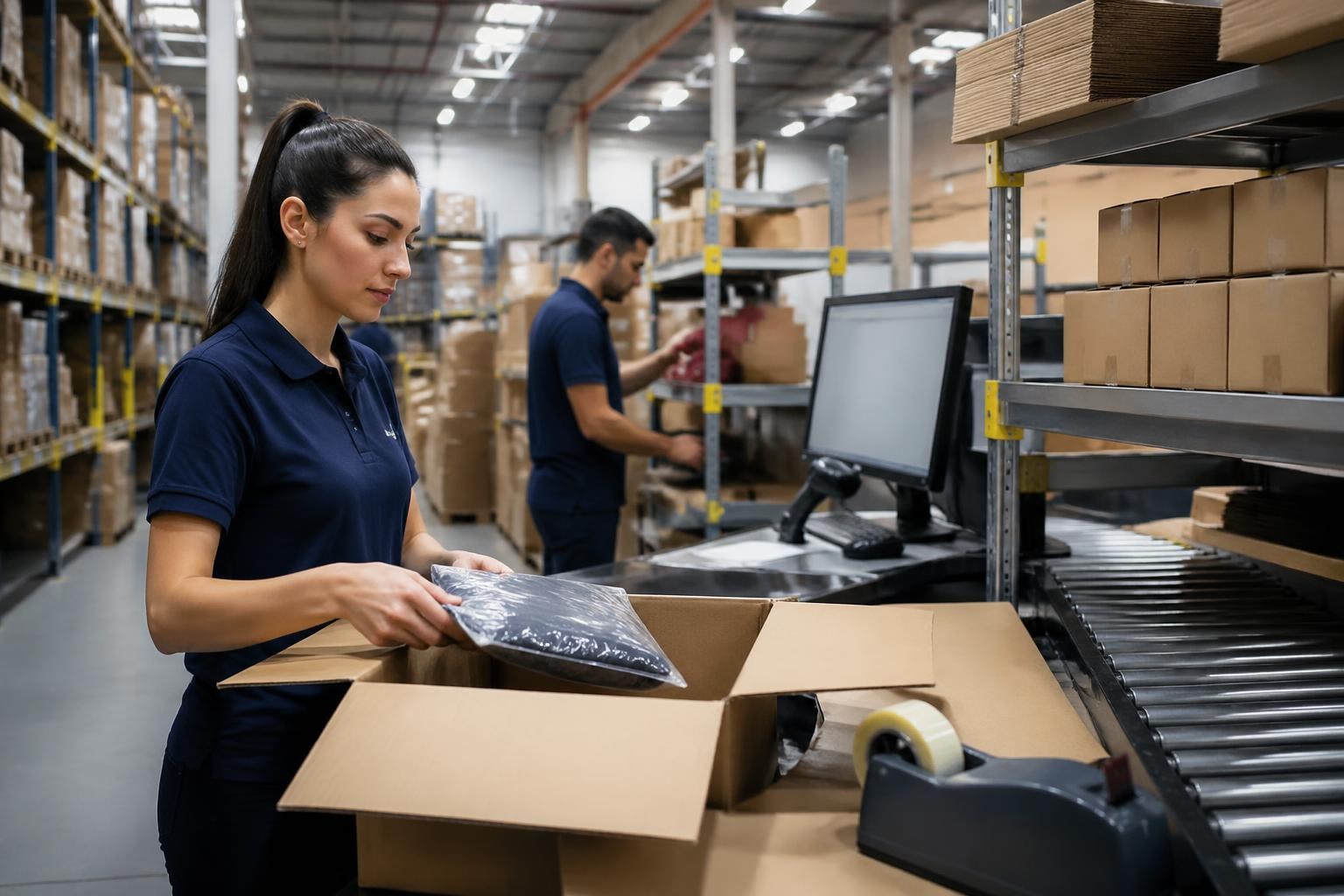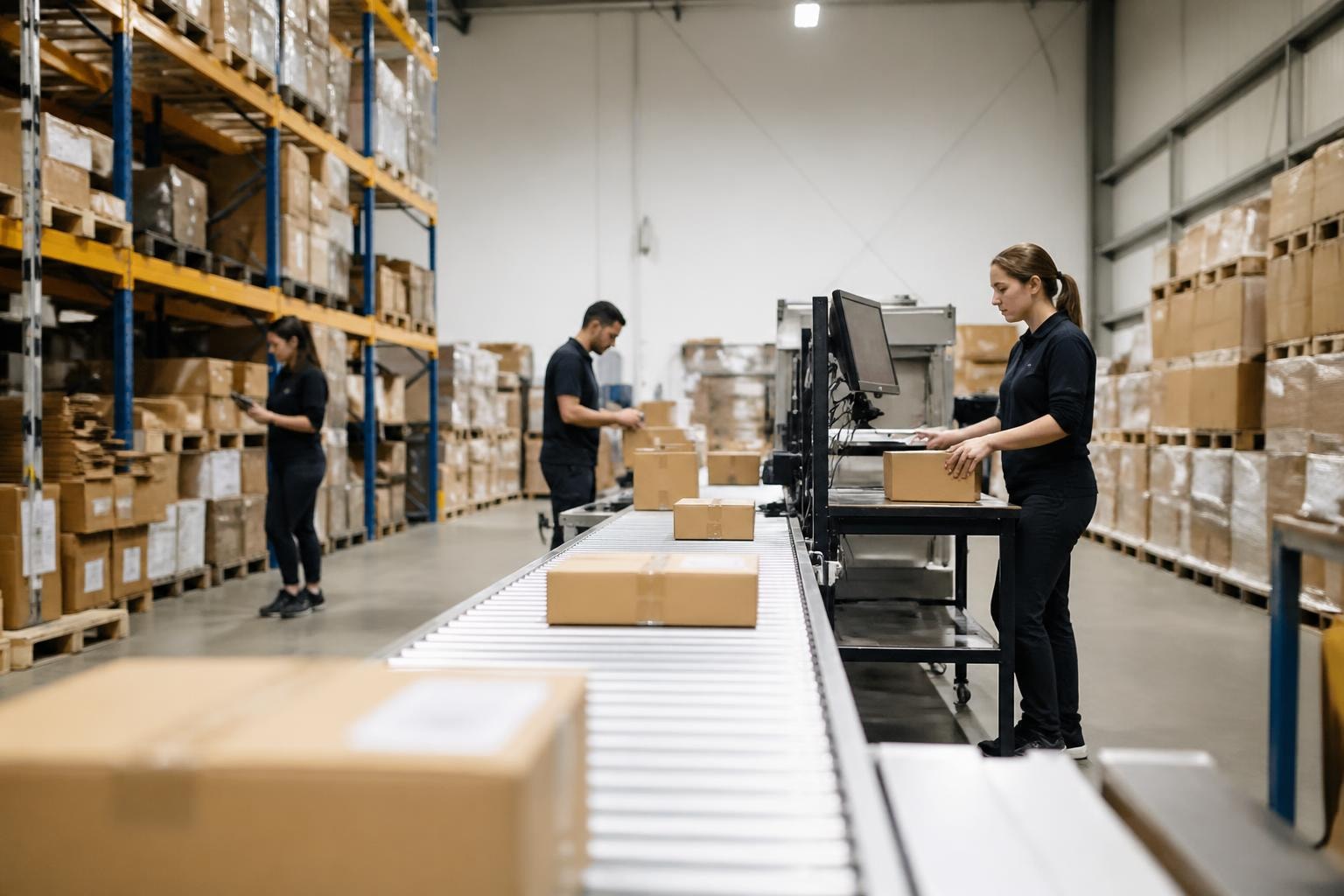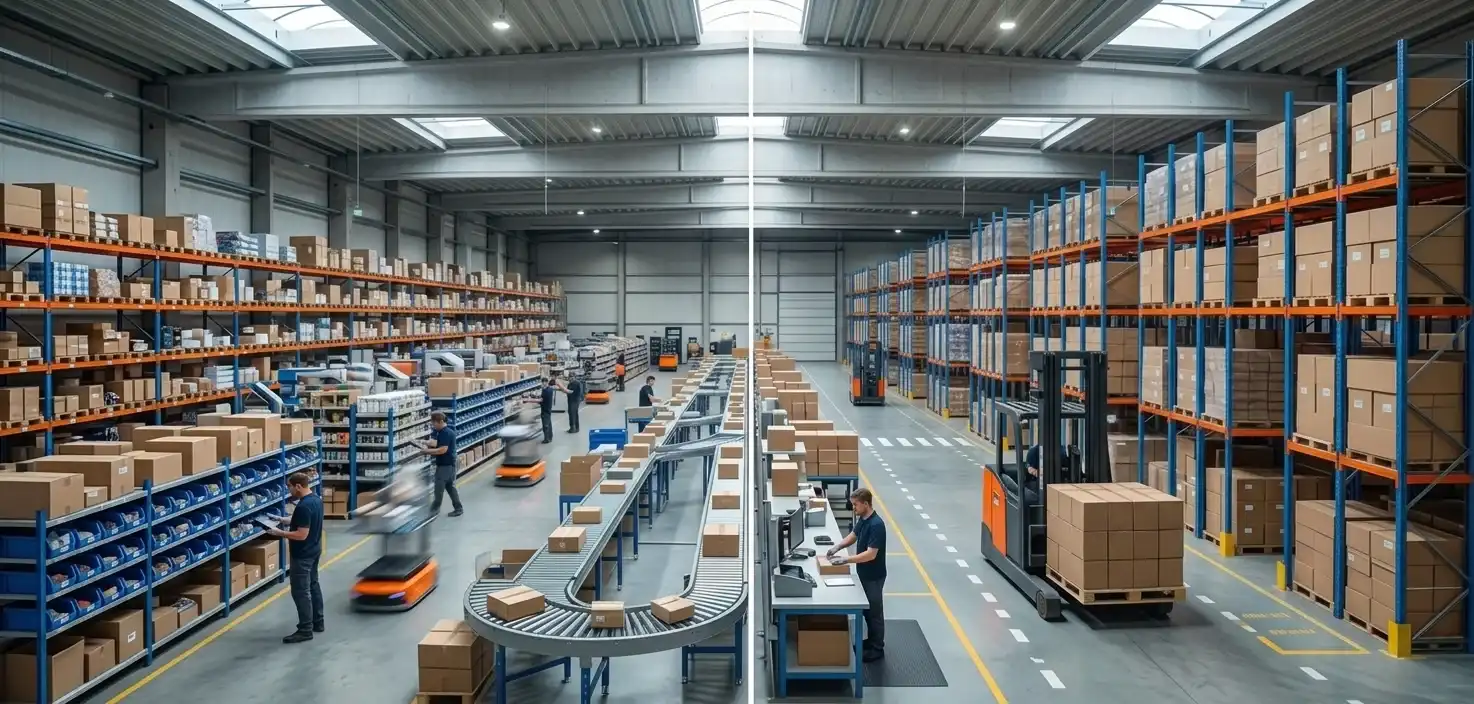

A fulfillment center and a warehouse are not the same thing, even though the terms get swapped constantly in ecommerce conversations. The warehouse vs fulfillment center question comes down to one core fact: a warehouse holds inventory, a fulfillment center moves it. That single distinction changes how each facility is laid out, staffed, priced, and integrated with your sales channels.
This guide breaks down the fulfillment center vs warehouse differences by purpose, storage duration, order type, operations, technology, shipping, and cost, then helps you decide which model, or combination of both, fits your ecommerce or B2B operation.
Fulfillment Center vs. Warehouse: Side-by-Side Comparison
The table below covers the fastest way to separate the two models. The sections that follow expand on why each difference exists operationally, without repeating the same point twice.
| Aspect | Warehouse | Fulfillment Center |
|---|---|---|
| Primary purpose | Long-term or bulk inventory storage | Rapid order processing and shipping |
| Storage duration | Weeks to months, sometimes longer | Days to a few weeks, high turnover |
| Order type | Pallets, cases, bulk B2B shipments | Individual B2C/DTC orders, smaller B2B orders |
| Picking method | Pallet or case picking | Each-picking, batch and zone picking |
| Technology focus | Inventory and location control | WMS/OMS, channel integrations, order routing |
| Shipping cadence | Scheduled LTL/FTL freight | Daily parcel cutoffs and carrier pickups |
| Pricing basis | Space and pallet rate, handling fees | Storage plus per-order and per-pick activity |
Purpose and Inventory Storage Duration
A warehouse exists to hold inventory efficiently, not to move it quickly. Products can sit for months, which works for raw materials, overstock, or seasonal goods that do not need to reach a customer this week. A fulfillment center is built around the opposite goal: rapid order fulfillment and short-term, high-turnover inventory. Stock moves in, gets picked against live orders, and moves out again within days. If your product sits on a shelf for six months before selling, that is a warehousing problem. If it needs to leave the building within 24 to 48 hours of an order, that is a fulfillment problem.
Order Type and End Recipient
Warehouses typically move pallets and cases to manufacturers, distributors, wholesalers, or retailers. The recipient is a business, and the shipment is bulk. Fulfillment centers process individual B2C/DTC orders and smaller B2B orders, shipping single units or small multi-item boxes directly to an end customer’s door. This is the clearest operational fork: one facility type is built around the pallet, the other around the individual SKU.
Operations, Layout, and Picking Methods
Warehouse layouts maximize storage density: tall racking, deep bays, and wide aisles built for forklifts moving full pallets. Fulfillment center layouts are order-driven, and slotting follows pick speed rather than storage density, with the fastest-moving SKUs placed in the most pick-speed-accessible locations, often called the golden zone. Picking itself happens by each, batch, or zone. A warehouse is optimized for how much it can hold. A fulfillment center is optimized for how fast a single item can leave the shelf and reach a packing station.
Technology and Ecommerce Integrations
A warehouse mainly needs inventory and location control: knowing what is on which pallet, in which bay. A fulfillment center needs that plus a WMS/OMS connected to sales channels, since orders arrive continuously from Shopify, Amazon, Walmart, eBay, or TikTok Shop and must route to the right pick queue in real time, with tracking flowing back to the customer automatically. The integration layer is what makes same-day and next-day shipping promises possible at scale.
Shipping, Returns, and Value-Added Services
Fulfillment centers run on daily parcel cutoffs. Orders received before a set time ship the same day through carriers like UPS, FedEx, USPS, or regional networks, and the facility also handles returns, kitting, and labeling as standard services. Warehouses ship on a different rhythm: scheduled LTL or FTL freight, planned days in advance, prioritizing full-truck efficiency over same-day speed. Returns and kitting are not core warehouse functions; they belong to the fulfillment side of the business.
Pricing Model and Best Fit
Warehouse pricing is built around space and pallet rate plus handling fees, so cost scales with how much you store, not how often you ship. Fulfillment pricing is built around storage plus per-order activity, so cost scales with order volume and pick complexity. The right comparison is not which rate is lower but total landed cost for your actual volume: a business with heavy storage and light shipping usually pays less through a warehouse rate; a business shipping thousands of small orders monthly usually pays less through a fulfillment structure, even with a higher per-pick fee, because parcel efficiency and accuracy reduce downstream costs.
What Is a Warehouse?
Purpose and Typical Warehouse Operations
A warehouse is a facility built for bulk or long-term storage rather than order-by-order shipping. Typical operations include pallet receiving and putaway, high-density storage, cycle counting, and occasional bulk outbound shipments to a manufacturer, distributor, or retail location. Activity is comparatively static: inventory moves in, gets stored, and moves out in large quantities, without the constant order flow that defines a fulfillment operation.
What Is a Fulfillment Center?
Purpose and Services Performed Inside a Fulfillment Center
A fulfillment center handles the full order lifecycle: intake, picking, packing, labeling, shipping, tracking, returns, and value-added services like kitting or FNSKU labeling. It is built for continuous order flow rather than static storage, with layout and technology tuned to move individual items quickly and accurately.
Which Model Is Better for Your Business?
Choose a Warehouse for Long-Term or Bulk Storage
A warehouse is the right fit when the problem is space, not speed. That includes slow-moving inventory, seasonal overflow ahead of a peak period, raw materials awaiting production, or finished goods staged as an upstream inventory buffer before they move downstream to a fulfillment operation or retail partner.
Choose a Fulfillment Center for Frequent Customer Orders
This is the right setup when orders arrive continuously and customers expect fast delivery. It fits ecommerce and DTC brands, multi-item orders, high inventory turnover, and businesses that need organized returns handling rather than returns piling up unprocessed.
Can a Business Use Both a Warehouse and a Fulfillment Center?
Yes, and for growing brands this is common rather than exceptional. A warehouse can serve as an upstream inventory buffer, holding bulk stock cost-effectively, while a connected fulfillment operation draws from a shared inventory pool to serve both DTC orders and retail distribution, an omnichannel setup that avoids stranding inventory in one channel while another runs short. It also lets a single WMS give visibility across both storage and shipping activity instead of managing two disconnected systems.
Where Does a Distribution Center Fit?
A distribution center sits between the two, built for fast throughput rather than long-term holding. It handles bulk retail and wholesale redistribution, cross-docking, and consolidation, breaking large inbound shipments into smaller outbound ones for stores, wholesalers, or downstream fulfillment operations. It does not typically ship to individual consumers, and a fulfillment center does not typically ship to another fulfillment center, so the flow generally runs one direction: distribution center first, fulfillment center second. Because speed and volume matter more than storage density, a distribution center often switches transport modes mid-route, receiving a shipment by rail or ocean freight and releasing it by truck or air to reach the next node faster. If a warehouse answers where to store this, and a fulfillment center answers how to get this to one customer fast, a distribution center answers how to move this efficiently to the next stop in the chain.
Questions to Ask a Fulfillment or Warehousing Provider
Checklist: Provider Evaluation Checklist
- Which sales channels and platforms does the provider integrate with directly?
- What are the daily order cutoff times and shipping SLAs?
- How is inventory and picking accuracy tracked, and how are discrepancies investigated?
- How does the facility handle peak-season volume without service slipping?
- What is the returns process, from receipt to restock or disposition?
- What are the fee structure, storage minimums, and contract terms?
How Ecom Auto Prep Supports Ecommerce Fulfillment and Storage
Ecom Auto Prep operates from a Class A industrial facility in Coral Springs, Florida, supporting both fulfillment and storage needs under one roof. Services include direct-to-consumer fulfillment, Amazon FBA prep, Walmart, eBay, and TikTok Shop fulfillment, B2B and wholesale order handling, kitting and bundling, returns processing, and pallet and bin storage on an ambient, non-temperature-controlled basis. Inventory runs through the Packiyo WMS with channel integrations for real-time order routing, and the team works directly with clients on receiving, inspection, and relabeling rather than routing every request through a support queue.
FAQ
What is the main difference between a fulfillment center and a warehouse?
A warehouse stores inventory in bulk for an extended period. A fulfillment center processes individual customer orders quickly, handling picking, packing, shipping, and returns as part of continuous daily activity.
Can a warehouse fulfill ecommerce orders?
Not efficiently in most cases. A traditional warehouse lacks the each-picking layout, parcel carrier cadence, and order-routing technology that ecommerce fulfillment requires, so bulk-storage warehouses typically hand off to a fulfillment operation for individual order shipping.
Is a fulfillment center more expensive than a warehouse?
Not automatically. Warehouse pricing is based on space and pallet rate, which is cheaper for pure storage. Fulfillment pricing includes per-order activity, which costs more per unit stored but reduces total cost for businesses shipping frequent individual orders, since it eliminates the need for separate in-house pick, pack, and shipping labor.
Should an ecommerce business use a warehouse or fulfillment center?
Most ecommerce and DTC businesses need a fulfillment center, since orders ship individually and customers expect fast delivery. A warehouse becomes relevant alongside it once the business also carries bulk, seasonal, or upstream inventory that does not need to move order by order.
How is a distribution center different from both?
A distribution center moves bulk shipments to retail stores and wholesale partners through cross-docking and consolidation, rather than holding inventory long-term like a warehouse or shipping to individual consumers like a fulfillment center.
Ready to Match Your Inventory to the Right Facility Model
The wrong facility setup slows down orders and raises cost per shipment. Ecom Auto Prep runs ambient warehousing and ecommerce fulfillment from one Coral Springs facility, giving growing brands storage and shipping under one roof. Get a quote for your order volume, schedule a meeting with our team, or request a service pricing breakdown before switching providers.