


The rapid growth of e-commerce has created unprecedented opportunities for online sellers, but managing Amazon FBA operations manually can quickly become overwhelming. Amazon FBA automation represents a strategic approach to streamlining your fulfillment processes, reducing operational overhead, and scaling your business efficiently. By implementing automated systems and workflows, e-commerce brands can focus on strategic growth initiatives while maintaining consistent, reliable fulfillment operations that meet Amazon's stringent requirements.
Understanding Amazon FBA Automation Fundamentals
Amazon FBA automation encompasses both technology-driven solutions and professional services designed to minimize manual intervention in your fulfillment workflow. At its core, automation in FBA operations involves systematizing repetitive tasks such as inventory management, order processing, and compliance documentation to improve accuracy and efficiency.
The automation landscape divides into two primary categories: software tools and managed services. Software solutions provide platforms for automating specific tasks like repricing, inventory tracking, and listing optimization. These tools integrate with Amazon's systems to execute predefined rules and workflows without constant manual oversight.
Automation Tools vs. Managed Services
Managed services take a comprehensive approach, where specialized providers handle entire aspects of your FBA business. This includes product sourcing, inventory preparation, quality control, and shipment coordination. Understanding what Amazon FBA automation truly entails helps sellers determine which approach aligns with their operational needs and growth objectives.
Key differences between automation approaches:
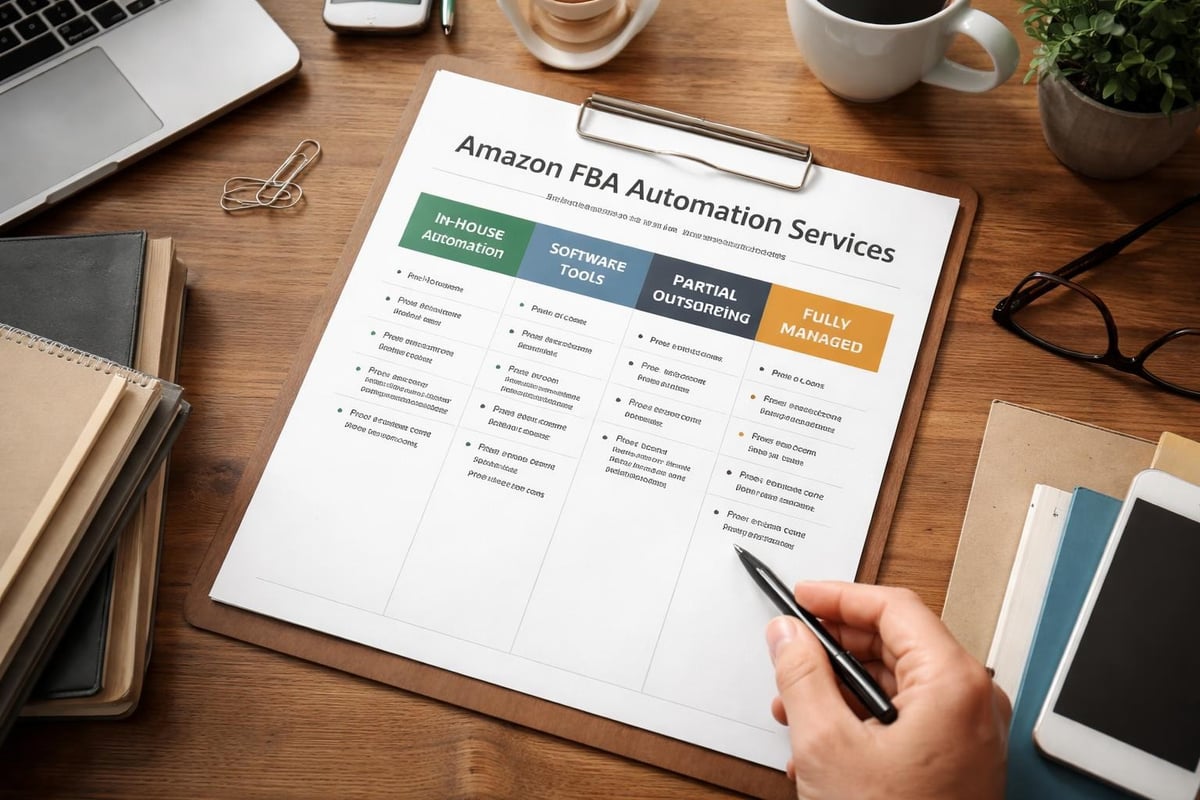
- Software Tools: Require initial setup and ongoing monitoring, provide granular control, typically subscription-based pricing
- Managed Services: Hands-off operation, comprehensive support, percentage-based or fixed-fee pricing models
- Hybrid Solutions: Combine technology platforms with expert oversight for balanced control and convenience
Strategic Benefits of Automating FBA Operations
Implementing amazon fba automation delivers measurable advantages across multiple operational dimensions. Time savings represent the most immediate benefit, as automation eliminates hours spent on routine tasks like manually updating inventory counts or creating shipment plans. This reclaimed time allows business owners to focus on product development, marketing strategies, and customer relationship building.
Error reduction constitutes another critical advantage. Manual data entry and processing create opportunities for costly mistakes, from incorrect shipment labels to inventory discrepancies that trigger Amazon penalties. Automated systems execute tasks consistently according to programmed parameters, significantly reducing human error rates.
Scalability and Growth Acceleration
As order volumes increase, manual processes quickly reach capacity limits. Amazon fba automation provides the infrastructure necessary to handle growth without proportional increases in labor costs or operational complexity. A fulfillment operation that once required constant monitoring can scale to 10x volume with minimal additional oversight when properly automated.
| Operational Metric | Manual Process | Automated Process | Improvement |
|---|---|---|---|
| Order Processing Time | 8-12 minutes | 2-3 minutes | 70-75% reduction |
| Error Rate | 3-5% | 0.5-1% | 80% reduction |
| Inventory Accuracy | 92-95% | 98-99% | 3-5% improvement |
| Labor Cost per Order | $4.50-$6.00 | $1.50-$2.50 | 60% reduction |
Financial optimization extends beyond labor savings. Automated inventory management prevents stockouts that cost sales opportunities while avoiding overstocking that ties up capital in slow-moving inventory. Predictive algorithms analyze sales velocity and seasonal patterns to recommend optimal reorder points and quantities.
Essential Components of an Automated FBA System
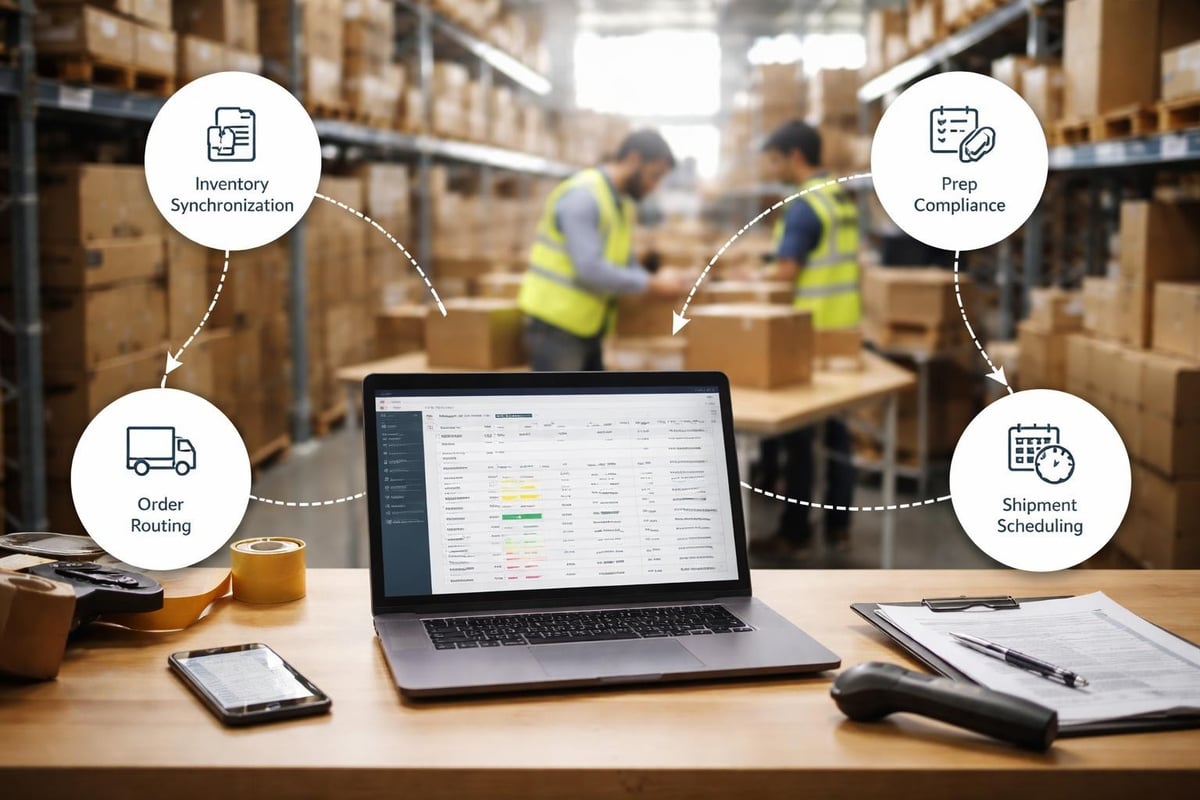
Building an effective amazon fba automation framework requires integrating several key components that work together seamlessly. Inventory management automation forms the foundation, synchronizing stock levels across multiple sales channels and triggering reorder notifications when quantities fall below predetermined thresholds.
Critical automation components include:
- Inventory synchronization systems that update stock levels in real-time across all platforms
- Automated repricing engines that adjust pricing based on competitive dynamics and profit targets
- Shipment creation workflows that generate compliant FBA shipments with proper labeling and documentation
- Quality control protocols that verify product condition and compliance before shipment
- Performance monitoring dashboards that track key metrics and flag anomalies
Prep and Compliance Automation
Amazon's stringent FBA preparation requirements demand meticulous attention to detail. Products must meet specific packaging, labeling, and documentation standards to avoid rejection or additional fees. Professional Amazon prep services automate these compliance tasks, ensuring every shipment meets Amazon's current requirements without requiring sellers to track constantly evolving guidelines.
Automated prep workflows include barcode application, polybagging, bubble wrapping, and carton configuration optimized for Amazon's dimensional weight pricing. Integration with Amazon's systems ensures that shipment plans reflect current warehouse capacity and routing requirements, minimizing receiving delays.

Implementing Automation for Different Business Models
The optimal amazon fba automation strategy varies significantly based on your business model and operational scale. Private label sellers face different challenges than wholesale distributors or retail arbitrage operations, requiring tailored automation approaches.
Private Label Automation Strategies
Private label brands typically maintain consistent product catalogs with predictable demand patterns. Automation for these sellers focuses on inventory forecasting, seasonal demand planning, and promotional campaign coordination. Integrated systems can automatically increase inventory levels before planned marketing pushes and adjust pricing strategies based on conversion data.
Product listing optimization automation continuously refines titles, bullet points, and backend search terms based on keyword performance data. A/B testing platforms automate the process of testing different creative elements and automatically implement winning variations.
Wholesale and Distribution Automation
Wholesale sellers managing hundreds or thousands of SKUs require robust automation to maintain competitive pricing and inventory availability. Understanding different e-commerce distribution approaches helps wholesalers optimize their fulfillment strategies for profitability and efficiency.
Automated repricing becomes essential in competitive wholesale categories, where profit margins depend on maintaining optimal pricing positions across multiple competitors. Advanced repricing algorithms factor in inventory levels, competitor stock availability, and historical sales data to maximize both sales velocity and profit margins.
Technology Stack for FBA Automation
Selecting the right technology infrastructure determines the success of your automation initiatives. Modern FBA automation relies on cloud-based platforms that integrate with Amazon's API to provide real-time data synchronization and automated action execution.
Essential technology components:
- Inventory management platforms that provide centralized control across multiple fulfillment channels
- Order management systems that route orders intelligently based on inventory location and shipping economics
- Analytics and reporting tools that identify trends, opportunities, and performance issues
- Integration middleware that connects disparate systems into cohesive workflows
Many sellers benefit from exploring how comprehensive fulfillment systems work to understand the full scope of automation possibilities beyond basic software tools.
| Technology Category | Primary Function | Key Features | Typical ROI Timeline |
|---|---|---|---|
| Inventory Management | Stock tracking and forecasting | Multi-channel sync, reorder automation | 2-3 months |
| Repricing Software | Dynamic price optimization | Competitor monitoring, profit rules | 1-2 months |
| Listing Optimization | SEO and conversion improvement | Keyword research, A/B testing | 3-4 months |
| Shipment Planning | FBA shipment creation | Label generation, box optimization | Immediate |
Evaluating Automation Service Providers
The growing popularity of amazon fba automation has spawned numerous service providers offering varying levels of support and expertise. Conducting thorough due diligence prevents costly partnerships with underqualified providers who make unrealistic promises.
Legitimate automation services demonstrate transparent fee structures, provide verifiable client references, and offer detailed explanations of their operational processes. Red flags include guaranteed profit claims, upfront fees without clear deliverables, and resistance to providing contract terms for review.
Critical Evaluation Criteria
When assessing potential automation partners, examine their track record with businesses similar to yours in scale and product category. Request case studies demonstrating measurable results over sustained periods. Real seller experiences with automation services provide valuable insights into provider performance and reliability.
Verify that providers maintain compliance with Amazon's Terms of Service and understand the platform's evolving requirements. Non-compliant practices may deliver short-term gains but risk account suspension with devastating long-term consequences.
Cost-Benefit Analysis of FBA Automation
Implementing amazon fba automation requires upfront investment in technology, training, or service fees. Conducting a comprehensive cost-benefit analysis ensures that automation investments generate positive returns aligned with business objectives.
Investment considerations include:
- Software subscription costs ranging from $50 to $500+ monthly depending on features and scale
- Service provider fees typically structured as percentage of revenue or fixed monthly retainers
- Initial setup and integration costs for implementing new systems
- Training expenses for staff learning new platforms and workflows
- Opportunity costs of time spent managing automation systems versus core business activities
Calculate your current operational costs per order, including labor, error-related expenses, and lost opportunity costs from time spent on manual tasks. Compare these figures against projected costs under various automation scenarios to determine the optimal investment level.
Integration with Broader Fulfillment Operations
Amazon FBA automation functions most effectively when integrated with comprehensive fulfillment strategies. Many successful e-commerce brands utilize FBA alongside other fulfillment methods, requiring coordination across multiple channels and warehouses.
Sophisticated sellers implement omnichannel fulfillment strategies that route orders to the most economical fulfillment location based on product availability, shipping destination, and carrier rates. This approach often combines FBA for prime-eligible products with direct-to-consumer fulfillment for specialty items or bundled offerings.
Multi-Channel Inventory Management
Automating inventory allocation across FBA, third-party warehouses, and direct fulfillment requires advanced orchestration systems. These platforms maintain unified inventory visibility while applying channel-specific rules for stock allocation and reordering priorities.
Consider how automation supports specialized fulfillment requirements such as subscription box fulfillment or custom kitting operations that complement your core FBA business. Integrated systems streamline operations across all fulfillment channels rather than creating operational silos.
Risk Management and Quality Control
While automation dramatically improves operational efficiency, implementing appropriate safeguards prevents automated errors from compounding into major problems. Establishing monitoring protocols and exception handling procedures ensures that automation enhances rather than replaces human oversight.
Configure automated alerts that flag unusual patterns such as sudden inventory discrepancies, pricing anomalies, or shipment rejections. Regular audits of automated processes verify that systems continue operating according to intended parameters and adapt to changing business conditions.
Maintaining Amazon Account Health
Amazon's performance metrics directly impact seller privileges and eligibility for programs like Prime and Featured Offers. Automated systems must prioritize maintaining excellent account health metrics including order defect rate, cancellation rate, and late shipment rate.
Quality control automation incorporates multiple verification checkpoints before products reach customers. This includes automated imaging systems that verify product condition, weight verification to confirm order accuracy, and barcode scanning to prevent mispicks and labeling errors.
Future Trends in FBA Automation
The amazon fba automation landscape continues evolving as artificial intelligence and machine learning capabilities advance. Predictive analytics increasingly power inventory forecasting, identifying demand patterns that human analysts might overlook and recommending optimal stock levels with greater precision.
Natural language processing enables automated customer service responses, review monitoring, and sentiment analysis that inform product development decisions. Computer vision technology automates quality inspection processes, identifying defects or packaging issues with superhuman consistency.
Emerging automation technologies include:
- AI-powered demand forecasting that incorporates external data sources like weather patterns and social media trends
- Automated product photography and listing creation using machine learning
- Blockchain-based supply chain tracking for enhanced transparency and authentication
- Robotic process automation for complex multi-step workflows
- Voice-activated warehouse management systems for hands-free operations
Understanding comprehensive approaches to Amazon automation helps sellers prepare for these technological advances and evaluate which innovations offer genuine business value versus speculative promises.
Building Internal Automation Capabilities
While many sellers leverage third-party providers, developing internal automation expertise provides long-term competitive advantages and operational flexibility. Training existing staff on automation platforms builds organizational knowledge and reduces dependence on external vendors.
Start with automating high-volume, repetitive tasks that offer clear ROI and low implementation risk. Document processes thoroughly before automating them, ensuring that automated workflows accurately replicate optimized procedures rather than perpetuating inefficient practices.
Gradually expand automation scope as teams gain confidence and expertise. This incremental approach minimizes disruption while building the technical capabilities necessary for advanced automation strategies. Streamlining the e-commerce order process provides a foundation for identifying additional automation opportunities throughout your fulfillment operations.
Successfully implementing amazon fba automation requires strategic planning, appropriate technology selection, and ongoing optimization to realize its full potential. Whether you choose software tools, managed services, or a hybrid approach, automation enables e-commerce brands to scale operations efficiently while maintaining the quality and consistency that Amazon's platform demands. Ecom Automation Prep specializes in providing comprehensive fulfillment solutions that integrate seamlessly with your automated FBA operations, offering expert prep services, multi-channel fulfillment capabilities, and scalable infrastructure designed for fast-growing e-commerce brands.