
Modern consumers expect to shop anywhere, anytime, and receive their orders through their preferred channels. This shift has transformed how e-commerce brands approach fulfillment, making omni channel ecommerce fulfillment a strategic necessity rather than a competitive advantage. Brands that successfully integrate inventory management, order processing, and shipping across multiple touchpoints create seamless experiences that drive customer loyalty and operational efficiency. Understanding how to implement and optimize these systems separates thriving e-commerce operations from those struggling to meet evolving customer demands.
Understanding Omni Channel Fulfillment Strategy
Omni channel ecommerce fulfillment represents the integration of inventory and order processing across all sales channels from centralized or distributed locations. Unlike multichannel approaches where each channel operates independently, omnichannel order fulfillment creates a unified system where inventory visibility and customer data flow seamlessly between touchpoints.
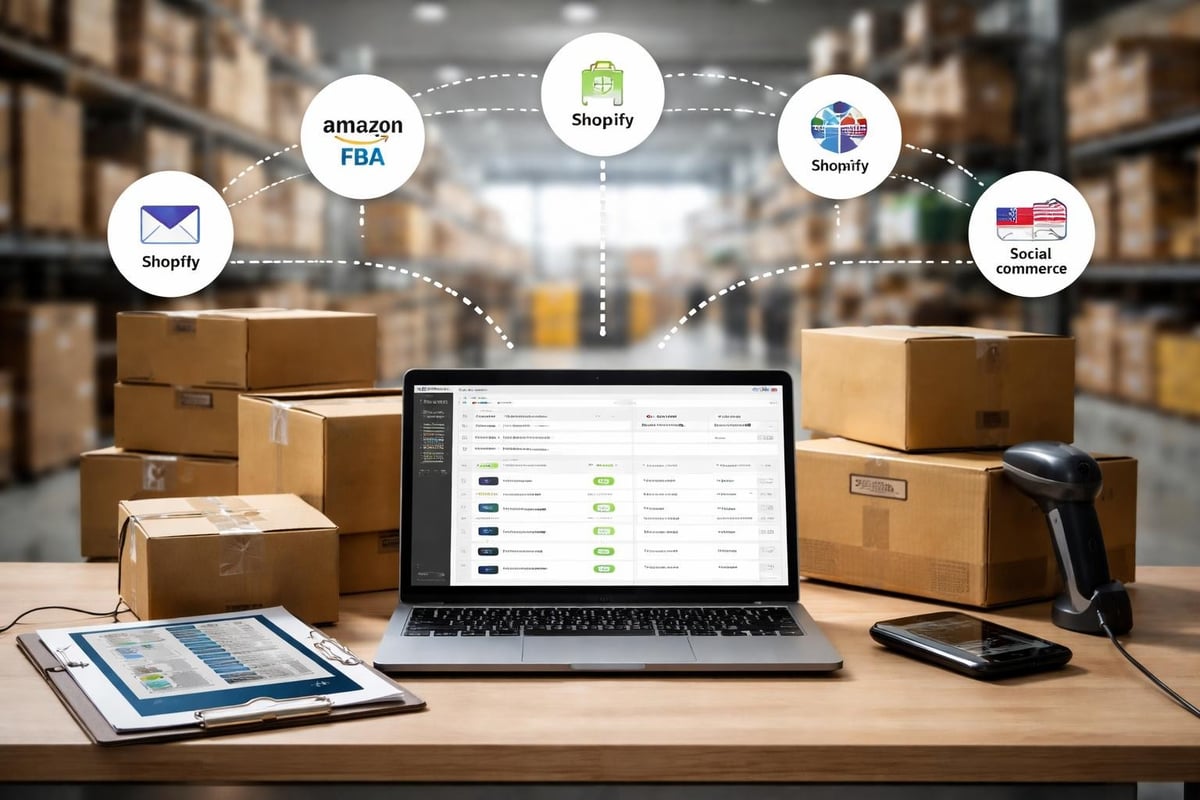
The fundamental difference lies in integration depth. Traditional multichannel selling maintains separate inventory pools for each channel, leading to overselling, stockouts, and inefficient inventory allocation. Omni channel strategies eliminate these silos by synchronizing inventory in real time across marketplaces, direct-to-consumer websites, retail locations, and social commerce platforms.
Core Components of Effective Systems
Successful omni channel ecommerce fulfillment relies on several interconnected elements:
- Unified inventory management that tracks stock levels across all locations and channels simultaneously
- Flexible order routing that directs orders to optimal fulfillment locations based on proximity, inventory availability, and cost
- Real-time data synchronization ensuring accurate inventory counts and order status across all platforms
- Integrated technology platforms connecting warehouse management systems, e-commerce platforms, and shipping carriers
- Scalable warehouse operations capable of handling diverse order types from bulk B2B to individual DTC shipments
These components work together to create responsive fulfillment networks. When a customer places an order through any channel, the system automatically identifies the best fulfillment location, reserves inventory, and initiates picking and packing processes without manual intervention.
Technology Infrastructure Requirements
Building robust omni channel ecommerce fulfillment capabilities requires significant technology investment. E-commerce fulfillment software serves as the operational backbone, connecting disparate systems and enabling real-time decision making.
Warehouse management systems (WMS) form the foundation of fulfillment operations. Modern WMS platforms provide barcode scanning, bin location management, picking optimization, and real-time inventory tracking. These systems must integrate seamlessly with e-commerce platforms, marketplaces, and enterprise resource planning (ERP) software to maintain data accuracy.
Integration Capabilities Matter
The ability to connect with multiple platforms determines operational efficiency. Leading integrations should include:
| Integration Type | Function | Business Impact |
|---|---|---|
| Shopping Carts | Shopify, WooCommerce, BigCommerce | Automated order import and inventory sync |
| Marketplaces | Amazon, eBay, Walmart | Multi-channel listing management |
| Shipping Carriers | UPS, FedEx, USPS, regional carriers | Rate shopping and label generation |
| 3PL Platforms | Shipstation, ShipBob, Deliverr | Extended fulfillment network access |
| ERP Systems | NetSuite, SAP, Microsoft Dynamics | Financial and operational reporting |
Application programming interfaces (APIs) enable these connections, allowing data to flow between systems without manual data entry. When implementing omni channel ecommerce fulfillment, prioritize platforms with robust API documentation and proven integration reliability.
Order management systems (OMS) sit above WMS platforms, orchestrating fulfillment across multiple warehouses and channels. An effective OMS evaluates order characteristics, inventory locations, shipping costs, and delivery timeframes to route each order optimally. This intelligence becomes particularly valuable during peak seasons when balancing inventory across locations maximizes fulfillment speed and minimizes shipping costs.
Inventory Management Strategies
Effective inventory management separates successful omni channel ecommerce fulfillment from costly operational failures. The challenge involves maintaining adequate stock levels across multiple locations while avoiding overstock situations that tie up capital and warehouse space.
Safety stock calculations become more complex in omni channel environments. Traditional formulas based on single-channel demand patterns fail to account for demand volatility across multiple channels. Advanced inventory planning considers:
- Channel-specific demand patterns and seasonality
- Lead times for replenishment from manufacturers or distributors
- Inventory transfer times between warehouse locations
- Marketplace-specific storage fees and restrictions
- Product velocity and profitability metrics
Distributed inventory networks offer significant advantages for omni channel operations. Rather than fulfilling all orders from a single central warehouse, strategically positioned fulfillment centers reduce shipping times and costs. Two-day ground shipping becomes achievable for most US destinations when inventory exists in East Coast, Central, and West Coast locations.
Demand Forecasting Precision
Accurate forecasting prevents stockouts and overstock situations. Machine learning algorithms analyze historical sales data across all channels, identifying patterns and predicting future demand with increasing accuracy. These systems account for:
- Seasonal trends specific to each product and channel
- Promotional impacts from planned marketing campaigns and sales events
- External factors including market trends, competitor actions, and economic conditions
- New product introductions requiring different forecasting approaches
- Product lifecycle stages from launch through maturity to decline
Fast-growing brands benefit from forecasting tools that adapt quickly to changing demand patterns. Comprehensive e-commerce fulfillment services often include inventory planning support, helping brands optimize stock levels without requiring in-house data science expertise.

Order Processing Workflows
Streamlined order processing forms the operational heart of omni channel ecommerce fulfillment. When orders arrive from multiple channels simultaneously, efficient workflows ensure accurate, timely fulfillment regardless of order source or complexity.
Order aggregation consolidates orders from all channels into a single processing queue. This approach eliminates the inefficiency of processing channel-specific batches, instead optimizing picking routes based on warehouse layout and product locations. Wave picking strategies group orders by shipping deadline, product category, or warehouse zone to maximize picker productivity.
Handling Complex Order Types
Modern fulfillment operations must accommodate diverse order characteristics:
- Standard single-item shipments requiring basic pick, pack, and ship processes
- Multi-item orders demanding careful picking accuracy and efficient packing
- Subscription box fulfillment involving recurring shipments with variable contents
- Kitting and bundling combining multiple SKUs into single sellable units
- Customization requests including gift wrapping, personalization, or special packaging
- B2B wholesale orders requiring case picking and pallet shipping
Kitting services become particularly important for brands creating product bundles or promotional sets. Professional kitting ensures consistent assembly quality while maintaining efficient throughput during high-volume periods.
Quality control checkpoints throughout the fulfillment process reduce error rates. Barcode verification at picking confirms correct item selection, while weight verification before shipping catches missing or incorrect items. These automated checks maintain accuracy rates above 99.5% even during peak volume periods.
Shipping and Last-Mile Delivery
Shipping strategy significantly impacts both customer satisfaction and operational profitability in omni channel ecommerce fulfillment. Carrier selection, service level offerings, and packaging optimization all influence the bottom line while shaping customer perceptions.
Multi-carrier shipping strategies provide flexibility and cost optimization. Rather than committing to a single carrier, sophisticated fulfillment operations negotiate rates with multiple carriers and select the optimal service for each shipment based on:
| Factor | Consideration | Impact |
|---|---|---|
| Package dimensions | Dimensional weight pricing | Carrier cost variance |
| Destination zone | Distance from fulfillment center | Transit time and cost |
| Delivery timeframe | Customer expectations | Service level selection |
| Declared value | Insurance requirements | Carrier restrictions |
| Delivery address type | Residential vs. commercial | Surcharge applicability |
Rate shopping software evaluates these factors in real time, selecting the carrier and service level that balances cost and delivery speed. This automated decision-making reduces shipping expenses by 15-30% compared to single-carrier approaches while maintaining service quality.
Sustainable Packaging Solutions
Packaging optimization reduces both costs and environmental impact. Right-sized packaging eliminates wasted space, reducing dimensional weight charges while improving the unboxing experience. Automated packaging systems measure items and construct custom boxes, though manual operations achieve similar results through standardized box size selection.
Sustainable packaging materials increasingly influence brand perception. Recyclable materials, minimal plastic usage, and compostable fill products align with consumer values while often reducing material costs. However, packaging must still protect products adequately during transit to prevent damage and returns.
Technology-driven e-commerce fulfillment incorporates these considerations systematically, ensuring every shipment balances cost efficiency with brand standards and customer expectations.
Returns Management Integration
Returns processing represents a critical yet often overlooked aspect of omni channel ecommerce fulfillment. Efficient returns handling recovers product value, maintains customer satisfaction, and generates data insights that improve product quality and reduce future return rates.
Reverse logistics requires dedicated workflows distinct from outbound fulfillment. Received returns undergo inspection to determine disposition: resalable inventory, refurbishment candidates, or liquidation. Speed matters, as delayed processing increases inventory holding costs and reduces resale value for seasonal products.
Multi-Channel Return Options
Customers expect flexible return methods across channels. Effective returns programs offer:
- Mail-in returns with prepaid shipping labels generated through customer portals
- Retail drop-off at partner locations for convenient label-free returns
- Cross-channel returns accepting online purchases at physical retail locations
- International returns with simplified customs processes and local drop-off points
- Exchange processing enabling customers to receive replacements before returning original items
These options improve customer satisfaction while controlling costs. Returnless refunds for low-value items eliminate processing costs that exceed product value, though this approach requires careful policy design to prevent abuse.
Data from returns processing identifies quality issues, sizing inconsistencies, and product description gaps. Analyzing return reasons by channel, product, and customer segment reveals opportunities to reduce return rates through improved product information, sizing guides, or quality control measures.
Scalability and Peak Season Preparation
Omni channel ecommerce fulfillment systems must scale efficiently to handle volume fluctuations. Holiday shopping seasons, promotional events, and viral product success create demand spikes that stress unprepared operations. Professional fulfillment partners provide infrastructure and expertise to navigate these challenges.
Capacity planning begins months before peak seasons. Historical data guides inventory buildup, staffing increases, and facility preparation. Leading fulfillment operations maintain surge capacity through:
- Flexible staffing models utilizing temporary workers during peak periods
- Extended operating hours adding shifts to maintain throughput without facility expansion
- Overflow partnerships with complementary fulfillment centers for exceptional volume
- Automation implementation reducing labor dependency through mechanized picking and packing
- Process optimization eliminating inefficiencies before volume intensifies
Subscription box fulfillment services exemplify scalable operations, managing predictable recurring shipments alongside variable one-time orders. This dual capability requires sophisticated planning and flexible workflows.

Measuring Performance and Continuous Improvement
Key performance indicators (KPIs) provide objective measures of omni channel ecommerce fulfillment effectiveness. Tracking these metrics identifies improvement opportunities and validates operational changes.
Essential fulfillment metrics include:
- Order accuracy rate measuring percentage of orders shipped without errors
- Average pick time indicating warehouse efficiency and layout optimization
- Shipping speed tracking time from order placement to carrier pickup
- Inventory accuracy comparing system counts to physical inventory
- Perfect order percentage combining accuracy, timeliness, and condition
- Return rate by product, channel, and reason
- Cost per order including labor, materials, and shipping
- Inventory turnover measuring how quickly stock converts to sales
Benchmark performance against industry standards and historical trends. Omni-channel e-commerce solutions providers often share anonymized performance data, enabling brands to understand competitive positioning.
Data-Driven Optimization
Regular performance reviews identify specific improvement opportunities. Weekly operational meetings examine KPI trends, investigate anomalies, and implement corrective actions. Monthly strategic reviews assess broader trends and guide long-term investments in technology, facilities, or processes.
A/B testing applies to fulfillment operations just as it does to marketing. Testing different packing materials, box sizes, or picking strategies with controlled comparison groups quantifies improvement potential before full implementation. This scientific approach reduces risk while accelerating optimization.
Customer feedback provides qualitative insights that complement quantitative metrics. Post-delivery surveys, review analysis, and customer service data reveal pain points that metrics alone might miss. Integrating this feedback into continuous improvement processes ensures operations remain customer-centric.
International Expansion Considerations
Global omni channel ecommerce fulfillment introduces complexity through customs regulations, international shipping costs, and varying customer expectations. Brands expanding internationally must navigate these challenges while maintaining the seamless experience that defines effective omni channel operations.
Distributed inventory across multiple countries reduces shipping times and costs while improving customs clearance. Local fulfillment centers operate under domestic shipping regulations, simplifying the customer experience. However, this approach requires larger inventory investments and more complex planning.
Cross-Border Logistics Partners
Specialized logistics providers simplify international expansion. Services covering sea freight and customs clearance handle import documentation, duties calculation, and regulatory compliance. These partnerships reduce the expertise required for international operations while ensuring legal compliance.
Landed cost calculation presents challenges for international e-commerce. Displaying accurate total costs including duties, taxes, and shipping at checkout prevents cart abandonment and delivery refusals. Integration with duty calculation services provides real-time estimates based on product classification, destination country, and order value.
Currency conversion, local payment methods, and language localization complete the international customer experience. While these elements extend beyond fulfillment operations, coordinating them with reliable delivery creates cohesive international purchasing experiences that drive global growth.
Choosing Fulfillment Partners
Many brands leverage third-party logistics (3PL) providers rather than building in-house omni channel ecommerce fulfillment capabilities. This decision involves evaluating provider capabilities, cost structures, and strategic fit.
Partner evaluation criteria should include:
| Evaluation Area | Key Questions | Decision Impact |
|---|---|---|
| Technology Platform | Does the WMS integrate with your systems? | Operational efficiency |
| Geographic Coverage | Where are fulfillment centers located? | Shipping speed and cost |
| Vertical Expertise | Do they serve similar brands successfully? | Process optimization |
| Service Offerings | Can they handle all your fulfillment needs? | Operational simplicity |
| Pricing Structure | How do costs scale with volume? | Financial predictability |
| Quality Standards | What are their accuracy and speed metrics? | Customer satisfaction |
Comprehensive fulfillment services that span preparation, storage, picking, packing, and shipping simplify vendor management while ensuring process consistency. Single-provider solutions reduce coordination complexity compared to managing multiple specialized vendors.
Visit potential partners’ facilities before committing. Observe operations firsthand, evaluate technology implementation, and assess overall professionalism. References from similar brands provide insights into partnership quality, responsiveness, and problem-solving capabilities during challenges.
Contractual terms deserve careful attention. Understand minimums, overage charges, and termination provisions. Flexible agreements that accommodate growth without punitive pricing protect brands during expansion while maintaining cost predictability.
Implementing effective omni channel ecommerce fulfillment requires careful planning, technology investment, and operational excellence across inventory management, order processing, and shipping. As your brand scales across multiple sales channels, partnering with experienced fulfillment providers eliminates operational complexity while maintaining the seamless customer experience that drives loyalty and growth. Ecom Automation Prep delivers comprehensive fulfillment solutions designed specifically for fast-growing e-commerce brands, combining advanced technology with scalable operations to make fulfillment effortless across all your sales channels.