

The modern e commerce warehouse represents far more than just a storage facility. In 2026, these dynamic operations centers serve as the backbone of successful online retail, where speed, accuracy, and efficiency directly impact customer satisfaction and profitability. As consumer expectations continue to rise with demands for same-day and next-day delivery, warehouse operations must evolve to meet these challenges while maintaining cost-effectiveness and scalability.
Understanding Modern E-Commerce Warehouse Requirements
Today’s e commerce warehouse operates under fundamentally different pressures compared to traditional distribution centers. The shift from bulk B2B shipments to individual consumer orders has transformed every aspect of warehouse operations.
Volume and Velocity Challenges
E-commerce warehouses process significantly higher order volumes with smaller individual shipments. Where traditional warehouses might handle dozens of pallet shipments daily, e-commerce facilities manage thousands of individual parcels. This creates unique demands:
- Peak season fluctuations requiring flexible staffing and space
- Multi-channel fulfillment across marketplaces, direct-to-consumer, and retail
- Real-time inventory accuracy to prevent overselling
- Returns processing integrated into daily workflows
The velocity of inventory turnover has accelerated dramatically. Products must move from receiving to available inventory within hours rather than days, and orders need to ship the same day they’re placed.

Technology Integration Necessities
Modern e-commerce warehouse management systems have become non-negotiable investments. These platforms synchronize inventory across all sales channels, automate picking sequences, and provide real-time visibility into every order’s status.
| Technology Component | Primary Function | Business Impact |
|---|---|---|
| WMS Software | Order routing and inventory tracking | 30-50% efficiency improvement |
| Barcode Scanning | Accuracy verification | 99.9% pick accuracy |
| Integration APIs | Channel synchronization | Real-time inventory updates |
| Analytics Dashboard | Performance monitoring | Data-driven decision making |
Designing an Efficient E-Commerce Warehouse Layout
Strategic layout design directly influences operational efficiency and labor costs. The 10-step approach to warehouse layout optimization emphasizes creating workflows that minimize travel time while maximizing throughput.
Zone-Based Organization
Effective e commerce warehouse layouts separate operations into distinct zones based on function and product characteristics. High-velocity items occupy premium picking locations closest to packing stations, while slow-moving inventory resides in overflow areas.
Primary functional zones include:
- Receiving and inspection area
- Reserve storage for bulk inventory
- Active picking locations
- Quality control stations
- Packing and shipping zones
- Returns processing area
The strategic warehouse design principles recommend allocating 40% of floor space to storage, 30% to aisles and movement, 20% to packing operations, and 10% to receiving and returns.
Vertical Space Optimization
Many warehouses underutilize vertical space, leaving potential capacity untapped. Modern racking systems can extend usable storage height to 30 feet or more, effectively tripling capacity without expanding the footprint. However, vertical storage requires appropriate material handling equipment and safety protocols.
Mezzanine levels provide additional workspace for light assembly, kitting operations, or administrative functions without consuming valuable ground-level square footage. This approach proves particularly valuable for kitting and bundling operations that require dedicated workspace.
Inventory Management Strategies for E-Commerce
Inventory represents both the lifeblood and the largest financial risk in e-commerce operations. Managing stock levels requires balancing availability against carrying costs.
SKU Rationalization and ABC Analysis
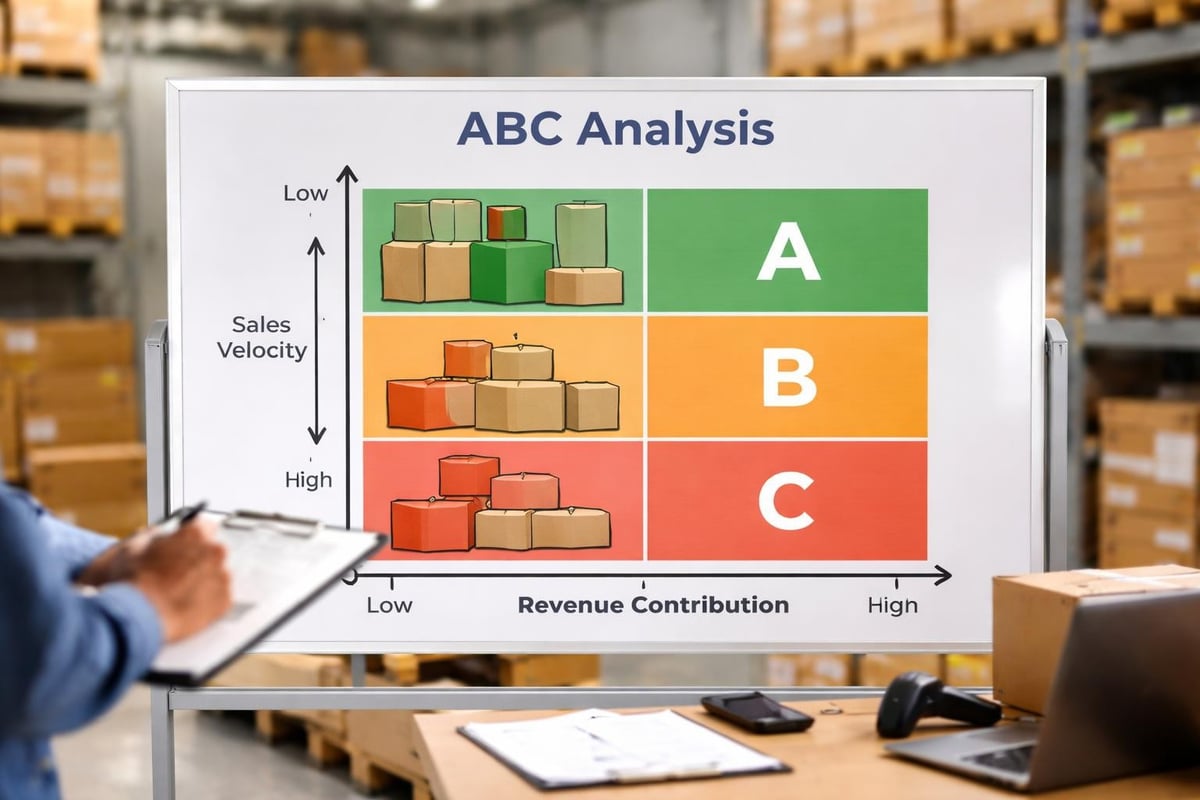
Not all products deserve equal attention or resources. ABC analysis categorizes inventory based on value and velocity:
- A-items (20% of SKUs, 80% of revenue) receive priority placement and frequent monitoring
- B-items (30% of SKUs, 15% of revenue) follow standard management protocols
- C-items (50% of SKUs, 5% of revenue) require minimal handling and basic oversight
This classification drives decisions about storage location, reorder frequency, and handling procedures. A-items occupy the most accessible locations with higher safety stock, while C-items may utilize deeper storage or consolidated locations.
Cycle Counting and Accuracy
Physical inventory accuracy prevents stockouts and overselling situations that damage customer relationships. Rather than annual physical inventories that disrupt operations, modern warehouse management best practices advocate continuous cycle counting.
High-value A-items receive weekly counts, B-items monthly verification, and C-items quarterly checks. This rolling approach maintains accuracy without operational shutdowns while identifying systemic issues causing discrepancies.
Picking and Packing Process Optimization
The picking and packing processes consume the majority of labor hours in any e commerce warehouse. Small improvements in these workflows generate substantial cost savings at scale.
Pick Path Strategy Selection
Different order profiles demand different picking strategies. Single-item orders benefit from discrete picking, where workers complete one order at a time. Multi-item orders may utilize batch picking, wave picking, or zone picking depending on warehouse layout and order characteristics.
Common picking methodologies:
- Discrete picking: One order at a time, simplest but slowest
- Batch picking: Multiple orders simultaneously, grouped by zone
- Wave picking: Scheduled picking runs for order groups
- Zone picking: Designated pickers handle specific areas
The strategies for maximizing warehouse efficiency emphasize analyzing actual order data to determine which methodology fits your specific product mix and order patterns.
Packing Station Configuration
Packing stations require ergonomic design with all necessary materials within arm’s reach. The optimal setup includes:
| Component | Specification | Purpose |
|---|---|---|
| Work surface | 30″ x 60″ minimum | Order assembly and packing |
| Box sizing guide | Visual reference chart | Right-size packaging selection |
| Void fill dispenser | Wall-mounted preferred | Quick access to protection materials |
| Scale integration | Connected to shipping software | Automatic carrier selection |
| Label printer | Direct thermal, 4×6 labels | Immediate shipping label printing |
Workstation standardization ensures consistent performance across shifts and enables faster training for new employees. Understanding the broader e-commerce order process helps contextualize how packing fits into the complete fulfillment cycle.
Technology and Automation Considerations
Automation represents a significant investment that requires careful evaluation of return on investment and operational fit.
When to Automate
Not every e commerce warehouse requires extensive automation. Consider these factors when evaluating automation investments:
- Order volume consistency: 5,000+ daily orders justify automation consideration
- Product standardization: Similar-sized products automate more easily
- Labor market challenges: Automation mitigates staffing difficulties
- Growth trajectory: Rapid expansion may outpace manual scaling
- Capital availability: Automation requires substantial upfront investment
Partial automation often delivers better ROI than full automation. Automated storage and retrieval systems (AS/RS) for reserve storage combined with manual picking zones create hybrid efficiency.
Software Integration Requirements
The most sophisticated physical systems fail without proper software integration. Your warehouse management system must communicate seamlessly with:
- E-commerce platforms (Shopify, WooCommerce, Magento)
- Marketplaces (Amazon, eBay, Walmart)
- Shipping carriers (UPS, FedEx, USPS)
- Inventory management systems
- Accounting and ERP platforms
The approaches to aligning warehouse operations with e-commerce demands stress the importance of real-time data flow between all systems to maintain accuracy and responsiveness.
Labor Management and Workforce Optimization
People remain the most valuable and variable resource in warehouse operations. Effective labor management directly impacts profitability and service quality.
Performance Metrics and Accountability
Clear performance standards establish expectations and identify improvement opportunities. Standard metrics include:
- Picks per hour: Baseline productivity measurement
- Order accuracy rate: Quality control indicator
- Items per labor hour: Overall efficiency metric
- On-time shipment percentage: Customer service measure
These metrics should be visible to employees and reviewed regularly. Top performers receive recognition while struggling workers receive additional training and support.
Training and Development Programs
Comprehensive onboarding reduces errors and accelerates productivity. New warehouse employees should complete structured training covering:
- Safety protocols and equipment operation
- Warehouse management system navigation
- Product knowledge and handling requirements
- Quality standards and accuracy expectations
- Customer service impact of their role
Cross-training employees across multiple functions creates flexibility for peak periods and employee absences. Workers who understand both picking and packing can shift between functions based on daily demands.

Managing Returns and Reverse Logistics
Returns processing represents one of the most challenging aspects of e-commerce warehousing. Product comes back in various conditions, requires inspection and disposition, and must be quickly returned to available inventory or properly disposed.
Returns Processing Workflow
Efficient returns handling requires dedicated space and clear procedures. Products arriving in the returns area need immediate triage:
- Resellable as new: Inspect, repackage if needed, return to inventory
- Resellable as open box: Mark down, move to clearance location
- Requires refurbishment: Send to appropriate repair vendor
- Damaged beyond repair: Dispose or liquidate appropriately
The speed of this process directly impacts inventory availability and working capital. Items sitting in returns limbo represent frozen capital that could be generating revenue. Comprehensive reverse logistics solutions minimize the financial impact of returns.
Restocking Efficiency Standards
Set clear time standards for processing returns. Industry benchmarks suggest:
| Return Condition | Target Processing Time | Restocking Priority |
|---|---|---|
| Unopened returns | Same day | High – immediate availability |
| Opened but unused | 24 hours | Medium – requires inspection |
| Used but resellable | 48 hours | Medium – cleaning/testing needed |
| Damaged items | 72 hours | Low – disposition decision required |
Scaling Your E-Commerce Warehouse Operations
Growth presents both opportunities and challenges. Scaling warehouse operations requires proactive planning rather than reactive adjustments.
Capacity Planning Frameworks
Monitor key indicators that signal the need for expansion:
- Warehouse utilization exceeding 85% consistently
- Pick path density creating worker congestion
- Inability to receive and process inventory within 24 hours
- Order fulfillment extending beyond same-day shipping cutoffs
- Overtime hours regularly exceeding 10% of total labor
These signals indicate capacity constraints that will worsen during peak seasons. Address them proactively through additional space, labor, or process improvements.
Partnership and Outsourcing Decisions
Not every e-commerce business should operate its own warehouse. Working with experienced fulfillment providers offers several advantages, particularly for growing brands facing capacity constraints or seasonal fluctuations.
Outsourcing proves most valuable when:
- Order volume fluctuates significantly by season
- Geographic expansion requires additional distribution points
- Specialized handling (temperature control, hazmat) exceeds internal capabilities
- Focus on core competencies drives operational decisions
- Capital preservation takes priority over operational control
Direct-to-consumer fulfillment services provide expertise and infrastructure without the capital investment required for owned facilities.
Quality Control and Accuracy Standards
Customer satisfaction depends heavily on receiving exactly what was ordered in perfect condition. Quality control processes protect brand reputation and minimize costly errors.
Multi-Point Verification Systems
Implement verification checkpoints throughout the fulfillment process:
- Receiving: Verify quantities and condition against purchase orders
- Putaway: Confirm location accuracy during initial storage
- Picking: Scan verification of every item selected
- Packing: Visual inspection before boxing
- Shipping: Final weight and dimension verification
This multi-layered approach catches errors before they reach customers. While it adds seconds to each process, the cost remains far lower than processing returns and replacing incorrect shipments.
Error Root Cause Analysis
When errors occur, investigate the underlying cause rather than simply correcting the immediate problem. Common root causes include:
- Inadequate product labeling or similar packaging
- Confusing bin locations or poor organization
- Insufficient lighting in picking areas
- Rushed employees under excessive time pressure
- Inadequate training on product differences
The efficient warehouse management strategies emphasize continuous improvement based on systematic error analysis.
Seasonal Preparation and Peak Management
E-commerce experiences dramatic volume swings during peak seasons. Black Friday through Christmas can generate 3-5 times normal daily volume, requiring careful preparation.
Peak Season Planning Timeline
90 days before peak:
- Finalize temporary labor hiring plans
- Secure additional packaging supplies
- Review and optimize warehouse layout
- Train core staff on peak procedures
60 days before peak:
- Begin hiring and training temporary workers
- Install temporary racking or storage solutions
- Test systems under simulated high-volume conditions
- Confirm carrier capacity and backup options
30 days before peak:
- Complete all hiring and training
- Stock extra packaging materials
- Establish extended operating hours
- Communicate expectations to all stakeholders
During peak:
- Monitor performance metrics hourly
- Address bottlenecks immediately
- Maintain communication with customers about timing
- Document lessons learned for future improvements
Optimizing an e commerce warehouse requires balancing technology investments, process improvements, and workforce management to create efficient, scalable operations that meet customer expectations. Whether you’re operating your own facility or evaluating alternatives, the principles of layout optimization, inventory accuracy, and quality control remain constant. If your growing e-commerce brand needs expert fulfillment support without the complexity of managing warehouse operations, Ecom Automation Prep delivers comprehensive solutions including Amazon FBA prep, direct-to-consumer fulfillment, and specialized kitting services designed to scale with your business.