
Most pick and pack fees run $1.50-$5.00 for the first item and $0.30-$1.50 for each additional item, but that’s only part of the bill. Once you add receiving, storage, and shipping handling, the real landed cost per order typically lands between $3.50 and $16, depending on SKU complexity, order volume, and where the warehouse sits. That spread is the whole story of pick and pack economics – and it’s why two brands shipping the same product can pay wildly different amounts for what looks like the same service.
The pick and pack process is the operational core of ecommerce fulfillment: retrieving items from storage, verifying and packaging them, and handing them to a carrier. Get it right and it’s invisible – orders just arrive, fast and correct. Get it wrong and it shows up everywhere at once: mispicks, blown shipping budgets, damaged goods, and support tickets.
This guide covers how the process actually works, what drives pricing, when in-house fulfillment beats outsourcing to a 3PL, and the mistakes that quietly inflate cost per order.
How the Pick and Pack Process Works
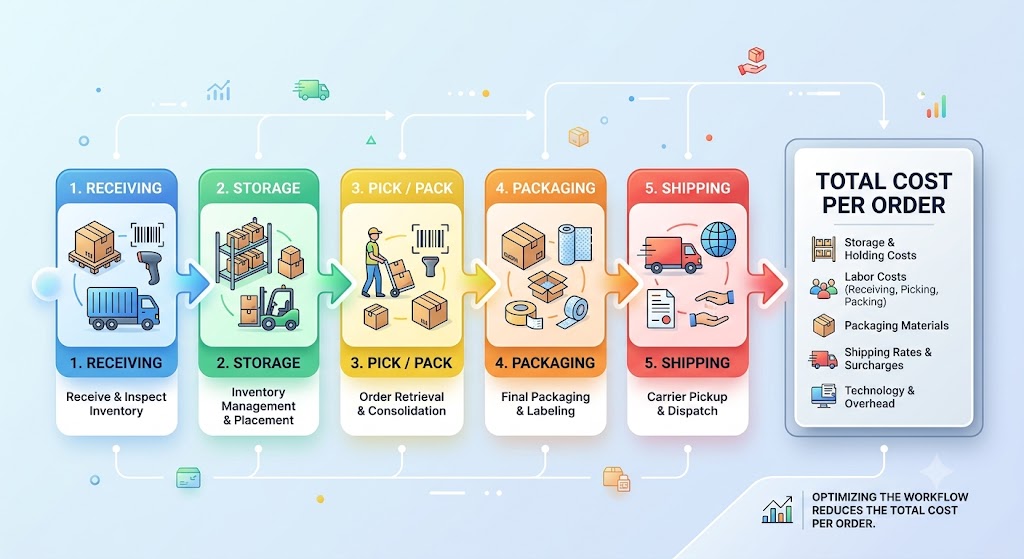
Every order moves through five stages, from checkout to carrier handoff:
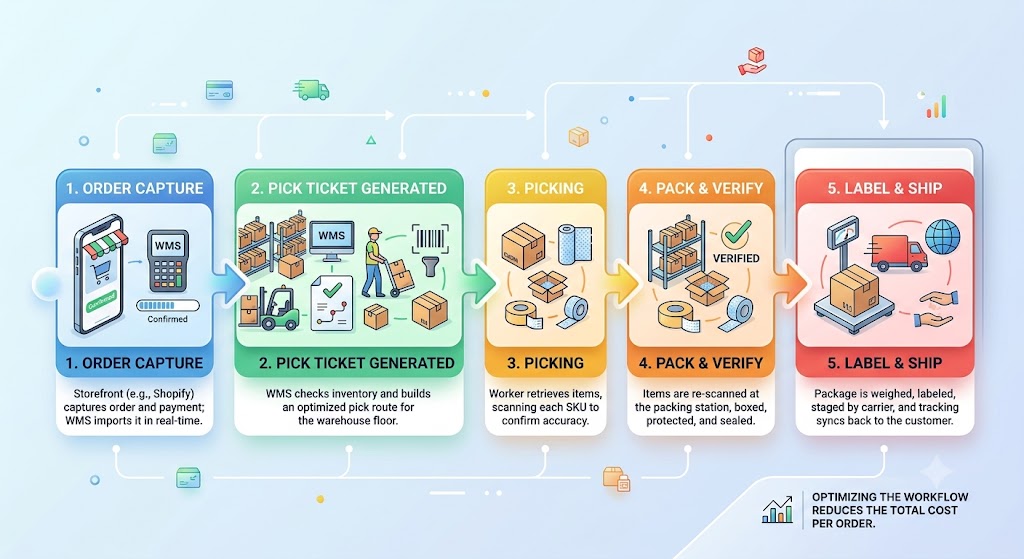
A few details decide whether that flow is fast and cheap or slow and expensive:
Picking strategy depends on volume and catalog size – piece picking (one order at a time) suits low-volume or bulky-item stores; batch picking (multiple orders per pass) suits high-volume stores with overlapping bestsellers; zone picking splits large facilities into worker zones; automated picking (conveyors, pick-to-light, robots) shows up at enterprise scale, where the equipment cost is justified by order volume.
Storage discipline – FIFO for standard goods, FEFO (first-expired-first-out) for perishables – determines how much time pickers waste hunting for items and how often the WMS’s stock count is simply wrong.
Packaging choice drives dimensional (DIM) weight, which most carriers now use to price a shipment instead of actual weight. An oversized box for a small item can raise the shipping charge more than the pick and pack fee itself.
When a storefront integrates directly with the WMS via API, this entire sequence runs without manual data entry – cutting fulfillment cycle time from days to hours and making same-day or next-day shipping realistic.
What Pick and Pack Actually Costs
Total fulfillment cost breaks into five components:
| Fee | Typical 2026 Range | Notes |
|---|---|---|
| Receiving | $25-$50/pallet, or $0.30-$0.60/unit for small items | Covers unloading, inspection, SKU scanning, putaway |
| Storage | $15-$45/pallet/month (~$0.46/cubic ft) | Rates jump sharply – often doubling or tripling – for stock sitting 90-180+ days |
| Pick and pack | $1.50-$5.00 first item, $0.30-$1.50 each additional | Widest published midpoint sits around $2.75 first item / $0.50 add-on |
| Packaging materials | Varies | Custom/branded packaging, inserts, and fragile-item void fill all add per-order cost |
| Shipping | Carrier-dependent | Priced on the greater of actual weight or DIM weight |
Stacked together, most brands land on a total fulfillment cost of $3.50-$16 per order – the wide range exists because SKU count, order volume, and storage duration all compound. Two operational levers matter more than any single line-item negotiation:
- Volume discounts. Brands shipping 5,000+ orders/month typically qualify for 15-30% off standard rates. Below that threshold, per-order cost is close to fixed no matter which provider you pick.
- Pick and pack as a share of spend. Pick and pack labor alone typically represents 35-50% of total non-shipping fulfillment cost – the single largest controllable line item, which is why picking-strategy and layout decisions (below) move the needle more than haggling over the base fee.
The trap to avoid: picking a provider on the lowest pick fee alone. A quote that undercuts the market on picking is frequently offset by higher storage rates, marked-up shipping, or uncapped “ancillary” fees – SKU management charges, kitting fees, peak-season surcharges – that only show up after signing. Ask for total landed cost per order, itemized, before comparing anyone’s headline rate.
In-House vs. 3PL: Which Costs Less?
This is the decision most guides skip, and it’s the one that actually changes your fulfillment cost structure.
In-house tends to win when:
- Order volume is low-to-moderate and doesn’t justify a 3PL’s monthly minimum (commonly $500+ in the U.S.)
- Products need heavy customization, fragile handling, or brand-specific unboxing that’s hard to standardize across a third party’s floor
- You need direct control over inventory accuracy during a scaling or SKU-launch phase
3PL tends to win when:
- You’re above roughly 5,000 orders/month and can access volume pricing
- You want multi-region storage to cut shipping zones and transit time without leasing your own warehouses
- Labor sourcing, seasonal staffing, and warehouse management aren’t core to your business
The number that actually settles it: compare your fully-loaded in-house cost (labor, rent, software, packaging, management time) against a 3PL’s all-in landed cost per order – not just their pick fee. Below ~2,000-3,000 orders/month, in-house frequently comes out cheaper once 3PL monthly minimums are factored in. Above that, 3PL economics usually improve faster than in-house scaling costs.
Edge Cases That Break Standard Pricing
Standard per-order pricing assumes a small, single-item, standard-weight parcel. Several common scenarios don’t fit that model:
- Oversized or non-stackable items (furniture, appliances) occupy pallet or floor space that standard per-bin storage pricing doesn’t account for – expect a separate oversized-item rate, not the standard per-pallet fee.
- High-return categories (apparel, footwear) carry return rates of 5-15% in some categories. Reverse logistics – inspecting, restocking, or discarding returns – is a cost center most pricing guides leave out entirely, and it should be quoted separately.
- Multi-item orders don’t scale linearly forever – bundles and kits often need manual assembly (“kitting”), which is priced per unit and can turn a $3 order into an $8-$12 one.
- Temperature-controlled or hazmat goods require dedicated infrastructure that most standard 3PL rate cards don’t cover – get a specialized quote rather than assuming a markup on the standard rate.
- International orders add customs documentation and often a separate DIM weight calculation per carrier per country – don’t assume domestic packaging rules transfer.
If a page – or a provider’s pricing page – doesn’t address at least the return-rate and oversized-item cases, it’s quoting a best-case number that most real catalogs won’t hit.
Best Practices That Actually Lower Cost Per Order
- Put bestsellers near packing stations. Picker travel time is pure labor cost with no offsetting value – warehouse layout is often a bigger lever than any fee negotiation.
- Scan at every stage, not just picking. Receiving, putaway, picking, and packing scans catch errors before they become a return.
- Run frequent small cycle counts on high-velocity SKUs instead of one disruptive annual count – this is what actually keeps “in stock” accurate on the storefront.
- Standardize box selection with WMS prompts rather than leaving it to packer judgment – oversized boxes are a direct, avoidable hit to DIM-weight shipping cost.
- Integrate scales at the pack station. A weight mismatch against expected SKU weight catches a wrong item before it ships, not after a customer complains.
- Watch inventory age. Because long-term storage fees can double or triple past the 90-180 day mark, slow-moving SKUs are often cheaper to discount and clear than to keep storing.
Common Pick and Pack Mistakes
- Poor warehouse layout – high-demand items stored far from packing stations inflate picker travel time on every single order.
- No packaging standard – packers left to choose box sizes without guidance produce oversized shipments, higher DIM-weight charges, and more transit damage.
- Manual order entry – CSV exports between storefront and WMS introduce delay and data errors that a direct API integration eliminates.
- Choosing a 3PL on price alone – the lowest headline pick fee is frequently the most expensive option once storage, shipping markups, and ancillary fees are totaled.
- Ignoring reverse logistics – unprocessed returns tie up both warehouse space and working capital, and this cost rarely appears in initial pricing comparisons.
Frequently Asked Questions
How much does pick and pack actually cost per order in 2026?
Base pick and pack fees run $1.50-$5.00 for the first item and $0.30-$1.50 per additional item, with a common working midpoint near $2.75 first item / $0.50 add-on. Once receiving, storage, and shipping are added, total landed cost per order typically runs $3.50-$16, depending on volume and SKU complexity.
Is in-house fulfillment cheaper than using a 3PL?
It depends on volume. Below roughly 2,000-3,000 orders/month, in-house often comes out cheaper once a 3PL’s monthly minimum (commonly $500+) is factored in. Above that threshold, 3PL volume pricing (typically 15-30% off standard rates past 5,000 orders/month) usually wins.
Why did my fulfillment quote come in higher than the advertised pick fee?
Advertised pick fees rarely include receiving charges, long-term storage penalties (which can double or triple after 90-180 days), packaging materials, kitting for multi-item bundles, or peak-season surcharges. Always ask for an itemized, all-in landed cost per order before comparing providers.
Does return volume affect fulfillment cost?
Yes, significantly in return-heavy categories like apparel and footwear, where return rates of 5-15% are common. Reverse logistics – inspection, restocking, or write-off – is a real cost center that most standard pick and pack quotes don’t include.
What single change lowers pick and pack cost the most?
Warehouse layout. Since pick and pack labor is typically 35-50% of non-shipping fulfillment spend, and picker travel time is the largest controllable variable inside that labor cost, placing bestsellers near packing stations usually moves cost per order more than renegotiating the base fee.