

Shipping is often one of the largest operational expenses for growing online businesses. Managing your ecommerce shipping costs effectively requires a clear understanding of carrier rates, packaging efficiency, and fulfillment logistics. While offering fast and free delivery boosts conversions, unmanaged shipping expenses can quickly erode your profit margins. A successful shipping strategy balances speed, cost, and reliability to protect your bottom line while delivering an exceptional customer experience.
How Ecommerce Shipping Works
Understanding how ecommerce shipping works from the moment a customer clicks “buy” to final delivery helps you identify bottlenecks, lower operational overhead, and streamline your entire logistics process.
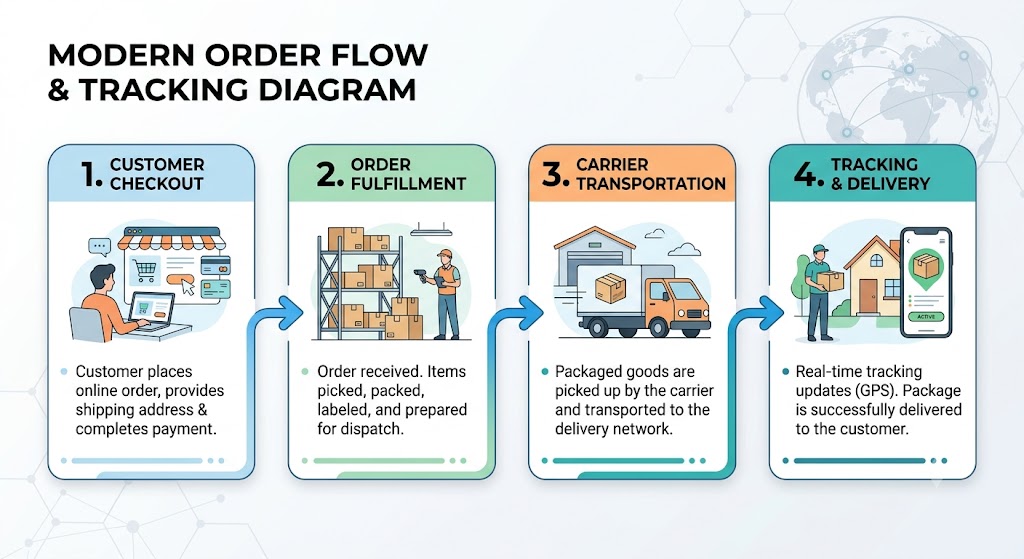
1. Customer Checkout → 2. Order Fulfillment → 3. Carrier Transportation → 4. Tracking & Delivery
Customer Places an Order
The process begins when a customer selects products and proceeds to checkout. Based on your store settings, the shipping method and delivery costs are calculated in real time or applied as a flat rate. Once payment is confirmed, order details, SKU quantities, and shipping preferences automatically flow into your warehouse management system (WMS).
Order Processing and Fulfillment
Once the order reaches the fulfillment team, processing begins:
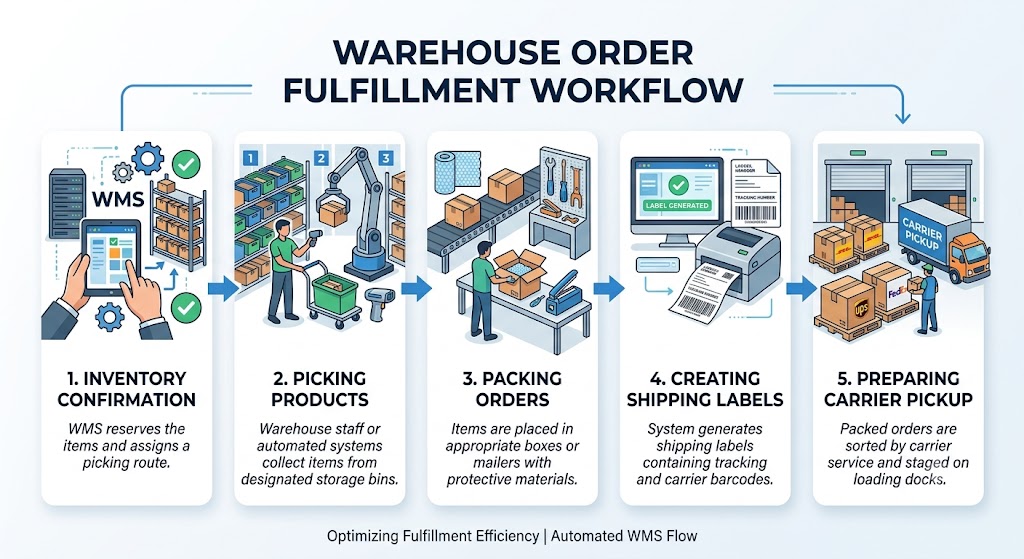
- Inventory Confirmation: WMS reserves the items and assigns a picking route.
- Picking Products: Warehouse staff or automated systems collect items from designated storage bins.
- Packing Orders: Items are placed in appropriate boxes or mailers with protective materials.
- Creating Shipping Labels: System generates shipping labels containing tracking information and carrier barcodes.
- Preparing Carrier Pickup: Packed orders are sorted by carrier service and staged on loading docks.
Carrier Transportation and Delivery
After pickup, the shipping carrier takes over final transit:
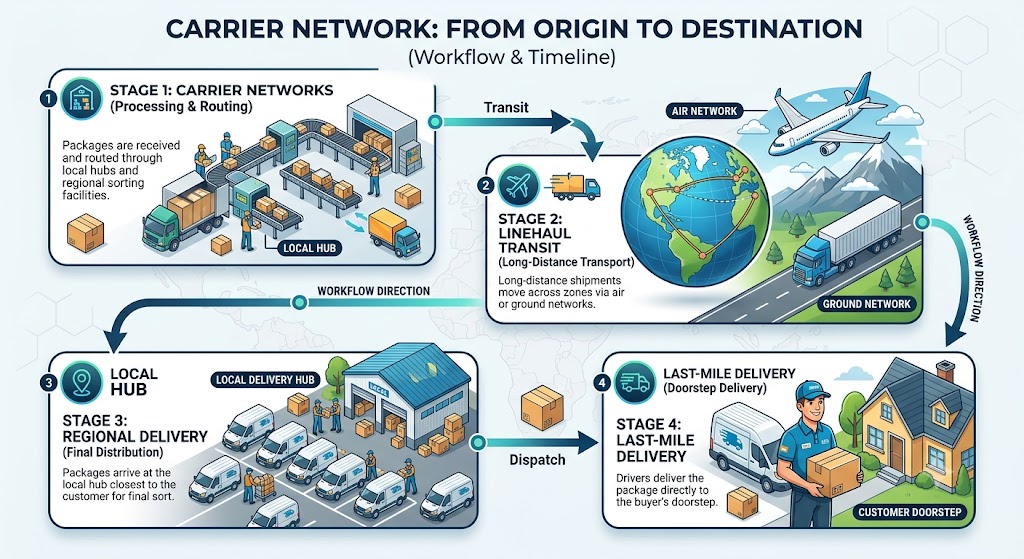
- Carrier Networks: Packages are routed through local hubs and regional sorting facilities.
- Linehaul Transit: Long-distance shipments move across zones via air or ground networks.
- Regional Delivery Hubs: Packages arrive at the local hub closest to the customer.
- Last-Mile Delivery: Drivers deliver the package directly to the buyer’s doorstep.
Tracking and Customer Communication
Throughout transit, automated notifications send real-time tracking numbers and delivery updates to the customer. If returns occur, clear reverse logistics workflows help process returns, manage customer expectations, and restock inventory efficiently.
What Affects Ecommerce Shipping Costs?
Several primary factors drive the pricing structure behind ecommerce shipping costs. Recognizing how carriers structure their fees allows you to design cost-effective packaging and fulfillment routines.
Package Size and Weight
Carriers charge based on actual physical weight or dimensional (DIM) weight – whichever is greater.
| Metric | Value |
|---|---|
| Actual weight | 2 lbs |
| Package size | 12″ × 12″ × 12″ = 1,728 cu. in. |
| DIM divisor | 139 |
| Calculated DIM weight | 1,728 ÷ 139 = 12.43 lbs |
| Billed weight | 13 lbs (rounded up, DIM exceeds actual) |
Using oversized packaging for lightweight items drastically increases shipping rates because bulky boxes take up space in delivery vehicles.
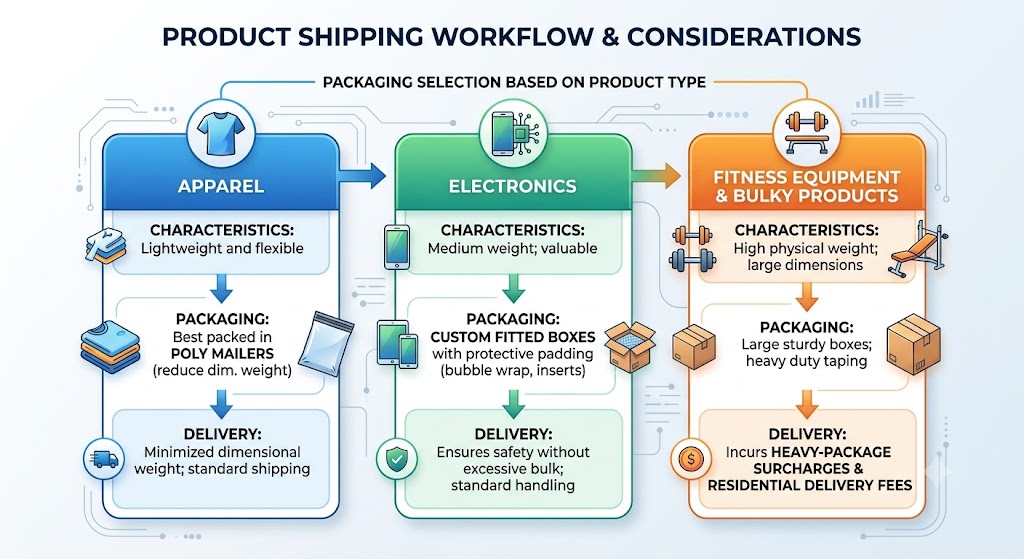
- Apparel: Lightweight and flexible; best packed in poly mailers to minimize dimensional weight.
- Electronics: Medium weight; requires custom fitted boxes and protective padding to ensure safety without excessive bulk.
- Fitness Equipment & Bulky Products: High physical weight and large packaging dimensions; incurs heavy-package surcharges and residential delivery fees.
Shipping Zones and Delivery Distance
Carriers divide geographical regions into shipping zones based on the distance between the origin warehouse location and the destination address.
| Shipping Zone | Distance / Range | Cost Impact |
|---|---|---|
| Zone 1 & 2 | Local / 1-150 miles | Lowest base shipping rates |
| Zone 3-5 | Regional / 151-600 miles | Moderate pricing; standard delivery times |
| Zone 6-8 | Cross-Country / 601+ miles | Highest shipping costs and longer transit times |
Distributing inventory across local fulfillment centers or multi-location regional warehouses allows you to utilize zone skipping, dramatically reducing delivery distance, shipping rates, and transit days. Warehouse placement is the single biggest lever for controlling zone exposure – a centralized single-warehouse model keeps most orders in Zones 5-8, while a distributed multi-warehouse model keeps most orders in Zones 1-3. The tradeoff, and the practical steps for acting on it, are covered under fulfillment locations below.
Carrier Rates and Service Levels
Choosing the right mix of carrier services directly impacts speed and operational costs:
- Standard Shipping: Ground transportation balancing economy and reasonable speed.
- Expedited Shipping: 2-day or priority air options for time-sensitive deliveries.
- Overnight Delivery: Premium next-day service options with high shipping costs.
- Economy Services: Hybrid postal delivery options ideal for non-urgent, lightweight orders.
| Factor | Impact on Shipping Costs |
|---|---|
| Speed | Faster delivery increases transportation costs exponentially. |
| Reliability | Premium services include guarantees and priority handling at higher rates. |
| Tracking | Standard on most commercial carrier services; basic on postal economy tiers. |
| Insurance | Adds coverage against loss or damage; extra fee per declared value tier. |
Major shipping carriers include USPS, UPS, FedEx, DHL, and specialized regional carriers.
How to Build an Ecommerce Shipping Strategy
A well-structured ecommerce shipping strategy aligns customer expectations with profit margins to establish a sustainable operational model. This section is about the decision framework – the pricing rules and tradeoffs you set once, up front. The specific tactics for cutting costs within that framework are covered in the reduction section further down.
Define Shipping Rules and Thresholds
Businesses utilize various pricing rules based on average order value (AOV) and product parameters:
- Free Shipping Thresholds: Encourages buyers to spend more to earn free shipping (e.g., “Free shipping on orders over $75”).
- Flat-Rate Shipping: Charges a predictable fee per order, simplifying checkout decisions.
- Weight-Based Pricing: Passes precise carrier costs directly to the buyer based on item weight.
- Location-Based Pricing: Uses real-time carrier rates based on exact delivery zones.
- Product-Specific Rules: Custom rules for heavy, oversized, or fragile merchandise.
Calculating Free Shipping Thresholds:
- Average Order Value (AOV): $55
- Average Shipping Cost: $8
- Target Minimum Order Threshold: $75
By setting the free shipping threshold at $75, customers are incentivized to add 1-2 items to their cart to qualify, boosting AOV enough to cover the shipping expense while preserving net margins.
Choose the Right Carrier Mix
Relying on a single shipping provider limits flexibility and exposes your supply chain to service disruptions. Combining multiple carrier services optimizes delivery performance across diverse order profiles.
| Carrier Type | Primary Strength | Ideal Use Case |
|---|---|---|
| National Carriers (UPS, FedEx) | Extensive ground and air infrastructure | High-value, heavy, or expedited commercial packages |
| Regional Carriers (OnTrac, LSO) | Low ground rates in specific areas | Short-haul, high-density metropolitan deliveries |
| Postal Services (USPS) | Last-mile network efficiency | Small, lightweight packages under 5 lbs and PO Boxes |
| Freight Carriers (LTL/TL) | Large palletized transit capabilities | Oversized items, commercial B2B, and bulk orders |
Which mix is right depends on your order profile – a store selling mostly small apparel leans on USPS and regional carriers, while one shipping bulky fitness equipment needs freight and national carrier accounts.
Balance Cost, Speed, and Customer Expectations
Designing a profitable shipping strategy requires finding the balance point across three conflicting factors:
Cost Efficiency ↔ Delivery Speed ↔ Reliability – improving one typically means giving ground on one of the other two.
- Lower Cost: Higher operating margins, but slower delivery speeds can reduce conversion rates.
- Faster Delivery: Exceptional customer experience and higher cart conversion, but increases shipping expenses.
- Reliability: Minimal lost packages and lower support overhead, requiring investments in premium carrier services.
The optimal shipping strategy isn’t necessarily the cheapest option; it’s the model that maximizes customer satisfaction while keeping margins healthy.
How to Reduce Ecommerce Shipping Costs
Implementing targeted cost-cutting measures allows you to reduce shipping costs ecommerce businesses face without degrading delivery quality.
| # | Strategy | What It Eliminates |
|---|---|---|
| 1 | Negotiate Rates | Overpaying at low-volume, non-tiered pricing |
| 2 | Optimize Packaging | DIM weight surcharges |
| 3 | Multi-Fulfillment | Excess shipping zones and last-mile costs |
| 4 | Automate Operations | Manual rate comparison errors |
| 5 | Inventory Planning | Emergency expedited freight |
Cost Reduction Strategy 1: Negotiate Better Carrier Rates
Carriers offer tiered discounts based on overall shipping volume.
- Aggregate total shipment volume across all sales channels before negotiating with carrier reps.
- Compare annual rate cards between national, regional, and postal options.
- Re-evaluate contracts annually and negotiate waivers for common surcharges like residential delivery fees or peak season adjustments.
Cost Reduction Strategy 2: Improve Packaging Accuracy and Efficiency
Excessive box sizes result in paying to ship trapped air – and inaccurate product data makes the problem worse by triggering carrier billing corrections after the fact.
- Measure product dimensions (length, width, height) and weight including packaging materials before listing items online, and keep a master dimension database in your ERP or WMS so checkout rates match what carriers actually bill.
- Switch from rigid boxes to poly mailers or padded envelopes for non-fragile soft goods.
- Standardize packaging to 3-5 box sizes to speed up packing and negotiate bulk packaging discounts, and work with suppliers to engineer custom boxes for top-selling products.
- Eliminate unnecessary inserts and heavy dunnage materials to lower total billable weight – small reductions in box dimensions can move a package down a full DIM weight pricing bracket.
- Periodically audit packaged SKUs against your dimension database, since packaging changes drift out of sync with what’s on file over time.
Cost Reduction Strategy 3: Use Multiple Fulfillment Locations
Distributing stock across strategically located fulfillment centers lowers shipping distances, as covered under shipping zones above.
- Place inventory near high-density customer populations to drop shipments from Zone 6-8 down to Zone 2-3.
- Lower zone distance translates into cheaper ground rates and faster delivery times.
- Partnering with a third-party logistics (3PL) provider gives access to nationwide multi-node networks without capital investment – the tradeoff is split inventory management and added coordination complexity.
Cost Reduction Strategy 4: Automate Shipping Operations
Manual shipping workflows increase errors, slow down order throughput, and raise labor overhead.
- Integrate multi-carrier shipping software to automate rate shopping at checkout instead of relying on a single negotiated carrier by default.
- Automate shipping label printing, packing slip creation, and inventory updates.
- Rules-based automation automatically routes orders to the fastest and most cost-effective carrier service level.
- Automate delivery-date estimates at checkout and proactive tracking notifications at key transit milestones – this doesn’t lower carrier costs directly, but it measurably cuts “Where Is My Order?” (WISMO) support volume, which is a real cost in its own right.
Cost Reduction Strategy 5: Improve Inventory Planning
Inaccurate demand forecasting results in stockouts and expensive emergency shipments.
- Use demand forecasting tools to predict seasonal demand spikes and order inventory early.
- Stock high-velocity products in regional hubs close to end consumers.
- Prevent split-shipment orders where single purchases must be fulfilled from separate warehouses.
Need Help Reducing Fulfillment and Shipping Expenses?
Partnering with an experienced logistics provider can unlock volume carrier discounts, optimize your packaging, and shorten shipping zones.
Common Ecommerce Shipping Mistakes
Avoiding common shipping mistakes helps protect profit margins and maintains customer trust.
Mistake 1: Choosing the Cheapest Carrier Only
Selecting a carrier solely based on the lowest rate often leads to late deliveries, damaged items, and poor customer service. Lost orders and negative customer experiences cost far more in the long run than moderate shipping savings.
Mistake 2: Not Tracking Shipping Performance
Failing to monitor shipping metrics hides operational inefficiencies. Keep track of key performance indicators (KPIs):
- Average shipping cost per order
- On-time delivery rate
- Order accuracy rate
- Claim/damage percentage
- Return shipping expenses
Mistake 3: Offering Shipping Options Without Profit Analysis
Offering free shipping or flat-rate options without factoring in carrier surcharges, packaging expenses, and product margins leads to unprofitability. Always perform a margin analysis before introducing new shipping promotions.
FAQ
How do ecommerce shipping costs work?
Ecommerce shipping costs are calculated using package weight, dimensional size, shipping zone distance, carrier service level, and fuel or residential surcharges. Shipping rates are calculated based on package characteristics and service requirements.
What is an ecommerce shipping strategy?
An ecommerce shipping strategy is a structured operational approach to managing shipping costs, carrier selections, pricing rules, packaging options, and fulfillment locations to maintain profit margins while meeting customer delivery expectations.
How can ecommerce brands reduce shipping costs?
The core levers are carrier rate negotiation, packaging accuracy, multi-location fulfillment, automation, and inventory planning – see the cost reduction section above for the specific tactics under each.
What are ecommerce shipping best practices?
Maintain precise, audited product dimensions, right-size packaging to avoid dimensional weight penalties, use a multi-carrier mix suited to your order profile, and communicate delivery timelines proactively to reduce support volume.