


The e-commerce landscape has evolved far beyond simple transactional exchanges. Modern consumers demand comprehensive experiences that combine product quality, seamless delivery, personalized service, and ongoing support. This shift has given rise to solutions commerce, an approach that transforms traditional selling into value-driven partnerships where businesses solve complete customer problems rather than just moving products. For e-commerce brands experiencing rapid growth, understanding and implementing solutions commerce principles can mean the difference between sustainable scaling and operational chaos.
Understanding Solutions Commerce in Modern E-Commerce
Solutions commerce represents a fundamental shift in how businesses approach customer relationships and operational design. Rather than focusing solely on product sales, this methodology emphasizes solving complete customer challenges through integrated offerings that combine products, services, technology, and expertise.
The core distinction lies in the value proposition. Traditional commerce asks "What can we sell?" while solutions commerce asks "What problems can we solve?" This customer-centric perspective drives businesses to develop comprehensive offerings that address pain points throughout the entire customer journey.
Key Components of Solutions Commerce
Successful implementation requires understanding the foundational elements that distinguish solutions commerce from conventional selling:
- Integrated service delivery that combines multiple touchpoints into cohesive experiences
- Scalable infrastructure capable of adapting to fluctuating demand without quality degradation
- Technology enablement through platforms that connect operations, inventory, and customer data
- Consultative relationships where expertise becomes as valuable as the products themselves
- Outcome-focused metrics measuring customer success rather than just transaction volume
Modern platforms like Commerce.com offers flexible, AI-driven solutions that enable businesses to create these integrated ecosystems, connecting disparate tools into unified commerce experiences.
The Role of Fulfillment in Solutions Commerce
Fulfillment serves as the operational backbone of solutions commerce, directly impacting customer satisfaction and brand reputation. When fulfillment operates as a strategic solution rather than a commodity service, it becomes a competitive differentiator.

Strategic Fulfillment Capabilities
Advanced fulfillment operations must provide more than basic pick-and-pack services. They need to function as comprehensive solutions that address multiple business challenges simultaneously.
| Capability | Traditional Approach | Solutions Commerce Approach |
|---|---|---|
| Inventory Management | Reactive restocking | Predictive analytics and automated reordering |
| Order Processing | Manual workflows | Intelligent automation with exception handling |
| Shipping Options | Standard carriers | Multi-carrier optimization based on cost and speed |
| Returns Processing | Basic restocking | Comprehensive reverse logistics with data capture |
| Scalability | Fixed infrastructure | Elastic capacity matching demand curves |
Fast-growing brands require omnichannel customer experience solutions that can adapt to changing business models, seasonal fluctuations, and market expansion without requiring complete operational overhauls.
Value-Added Services as Solution Elements
Solutions commerce thrives when businesses extend beyond core competencies to offer complementary services that enhance customer outcomes. In fulfillment, these value-added services transform basic logistics into comprehensive solutions.
Kitting and bundling exemplify this approach. Rather than shipping individual components, brands can create curated experiences that increase perceived value while optimizing shipping costs. Subscription box companies, seasonal promotions, and product launches all benefit from professional kitting that ensures consistency and quality.
Amazon FBA preparation represents another specialized service that solves specific channel challenges. Brands selling through Amazon must navigate strict requirements for labeling, packaging, and shipment preparation. Professional prep services eliminate rejection risks and accelerate inventory availability.
Direct-to-consumer fulfillment requires different capabilities than marketplace selling. Solutions commerce providers offer channel-specific expertise that optimizes operations for each sales platform's unique requirements.
Technology Integration in Solutions Commerce
Technology serves as the connective tissue in solutions commerce, enabling seamless information flow across systems, partners, and touchpoints. Without robust integration, even the best individual services remain isolated rather than forming cohesive solutions.
Essential Technology Layers
Modern solutions commerce requires multiple technology layers working in harmony:
- Order management systems that aggregate orders from multiple channels
- Inventory synchronization providing real-time visibility across locations
- Warehouse management software optimizing picking, packing, and shipping workflows
- Customer communication platforms delivering proactive updates and exception notifications
- Analytics dashboards transforming operational data into actionable insights
AI-driven e-commerce platforms create personalized experiences by leveraging data across the entire customer journey, from product discovery through post-purchase support.
Data as a Strategic Asset
Solutions commerce generates valuable data that informs business decisions beyond operational efficiency. Fulfillment patterns reveal customer preferences, inventory turnover identifies winning products, and shipping data exposes geographic opportunity zones.
Smart businesses leverage this data to optimize product development, marketing strategies, and expansion plans. When fulfillment partners provide comprehensive reporting and analytics access, they elevate themselves from service providers to strategic partners.

Building Scalable Solutions Commerce Operations
Scalability challenges plague rapidly growing e-commerce brands. Operations that work at 100 orders per day often collapse at 1,000 orders per day without strategic planning and infrastructure investment.
Infrastructure Considerations
Solutions commerce requires physical and operational infrastructure designed for growth rather than current state:
- Flexible warehouse space that expands without requiring relocation
- Modular technology systems adding capabilities as business needs evolve
- Trained workforce with cross-functional skills handling multiple service types
- Carrier relationships providing negotiating power and service level diversity
- Quality control processes maintaining standards during volume increases
Companies leveraging intelligent supply chain network solutions can build AI-ready data foundations that support automation and workflow optimization as volume scales.
Process Standardization and Customization Balance
Effective solutions commerce balances standardization for efficiency with customization for differentiation. Core processes benefit from standardization that enables automation, reduces errors, and facilitates training. However, customer-facing elements often require customization that reflects brand identity and unique value propositions.
Packaging presents a perfect example. Standard box sizes and protection materials optimize storage and cost, but custom branded inserts, tissue paper, and thank-you cards create memorable unboxing experiences that drive social sharing and repeat purchases.
Customer Experience in Solutions Commerce
Solutions commerce ultimately succeeds or fails based on customer experience quality. Every operational decision ripples through to customer perception, making experience design a strategic imperative rather than an afterthought.
Experience Design Principles
| Principle | Implementation | Business Impact |
|---|---|---|
| Transparency | Real-time tracking and proactive communication | Reduced support inquiries and increased trust |
| Consistency | Standardized packaging and delivery windows | Enhanced brand recognition and reliability perception |
| Flexibility | Multiple shipping speeds and delivery options | Higher conversion rates and customer satisfaction |
| Recovery | Streamlined return processes and issue resolution | Improved lifetime value despite transaction friction |
AI-powered commerce solutions enhance eCommerce search and discovery experiences, delivering direct answers that streamline digital customer journeys from browsing through purchase completion.
Post-Purchase Experience Optimization
The relationship between brand and customer intensifies after purchase rather than concluding. Solutions commerce recognizes this reality and designs post-purchase experiences that build loyalty and encourage advocacy.
Delivery communication keeps customers informed without requiring them to track packages manually. Exception notifications about delays allow brands to manage expectations proactively rather than reactively addressing complaints.
Returns and exchanges test customer relationships under stressful circumstances. Friction-free return processes, prepaid labels, and quick refunds transform potentially negative experiences into demonstrations of customer commitment.
Subscription and recurring purchase programs exemplify solutions commerce by solving ongoing customer needs rather than requiring repeated purchase decisions. These models require fulfillment operations designed for predictable cadences and flexible modification handling.
Specialized Solutions for Diverse Business Models
Different e-commerce business models require tailored solutions commerce approaches. Cookie-cutter fulfillment strategies fail to address the unique challenges each model presents.
B2B E-Commerce Solutions
Business-to-business commerce involves distinct requirements compared to direct-to-consumer operations. Larger order quantities, complex pricing structures, and specialized shipping needs demand different fulfillment capabilities.
- Pallet-level shipping for bulk orders
- Custom documentation for corporate receiving departments
- Scheduled delivery windows coordinating with business hours
- Account-specific pricing and terms reflected in invoicing
- Quality inspection protocols meeting business purchasing standards
Solutions designed for B2B enterprises feature AI-driven personalization and intelligent automation that optimize complex interactions across procurement workflows.
Multi-Channel Distribution Complexity
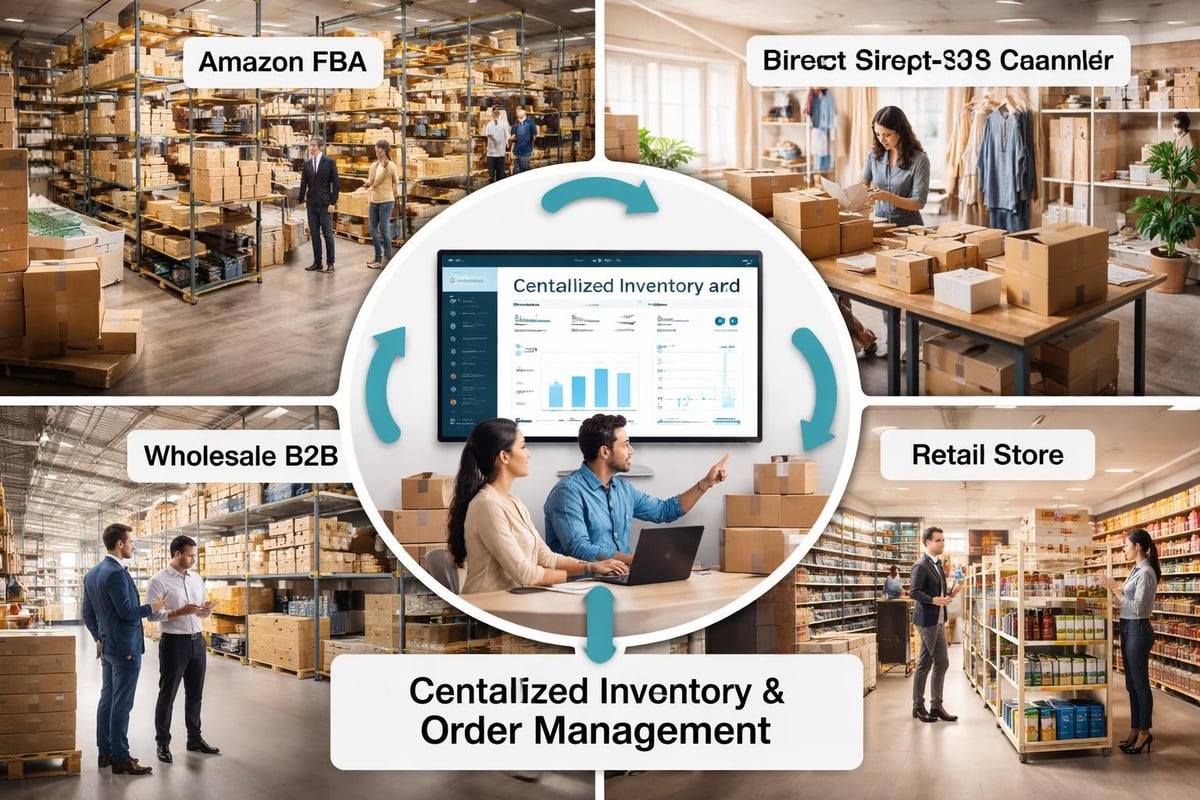
Brands selling through multiple channels face inventory allocation challenges, channel-specific requirement compliance, and brand consistency maintenance across touchpoints. Solutions commerce addresses these challenges through centralized operations that feed multiple channels efficiently.
Inventory visibility across channels prevents overselling while maximizing product availability. When marketplace, website, and retail orders all draw from unified inventory pools with real-time synchronization, brands can optimize stock levels without safety stock bloat.
Channel-specific workflows ensure compliance with platform requirements without manual intervention. Amazon shipments receive proper labeling, wholesale orders include account-specific documentation, and retail transfers meet distribution center receiving standards automatically.
Multi-channel eCommerce management solutions centralize and automate business operations, helping retailers succeed across various online marketplaces while maintaining operational efficiency.
Implementation Strategy for Solutions Commerce
Transitioning to solutions commerce requires strategic planning rather than tactical changes. Businesses must assess current capabilities, identify gaps, and develop roadmaps that balance immediate improvements with long-term transformation.
Assessment and Planning Phase
Begin with honest evaluation of current operations, technology, and customer experience quality. Identify pain points causing customer friction, operational inefficiencies creating cost overruns, and scalability limitations threatening growth.
Set clear objectives tied to business outcomes rather than operational metrics alone. Instead of "reduce shipping time by one day," target "increase customer satisfaction scores by 15% through delivery improvements." This outcome focus aligns with solutions commerce principles.
Partnership Selection Criteria
Choosing solutions commerce partners represents one of the most critical decisions growing brands make. The right partner accelerates growth while the wrong partner constrains potential and damages customer relationships.
- Scalability track record with brands experiencing similar growth trajectories
- Technology integration capabilities connecting with existing systems seamlessly
- Service flexibility adapting to changing business needs and seasonal demands
- Geographic footprint supporting current markets and expansion plans
- Expertise depth in relevant product categories and fulfillment specialties
- Communication quality providing visibility and proactive problem-solving
Evaluate partners based on their ability to function as strategic collaborators rather than simple vendors. Solutions commerce requires relationships built on shared success rather than transactional exchanges.
Measuring Solutions Commerce Success
Traditional commerce metrics focus on transaction volume, average order value, and conversion rates. Solutions commerce demands additional metrics that capture customer satisfaction, operational efficiency, and relationship depth.
Comprehensive Performance Metrics
| Metric Category | Key Indicators | Strategic Insight |
|---|---|---|
| Operational Efficiency | Order accuracy, fulfillment speed, inventory turnover | Cost optimization and capacity planning |
| Customer Satisfaction | Net Promoter Score, return rate, repeat purchase rate | Experience quality and loyalty building |
| Scalability Health | Cost per order at varying volumes, peak capacity utilization | Growth readiness and infrastructure adequacy |
| Partnership Value | Revenue per customer, lifetime value, referral rate | Relationship strength and advocacy potential |
Monitor trends rather than point-in-time snapshots. Solutions commerce improvements often require sustained effort before delivering measurable results, making trend analysis essential for accurate assessment.
Continuous Improvement Processes
Solutions commerce never reaches a final state. Customer expectations evolve, competitive landscapes shift, and new technologies emerge. Successful businesses establish continuous improvement processes that identify optimization opportunities and implement refinements systematically.
Regular business reviews with fulfillment partners ensure alignment on objectives, surface emerging challenges before they become crises, and identify collaborative improvement opportunities. These reviews should examine operational performance, customer feedback, and market changes holistically.
Customer feedback loops capture experience quality data directly from the source. Post-purchase surveys, review analysis, and support ticket patterns reveal friction points that metrics alone might miss.
Future Trends Shaping Solutions Commerce
The solutions commerce landscape continues evolving as technology advances, consumer expectations rise, and competitive pressures intensify. Forward-thinking brands monitor emerging trends and position themselves to capitalize on new opportunities.
Artificial Intelligence and Automation
AI technologies transform solutions commerce by enabling personalization at scale, predictive analytics for demand forecasting, and intelligent automation for complex decision-making. Chatbots handle routine customer inquiries, machine learning optimizes inventory allocation, and computer vision systems enhance quality control accuracy.
Automation extends beyond simple repetitive tasks to encompass judgment-based processes previously requiring human intervention. Exception handling, carrier selection, and routing optimization increasingly rely on algorithms that learn from historical patterns and adapt to changing conditions.
Sustainability and Ethical Commerce
Consumer consciousness about environmental and social impacts influences purchasing decisions increasingly. Solutions commerce incorporating sustainability demonstrates values alignment that builds deeper customer relationships beyond transactional exchanges.
Packaging optimization reduces material waste while maintaining product protection. Right-sized boxes, recyclable materials, and minimal void fill appeal to environmentally conscious consumers while reducing shipping costs through dimensional weight optimization.
Carbon-neutral shipping options, ethical sourcing transparency, and circular economy participation through returns refurbishment programs differentiate brands in competitive markets while contributing to broader sustainability goals.
Hyper-Personalization and Customization
Mass customization capabilities enable solutions commerce providers to offer personalized products and experiences at scale. Print-on-demand integration, custom kitting based on customer preferences, and personalized packaging create unique experiences without inventory complexity.
Subscription customization allows customers to modify product selections, delivery frequency, and shipment timing flexibly. Solutions commerce infrastructure supporting these preferences requires sophisticated systems managing individual customer profiles and automated workflow adaptation.
Solutions commerce transforms e-commerce fulfillment from a commodity service into a strategic differentiator that drives customer satisfaction and enables sustainable growth. By focusing on comprehensive problem-solving rather than transactional efficiency alone, brands build deeper relationships and operational resilience. When you're ready to elevate your fulfillment operations with scalable solutions that grow with your business, Ecom Automation Prep provides the comprehensive services and strategic partnership your brand needs to thrive in the competitive e-commerce landscape.