

Modern e-commerce businesses face mounting pressure to deliver faster, operate leaner, and scale efficiently. Manual processes that worked for small operations become bottlenecks as order volumes increase and customer expectations rise. Automation for ecommerce addresses these challenges by eliminating repetitive tasks, reducing human error, and freeing teams to focus on strategic growth. For brands managing complex fulfillment operations, implementing the right automation tools transforms operations from reactive firefighting into proactive scaling.
Understanding Automation for Ecommerce Operations
Automation for ecommerce encompasses the technologies and workflows that handle routine business processes without manual intervention. These systems range from simple email autoresponders to sophisticated inventory management platforms that sync across multiple sales channels.
The core benefit lies in consistency. Automated systems execute tasks the same way every time, eliminating the variability that plagues manual processes. When an order arrives, automation can trigger inventory updates, generate pick lists, route items to the correct fulfillment center, and send tracking notifications-all without human input.
Key areas where automation delivers immediate value:
- Inventory tracking and reorder point management
- Order routing and fulfillment assignment
- Customer communication and status updates
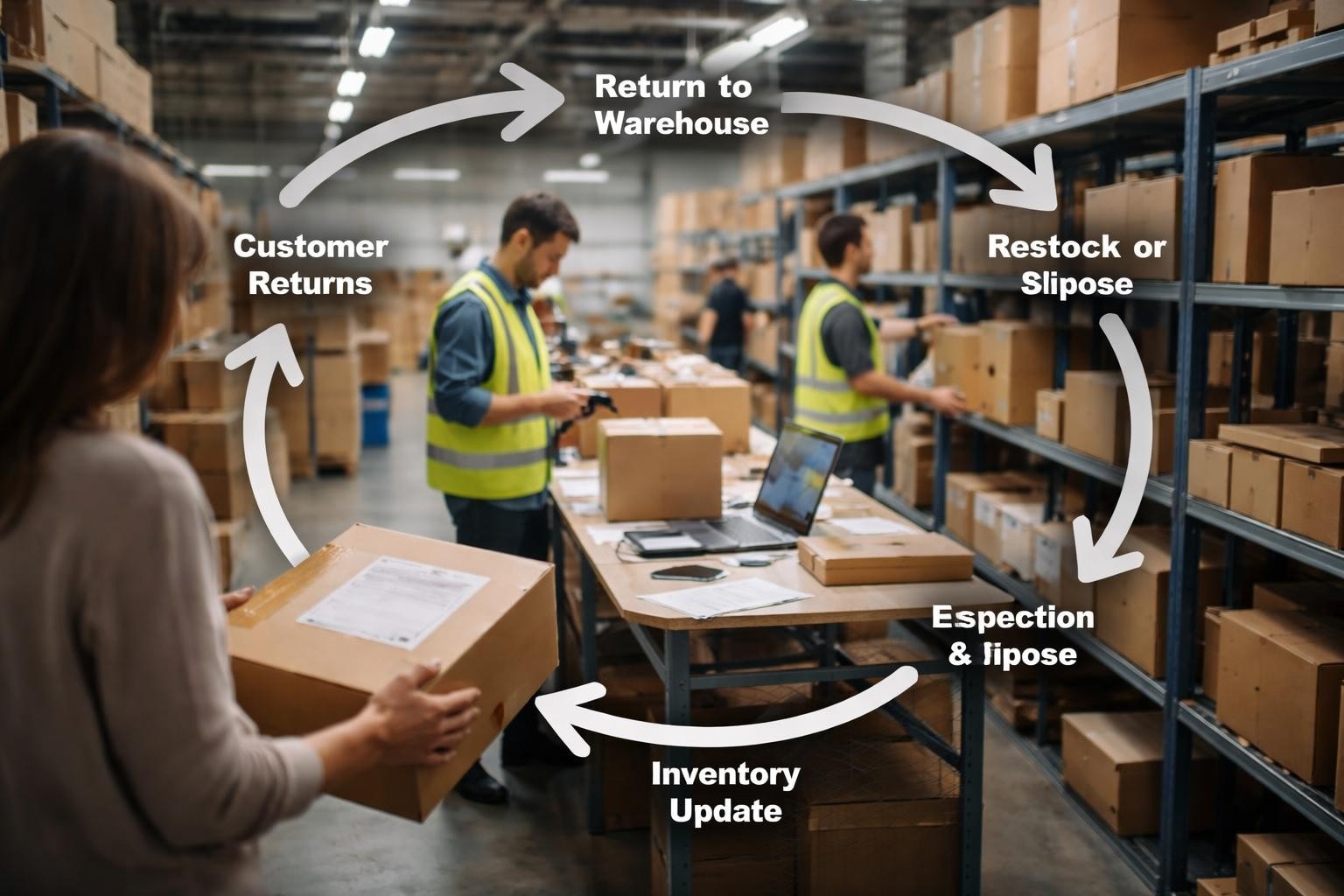
- Returns processing and quality control documentation
- Shipping label generation and carrier selection
Research shows that workflow automation can significantly reduce execution time and error rates when properly implemented in business operations. This efficiency gain becomes particularly critical during peak seasons when manual systems buckle under volume pressure.

Automating Inventory Management and Fulfillment
Inventory represents the lifeblood of e-commerce operations. Without accurate stock counts, businesses face stockouts that kill sales momentum or overstock situations that tie up capital. Automation for ecommerce transforms inventory management from a periodic counting exercise into real-time visibility.
Real-Time Stock Synchronization
Modern inventory systems connect directly to sales channels, updating quantities instantly when orders arrive. This synchronization prevents overselling-the nightmare scenario where multiple customers purchase the same last unit.
| Manual Process | Automated Process | Time Savings |
|---|---|---|
| Daily spreadsheet updates | Real-time API sync | 2-3 hours daily |
| Weekly stock counts | Continuous tracking | 4-6 hours weekly |
| Manual reorder calculations | Automated reorder triggers | 1-2 hours weekly |
The comprehensive services offered by Ecom Automation Prep integrate directly with major e-commerce platforms, ensuring inventory accuracy across all channels.
Predictive Reordering Systems
Advanced automation goes beyond tracking current stock. Predictive systems analyze sales velocity, seasonal trends, and lead times to automatically generate purchase orders before stockouts occur.
These systems factor in variables human managers often miss-upcoming promotions, historical holiday spikes, supplier lead time fluctuations. The result is optimal stock levels that balance availability against carrying costs.
For growing brands, the choice between Amazon FBA prep and 3PL fulfillment often hinges on automation capabilities. Both models leverage automation differently, with FBA handling logistics while 3PLs offer customization.
Order Processing and Fulfillment Automation
Order fulfillment represents the most labor-intensive aspect of e-commerce operations. Every order requires picking items from inventory, quality checking, packing appropriately, generating shipping labels, and updating the customer. Automation for ecommerce streamlines this multi-step process into coordinated workflows.
Intelligent Order Routing
When orders arrive from multiple channels-your website, Amazon, Shopify, wholesale partners-automation determines the optimal fulfillment path. Routing rules consider:
- Inventory location: Which warehouse holds the product?
- Shipping speed requirements: Does the customer need two-day delivery?
- Product characteristics: Does the item require special handling or kitting?
- Cost optimization: Which carrier and service level minimizes expense?
- Geographic proximity: Which facility is closest to the destination?
This decision tree happens in milliseconds, routing orders to the appropriate facility and generating pick tickets automatically. The integration capabilities between e-commerce platforms and fulfillment systems make this seamless routing possible.
Automated Packing and Shipping
Modern fulfillment centers use automation to optimize packing decisions. Systems calculate the smallest box size for each order, reducing dimensional weight charges. They automatically apply correct shipping methods based on customer selection and generate carrier-compliant labels.
Benefits of automated packing workflows:
- Consistent packaging quality reduces damage rates
- Optimal box selection cuts shipping costs by 15-25%
- Automatic label generation eliminates manual data entry errors
- Real-time tracking updates improve customer satisfaction
The direct-to-consumer fulfillment model particularly benefits from these automated workflows, as the high order volumes and varied product mixes demand systematic efficiency.

Marketing and Customer Communication Automation
While fulfillment automation handles physical goods, marketing automation manages customer relationships at scale. These systems deliver personalized experiences that would be impossible to execute manually across thousands of customers.
Segmentation and Personalization
Automation for ecommerce enables sophisticated customer segmentation based on behavior, purchase history, and engagement patterns. Systems automatically categorize customers into segments like first-time buyers, repeat customers, high-value accounts, or dormant subscribers.
Each segment receives tailored messaging. First-time buyers get welcome sequences and product education. Repeat customers receive loyalty rewards and early access to new products. Dormant customers trigger win-back campaigns with special incentives.
According to best practices for e-commerce email automation, strategic audience segmentation combined with testing dramatically improves conversion rates compared to one-size-fits-all approaches.
Abandoned Cart Recovery
Cart abandonment affects 70% of online shopping sessions. Automated recovery sequences capture lost revenue by reminding customers about items left behind. These campaigns typically involve:
- First email: Reminder sent 1-3 hours after abandonment
- Second email: Urgency message with limited-time offer sent 24 hours later
- Third email: Final reminder with stronger incentive sent 48-72 hours later
The personalization extends beyond just product reminders. Systems can adjust incentive levels based on cart value, customer lifetime value, or previous purchase behavior.
Post-Purchase Engagement
The customer relationship doesn't end at checkout. Automated post-purchase workflows include:
- Order confirmation with detailed information
- Shipping notifications with tracking links
- Delivery confirmations
- Review request emails
- Replenishment reminders for consumable products
- Cross-sell recommendations based on purchase history
These touchpoints build customer loyalty while gathering valuable feedback and encouraging repeat purchases. Case studies show that businesses implementing comprehensive marketing automation see significant increases in sales and customer engagement.
Returns Management and Quality Control
Returns represent a significant cost center for e-commerce businesses. Automation for ecommerce streamlines returns processing while maintaining quality standards that protect brand reputation.
Automated Return Authorization
Customer-facing return portals allow shoppers to initiate returns without contacting support. The system validates return eligibility based on purchase date, product category, and return policy rules. Approved returns generate prepaid shipping labels and instructions automatically.
This self-service approach reduces support ticket volume while providing customers with instant resolution. Automation tracks return reasons, identifying product quality issues or sizing problems that require attention.
Quality Control Documentation
For businesses offering kitting, bundling, or prep services, quality control automation ensures consistency. Digital checklists guide workers through inspection processes, with photographic documentation stored for each batch.
| Manual QC | Automated QC | Accuracy Improvement |
|---|---|---|
| Paper checklists | Digital step-by-step guides | 35% fewer errors |
| Verbal handoffs | System-tracked workflows | 50% better accountability |
| Periodic sampling | 100% documented inspection | 90% issue detection |
The subscription box fulfillment services particularly benefit from automated quality control, as each box requires precise component verification.
Technology Integration and Platform Selection
Successful automation for ecommerce requires careful technology selection and integration planning. The right platform stack connects inventory, orders, fulfillment, and customer data into unified workflows.
Essential Integration Points
Modern e-commerce operations involve multiple systems that must communicate seamlessly:
- E-commerce platform: Shopify, WooCommerce, BigCommerce, or custom solutions
- Marketplace integrations: Amazon, eBay, Walmart, Etsy
- Inventory management: SKU tracking, reorder points, supplier management
- Fulfillment systems: Warehouse management, pick-and-pack automation
- Shipping carriers: USPS, UPS, FedEx, DHL API connections
- Customer service: Support ticket systems, chat platforms
- Analytics: Business intelligence and reporting dashboards
Research on implementing e-commerce automation emphasizes the importance of designing comprehensive workflows before selecting specific tools. The automation architecture should align with business processes rather than forcing processes to fit tool limitations.
API-First Architecture
The most flexible automation systems utilize API-first architecture, allowing custom integrations between best-of-breed solutions. This approach avoids vendor lock-in while enabling specialized functionality in each operational area.
Advantages of API-based integration:
- Connect any system regardless of native compatibility
- Build custom workflows for unique business requirements
- Swap individual components without rebuilding entire systems
- Scale specific functions independently as needs evolve
Understanding how automated fulfillment workflows operate helps businesses evaluate whether prospective partners offer the integration flexibility required for growth.

Scaling Strategies and Performance Optimization
As order volumes grow, automation for ecommerce becomes essential for maintaining service levels without proportionally increasing labor costs. Strategic scaling requires both technology and process optimization.
Proactive Resource Allocation
Advanced automation systems predict resource requirements based on order patterns, enabling proactive scaling. Studies on proactive auto-scaling for e-commerce workloads demonstrate that anticipatory approaches achieve significantly better performance than reactive scaling.
For physical fulfillment operations, this means:
- Forecasting labor needs based on expected order volumes
- Prepositioned inventory at facilities closest to anticipated demand
- Carrier capacity booking before peak periods create shortages
- Equipment maintenance scheduling during predicted slow periods
Performance Monitoring and Continuous Improvement
Automation generates detailed performance data that reveals optimization opportunities. Key metrics include:
- Order processing time from receipt to shipment
- Pick accuracy rates and error sources
- Shipping cost per order and carrier performance
- Customer satisfaction scores and complaint categories
- Inventory turnover rates and stockout frequency
The proven e-commerce automation strategies that drive sales growth rely heavily on data-driven optimization based on these metrics.
Implementation Best Practices
Successfully deploying automation for ecommerce requires methodical planning and execution. Rushing implementation or skipping critical steps leads to disrupted operations and frustrated teams.
Phased Rollout Approach
Rather than automating everything simultaneously, successful implementations follow a phased approach:
Phase 1 – Quick Wins: Automate simple, high-volume tasks like order confirmation emails and shipping notifications. These deliver immediate value with minimal complexity.
Phase 2 – Core Operations: Implement inventory synchronization and order routing automation. These foundational systems enable subsequent automation layers.
Phase 3 – Advanced Workflows: Deploy predictive reordering, dynamic pricing, and personalized marketing campaigns that require historical data and tuned algorithms.
Phase 4 – Optimization: Refine existing automation based on performance data, adding conditional logic and exception handling.
Staff Training and Change Management
Automation changes how teams work. Effective implementations include comprehensive training on new systems and clear communication about how roles evolve. The best practices for e-commerce marketing automation emphasize that technology alone doesn't guarantee success-teams must understand and embrace new workflows.
Workers should understand not just how to use automated systems but why automation benefits both the business and their daily work. When employees see automation eliminating tedious tasks rather than threatening their jobs, adoption accelerates.
Cost-Benefit Analysis and ROI Expectations
Investing in automation for ecommerce requires upfront costs for software, integration, and implementation. Understanding realistic ROI timelines helps set appropriate expectations and justify investments.
Direct Cost Savings
Automation reduces labor costs for routine tasks, though rarely eliminates positions entirely. Instead, teams shift from manual data entry and order processing to exception handling and customer experience enhancement.
| Cost Category | Typical Reduction | Payback Period |
|---|---|---|
| Order processing labor | 30-50% | 6-12 months |
| Shipping costs (optimization) | 15-25% | 3-6 months |
| Inventory carrying costs | 20-30% | 12-18 months |
| Customer service labor | 25-40% | 9-15 months |
Revenue Enhancement
Beyond cost reduction, automation for ecommerce enables revenue growth through improved customer experience and operational capacity. Automated systems handle higher order volumes without proportional cost increases, improving unit economics as businesses scale.
The strategies for automating e-commerce operations demonstrate that businesses implementing comprehensive automation often see 20-40% revenue growth within the first year as operational constraints are removed.
Future Trends in Ecommerce Automation
Automation technology continues evolving rapidly. Understanding emerging trends helps businesses prepare for the next generation of capabilities.
Artificial Intelligence and Machine Learning
AI-powered automation moves beyond rule-based workflows to adaptive systems that learn from patterns. Machine learning algorithms optimize:
- Demand forecasting: Predicting sales with greater accuracy by identifying complex patterns human analysts miss
- Fraud detection: Identifying suspicious orders while minimizing false positives that frustrate legitimate customers
- Dynamic pricing: Automatically adjusting prices based on demand, competition, and inventory levels
- Chatbot capabilities: Handling increasingly sophisticated customer service interactions
Voice and Conversational Commerce
Voice-activated ordering through smart speakers represents a growing channel. Automation for ecommerce will increasingly need to handle conversational interfaces where customers describe needs rather than browsing catalogs.
Sustainability Automation
Environmental concerns drive demand for automated carbon footprint tracking, optimal packaging selection that minimizes waste, and route optimization that reduces transportation emissions. These capabilities will transition from differentiators to baseline expectations.
The comprehensive exploration of e-commerce automation approaches highlights that businesses embracing automation early gain competitive advantages that become harder to replicate as automation matures from innovation to industry standard.
Automation for ecommerce transforms growing brands from reactive operations constantly fighting fires into proactive businesses that scale efficiently. By systematically eliminating manual tasks, reducing errors, and optimizing resources, automation enables sustainable growth while maintaining exceptional customer experiences. Ecom Automation Prep specializes in automated fulfillment solutions that integrate seamlessly with your e-commerce platforms, handling everything from Amazon FBA prep to direct-to-consumer fulfillment. Ready to make fulfillment effortless? Discover how our scalable automation can support your brand's growth.